 Seba.Health
Key Takeaways
- Graver demonstrates that the Stoics never prescribed the elimination of feeling itself but rather the elimination of *false judgment about value*—a distinction that collapses the millennia-old caricature of Stoic apatheia as emotional suppression and reveals it as a sophisticated cognitive therapy of assent.
- The book recovers the Stoic category of *eupatheiai* (good feelings)—joy, wish, and caution—as rationally structured affective states available to the sage, proving that the Stoic ideal was not an emotionless fortress but a psyche whose feelings had been recalibrated to track reality accurately.
- By reconstructing the Chrysippean theory of emotion as mistaken judgment rather than irrational force, Graver exposes the deep incompatibility between Stoic psychology and any depth-psychological model that treats affect as autonomous—a tension that makes the book an essential counterweight to Jung, Hillman, and the entire tradition that locates the soul's work in undergoing rather than correcting feeling.
Apatheia Was Never the Abolition of Feeling but the Correction of Judgment
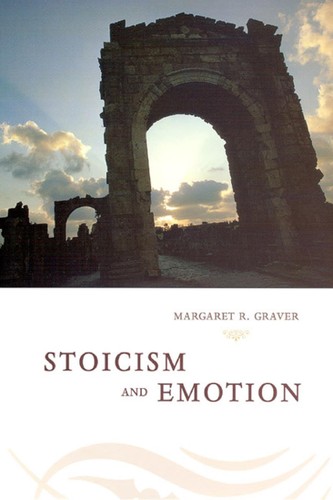
Margaret Graver’s Stoicism and Emotion performs a sustained act of philosophical archaeology. Its central achievement is to dismantle the received image of the Stoic sage as an affectless automaton—a caricature that has persisted from the Church Fathers through popular self-help Stoicism and, critically, through the depth-psychological tradition that defines itself against this very image. Edward Edinger, summarizing the standard line, writes that apatheia means “without affect or without emotion or suffering” and that the Stoic wise man sought to achieve this condition, which “ran into the criticism that it was promoting human insensitivity.” Graver shows this reading to be a profound misunderstanding. For Chrysippus, the founder of the mature Stoic theory of emotion, a pathos is not a feeling-state but a specific propositional judgment—an assent to the impression that something indifferent (health, reputation, life) is genuinely good or bad. The Stoic sage does not cease to feel; the sage ceases to assent to false evaluations. Apatheia is the absence of error, not the absence of experience. This distinction reshapes everything downstream. Edinger’s claim that “psychological analysis does promote something akin to apatheia, because it deliberately makes the effort to promote disidentification from the affects” is closer to the Stoic position than Edinger himself realizes, but it still mislocates the operation: for the Stoics, the problem is not identification with affect but identification with incorrect propositional content. The therapeutic target is the belief, not the feeling.
The Eupatheiai Reveal a Stoic Affective Life That Depth Psychology Has Refused to See
Graver’s most consequential recovery is the doctrine of eupatheiai—the “good feelings” that the sage not only permits but cultivates. These are joy (chara), wish (boulēsis), and rational caution (eulabeia), each corresponding structurally to one of the three temporal orientations of the pathē (present, future-attractive, future-aversive) but grounded in correct judgment rather than false valuation. The sage feels joy because the sage accurately perceives that virtue is present; the sage wishes for future goods because the sage correctly identifies what is genuinely choiceworthy. This is not the thin gruel of intellectual satisfaction. Graver marshals textual evidence—from Seneca’s descriptions of the sage’s elation, from Epictetus’s warmth toward students, from the Stoic analysis of the “first movements” (propatheiai) that precede full assent—to show that Stoic affective life was rich, textured, and phenomenologically intense. Cody Peterson’s analysis of apatheia as “the negation of paschō—literally ‘not-undergoing,’ the refusal of the patientive position itself,” which “sealed the intake valve of the thūmos,” captures the mythic severity of the caricature Graver dismantles. Peterson is right that the philosophical tradition as received prescribed the closure of receptivity, but Graver’s philological work demonstrates that the original Stoic prescription was subtler: not the sealing of the vessel but its recalibration so that what enters is received accurately. The sage still undergoes—but undergoes correctly.
The Stoic Theory of Emotion as Judgment Exposes the Central Fault Line with Depth Psychology
Here the book becomes most provocative for readers of Jung and Hillman. The Chrysippean position holds that emotions are not autonomous forces that seize the ego from below; they are judgments the rational soul makes about value. There is no separate irrational faculty, no thumos that barks independently of reason, no autonomous complex that ambushes consciousness. The soul is a unity—hēgemonikon, the ruling center—and every emotional disturbance is that center’s own error. This stands in total opposition to Jung’s model, in which affects “come from the Self and not from the ego,” as Edinger formulates it, and are “experienced as manifestations of transpersonal libido.” For Jung, the ego that claims sovereignty over its own affects is inflated; for Chrysippus, the psyche that attributes its affects to an alien source is confused. Hillman deepened this opposition by insisting that the soul’s work occurs precisely in the undergoing—in what Peterson calls the “Middle Voice” stance of peisomai, where suffering enters and reconstitutes the subject. The Stoics would diagnose this entire operation as pathological: to be reconstituted by suffering is to have assented to the false proposition that something beyond virtue has been lost. Graver does not adjudicate this dispute, but her reconstruction makes it impossible to ignore. She forces the depth-psychological reader to confront the possibility that the tradition’s foundational antagonist—Stoic rationalism—was never as monolithic or as impoverished as Hillman and his heirs assumed.
Why Graver’s Separatio Matters: The Stoic Phase of Individuation Reconsidered
Edinger, drawing on Jung’s Mysterium Coniunctionis, argues that “one has to go through a Stoic phase of individuation”—a separatio in which the mind is freed from the body’s affective contamination so that a conscious coniunctio becomes possible. Jung himself acknowledged this was “a clear blend of Stoic philosophy and Christian psychology” but insisted it was “not satisfactory inasmuch as reason alone cannot do complete or even adequate justice to the irrational facts of the unconscious.” Graver’s book transforms this assessment. If the Stoics never banished feeling but only false feeling—if the eupatheiai constitute a genuine affective life grounded in accurate perception—then the “Stoic phase” is not merely a preliminary asceticism to be transcended but a permanent achievement of discriminating consciousness. The separatio does not strip away affect; it strips away misvaluation. Read through Graver, the Stoic sage is not the precursor to the dissociated modern ego but something closer to the individuated personality: a psyche whose feelings track the real structure of value.
This is what makes Stoicism and Emotion indispensable for anyone working at the intersection of ancient philosophy and depth psychology. It does not merely correct a scholarly error about Stoic doctrine. It removes the straw man against which an entire therapeutic tradition has defined itself. Once the reader grasps that the Stoics were not advocating the death of feeling but its philosophical maturation—that apatheia names the absence of cognitive error, not the absence of inner life—the supposedly irreconcilable opposition between Stoic rationalism and Jungian soul-work begins to dissolve. What remains is a harder, more interesting question: whether the affects that depth psychology treats as autonomous messengers from the Self might also be, as Chrysippus insisted, propositions the soul has endorsed without examination.
Sources Cited
- Graver, M. (2007). Stoicism and Emotion. University of Chicago Press.
- Chrysippus. Fragments in SVF (Stoicorum Veterum Fragmenta), ed. H. von Arnim.
- Sorabji, R. (2000). Emotion and Peace of Mind: From Stoic Agitation to Christian Temptation. Oxford University Press.