 Seba.Health

Key Takeaways
- Anthony transforms the I Ching from a divination manual into a depth-psychological instrument for ego dissolution, treating each hexagram as a mirror of inner attitude rather than a prediction of outer events — effectively performing the same operation on the oracle that Jung performed on alchemy.
- The book's central therapeutic mechanism is what Anthony calls "disengagement" — a precise inner action that withdraws projected energy from situations and returns authority to what she names the "Creative," making this one of the few Western guides to the I Ching that functions as a manual for active imagination conducted through coin-throws.
- Anthony's concept of the ego as a "parasitic" self-image that gains power through the grammatical trick of claiming "I" constitutes an independent phenomenology of identification that parallels Buddhist anattā doctrine and Jungian shadow work without deriving from either.
The I Ching Becomes a Depth-Psychological Mirror When Its Metaphors Are Read as Inner Events
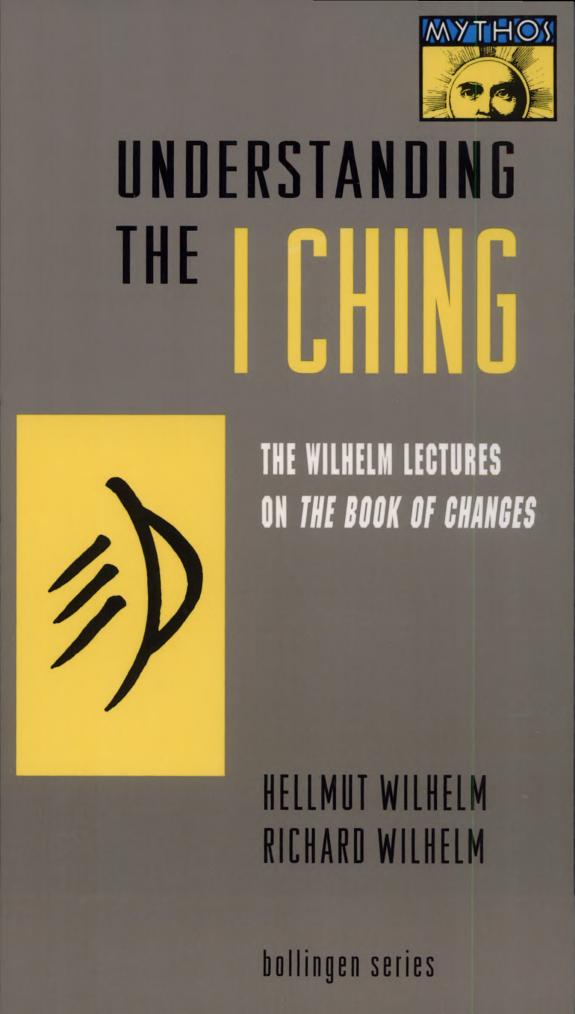
Carol K. Anthony’s A Guide to the I Ching accomplishes something no prior English-language commentary had attempted: it systematically reinterprets every hexagram and every changing line of the Wilhelm/Baynes translation as a communication about the reader’s inner attitude rather than about external circumstances. “Crossing the great water” does not mean taking a trip; it means getting past a situation dangerous to inner equilibrium. “The army carries corpses in the wagon” does not describe literal warfare; it describes ego elements usurping control of the personality. This hermeneutic move — treating the oracle’s imagery as psychic topology — places Anthony squarely in the lineage Jung opened in his 1949 foreword to the Wilhelm/Baynes edition, where he described the I Ching as “a method of exploring the unconscious” and insisted that its hexagrams coincide with the quality of the psychological moment. But where Jung theorized the mechanism (synchronicity) and left the practical implications largely unelaborated, Anthony fills in the entire therapeutic architecture. Each hexagram becomes a diagnostic scene in which the “Superior Man” (the essential self), the “Inferior Man” (the ego-self-image), and the various “inferiors” (emotional and bodily drives) interact according to patterns the oracle reflects back to the consulter. This is not loose analogy; Anthony builds a consistent internal dramatis personae across all sixty-four hexagrams that functions like Edward Edinger’s ego-Self axis recast in Chinese symbolic language.
Disengagement Is Anthony’s Name for the Withdrawal of Projection — and It Is the Book’s Core Therapeutic Act
The single most important instruction in the Guide is what Anthony calls “disengagement”: a disciplined, step-by-step withdrawal from emotional reactivity into neutrality and acceptance. This is not passivity. Anthony is explicit that disengagement “empowers the Creative to correct the problem,” while intervention — what the I Ching calls “lawsuits” and “wars” — isolates the individual from cosmic help. The dynamic mirrors Jung’s insistence that the ego must surrender its claim to omnipotence before the Self can function as a regulating center, but Anthony operationalizes this insight with a specificity Jung rarely achieved in clinical writing. She describes, hexagram by hexagram, what disengagement looks like in the face of envy, ambition, fear, desire, and what she memorably calls “the crescendo of awfulness.” The parallel with Liu I-ming’s Taoist commentary (translated by Thomas Cleary in The Taoist I Ching, 1986) is instructive: Liu reads each hexagram as a stage in inner alchemical refinement, the progressive stripping away of acquired temperament to recover original nature. Anthony arrives at a structurally identical conclusion — that the I Ching teaches the recovery of “the innocence and purity of our original nature” — but through an experiential, relational method rather than through alchemical metaphysics. Where Liu speaks of refining lead into gold, Anthony speaks of learning not to let the ego assert “I” and thereby parasitize the personality. Both describe the same operation; Anthony’s language is simply closer to the consulting room.
The Ego as Grammatical Parasite: Anthony’s Independent Phenomenology of Identification
Anthony’s most striking original contribution is her account of how the ego gains and maintains power. In her commentary on Hexagram 7 (The Army), she writes: “By the simple trick of asserting that it is ourself, it gains mastery of our personality. If we deny it this identity by saying to it, ‘You are not me,’ it remains powerless.” This is not borrowed from Jung, who tended to locate the ego’s pathology in its inflation relative to the Self. It is not borrowed from Buddhism, though it resonates with the Theravāda analysis of self-view (sakkāya-diṭṭhi). It emerges directly from Anthony’s years of consulting the oracle and observing the interior mechanics of reactivity. The ego-self-image, in her phenomenology, is not merely inflated or deflated — it is demonic and parasitic, feeding on the grammatical claim of first-person identity. This insight gives the book a clinical edge that distinguishes it from Alfred Huang’s The Complete I Ching (1998), which pursues philological fidelity to the Chinese original, and from Ritsema and Karcher’s I Ching: The Classic Chinese Oracle of Change (1994), which pursues imagistic density through etymological excavation. Neither of those projects addresses the question Anthony centers: what happens inside the person who consults, and how does the oracle reshape the consulter’s relationship to their own ego?
Inner Truth as the Mechanism of Influence: Beyond Moralizing into Resonance
Anthony insists that the I Ching never moralizes. It does not prescribe right and wrong; it draws on the reader’s own inner knowledge and reinforces it. The therapeutic vector is what she calls “inner truth” — the perception of the higher truth in any situation, which, once perceived, “is automatically communicated to others with no effort on our part.” This is the I Ching’s version of what Jung called the constellation of an archetype: the moment when an intrapsychic shift produces effects in the interpersonal field without deliberate action. Anthony’s formulation is more radical than Jung’s, however, because she extends the principle to claim that “society cannot be regenerated through any other means” than individual inner correction. This is not quietism; it is a precise metaphysical claim about the primacy of attitude over action, resonant with the Taoist wu-wei tradition but articulated through the vocabulary of personal relationship with what she calls the Sage. The consulter does not receive commandments; the consulter enters a conversation — “an open and free conversation between our inner thoughts and its replies” — that restructures perception from within.
For anyone working within the depth-psychological tradition today, Anthony’s Guide illuminates a gap that no other book fills: the space between Jungian theory about the I Ching (synchronicity, the unconscious, the numinous) and the actual daily practice of consulting the oracle as a vehicle for self-confrontation. It provides what the Wilhelm/Baynes translation assumes but never teaches — a method for reading the I Ching as a psychological instrument rather than a philosophical text. Its phenomenology of the ego as grammatical parasite, its operational definition of disengagement, and its insistence on the primacy of attitude over action constitute an original contribution to the psychology of inner work that has no precise equivalent in the Western canon.
Sources Cited
- Anthony, C.K. (1988). A Guide to the I Ching. Anthony Publishing.
- Wilhelm, R. (trans.) & Baynes, C.F. (English trans.). (1950). The I Ching or Book of Changes. Princeton University Press.
- Jung, C.G. (1951). Aion: Researches into the Phenomenology of the Self. Collected Works, Vol. 9ii. Princeton University Press.