 Seba.Health
Key Takeaways
- Campbell's "follow your bliss" is not a hedonistic slogan but a precise technical instruction: bliss (ānanda) names the fifth and innermost Vedantic sheath, and tracking it is the method by which the mental sheath (manomaya-kośa) re-establishes contact with the wisdom sheath (vijñānamaya-kośa) — making it a yogic discipline disguised as American self-help.
- The book's most radical move is to subordinate all four functions of mythology to the fourth — the psychological — thereby converting myth from a collective regulatory mechanism into a private initiatory technology, a position that quietly breaks with both Durkheim's sociology and Jung's insistence on the numinous autonomy of the archetype.
- Campbell's critique of Maslow's hierarchy of needs as corresponding only to the first three cakras reframes humanistic psychology as a pre-spiritual endeavor, positioning the "awakening of awe" at the fourth cakra as the actual threshold of psychological life — a claim that inverts the dominant developmental model of his era.
Bliss Is Not a Feeling but a Structural Position within the Vedantic Sheaths
Campbell’s most misunderstood contribution — “follow your bliss” — receives its only rigorous exposition in Pathways to Bliss. Here Campbell maps the phrase onto the Taittirīya Upaniṣad’s five kośas with surgical precision. The outermost three sheaths — food (annamaya), breath (prāṇamaya), and mind (manomaya) — correspond to biological, metabolic, and cognitive existence. The mental sheath, bound to the sensory data of the food sheath, generates the characteristic modern question: “Is life worth living?” This question, Campbell insists, is itself symptomatic — it signals that manomaya-kośa has lost contact with vijñānamaya-kośa, the wisdom sheath through which transcendent energy organizes organic form. Myth is the connective tissue between the third and fourth sheaths; destroy myth, and you sever “the vocabulary of discourse between mental wisdom and organic, life-body wisdom.” The fifth sheath, ānandamaya-kośa — bliss — is not emotional pleasure but the transcendent kernel itself, the ground from which all form emerges. To “follow your bliss” is therefore to track the felt registration of vijñānamaya-kośa’s activity within conscious experience: it is a diagnostic method, not an endorsement of appetite. This reframes the entire book as a manual for restoring sheath-to-sheath conductivity, a project that parallels Karlfried Graf Dürckheim’s insistence that illness results from blocked transcendent energy. Dürckheim’s formulation — “make yourself transparent to the transcendent” — becomes Campbell’s operational definition of psychological health.
Maslow’s Hierarchy Terminates Where Mythic Life Begins
Campbell’s most polemical claim in the book is that Abraham Maslow’s hierarchy of needs — survival, security, relationship, prestige, self-development — maps precisely onto the first three cakras of kuṇḍalinī yoga: the survival drive, the sex drive, and the drive to power. “These are exactly the values that a mythically inspired person doesn’t live for,” Campbell states flatly. The fourth cakra, at the heart, marks the hearing of the sacred syllable AUM — the awakening of awe — and Campbell locates here the actual origin of the spiritual and psychological life. This is not anti-humanistic posturing. Campbell acknowledges that no one reaches the fourth cakra without satisfying the first three; the lower centers are “merely the ground base of a larger structure.” But by placing Maslow’s entire developmental schema below the threshold of mythic consciousness, Campbell performs an act of intellectual violence against the dominant psychology of his era. The implication is devastating: a person who has achieved self-actualization in Maslow’s terms but has never been “seized” — Leo Frobenius’s Ergriffenheit — remains, in Campbell’s framework, psychologically incomplete. The Gauguin example is not incidental decoration; it demonstrates that authentic mythic seizure can and will annihilate every value on Maslow’s pyramid. This argument resonates with James Hillman’s critique in The Soul’s Code that psychology has been trapped in a developmental model that mistakes biography for destiny; Campbell arrives at a convergent conclusion through comparative mythology rather than archetypal theory.
The Shaman’s Crisis as the Template for All Individuation
Campbell’s account of shamanic vocation in Pathways to Bliss does more than illustrate a cultural phenomenon — it provides the structural model for his entire psychology of transformation. The shaman is “one who has actually gone through a psychological crack-up and recovery.” The adolescent hears a song or receives a vision; refusal of this call produces psychological shipwreck; acceptance requires disciplines that reconnect the individual to the collective unconscious of the society. Campbell then universalizes this pattern: the West Virginia woman who heard “marvelous music” in childhood and came to a psychiatrist in her sixties with “the feeling that she had missed a life” is the shaman who refused the call, transposed into modern anonymity. This is not metaphor. Campbell means that the dynamic is structurally identical. The vocation arrives as Ergriffenheit; the culture either provides initiatory containers (as in traditional societies) or fails to (as in modernity); and the individual either integrates the numinous content or fragments. Here Campbell converges with Erich Neumann’s argument in The Origins and History of Consciousness that ego development proceeds through a series of mythic stages, each requiring the assimilation of archetypal material. But Campbell diverges from Neumann — and from Jung — in a crucial respect articulated by Richard Underwood: “Jung remains a Christian — a Gnostic Christian, to be sure — but a Christian nevertheless. Campbell breaks through the Christic mandala to a Buddhist-like experience of the No-thing in the Every-thing.” Where Jung’s individuation terminates in the coniunctio, the reconciliation of opposites within the alchemical vessel of the self, Campbell’s hero’s journey terminates in transparency — the self becoming a window rather than a container. The goal is not wholeness but translucence.
The Antithetical Mask as the West’s Unique Mythic Contribution
Campbell identifies a structural difference between Eastern and Western mythic orientations that has profound psychological consequences. Eastern cultures, he argues, require identification with the “primary mask” — dharma, Tao, duty — producing “repetitions of what there was before.” Western culture alone pushes the individual toward what Yeats called the “antithetical mask”: the unrealized potential self that contradicts social conditioning. This is why Campbell insists that revolution means “bringing something forth,” not “smashing something.” The antithetical mask corresponds to what Jung called the unconscious self, the totality that the ego has not yet integrated. But Campbell gives it a voluntaristic inflection absent in Jung: “The only place to look for blame is within: you didn’t have the guts to bring up your full moon and live the life that was your potential.” This is harsher than anything in Jung’s clinical writing, and it reveals the existentialist substrate beneath Campbell’s comparative mythology — closer to Nietzsche’s amor fati than to Jung’s religious empiricism.
Pathways to Bliss matters today not because it popularizes mythology but because it is the only text in Campbell’s corpus that systematically connects the hero’s journey to a practical psychology of self-diagnosis. It provides what The Hero with a Thousand Faces deliberately withheld: the instruction manual for applying the monomyth to one’s own biographical situation. For readers formed by Jungian depth psychology, it specifies exactly where Campbell breaks from Jung — not in content but in telos. For readers saturated in humanistic psychology, it names what Maslow’s model cannot see: the fourth cakra, the awakening of awe, the point where psychological life actually begins.
Sources Cited
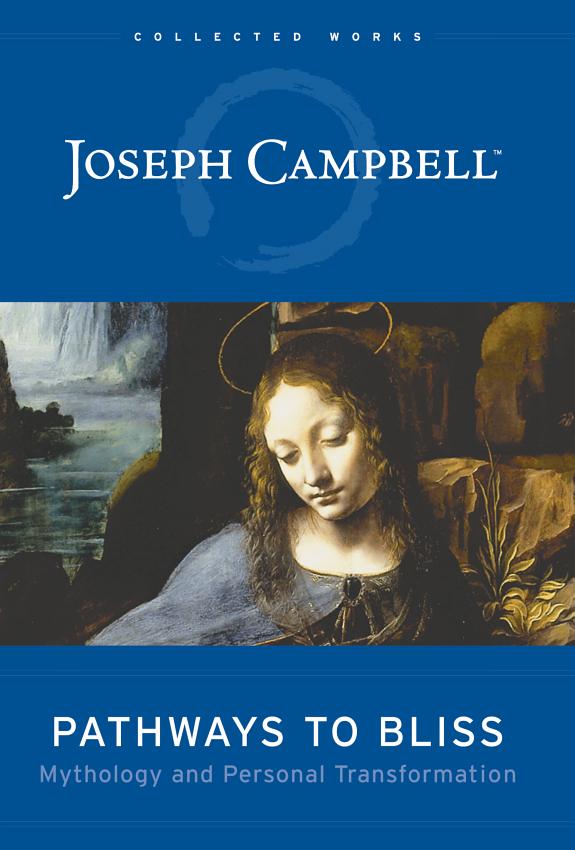
- Campbell, Joseph (2004). Pathways to Bliss: Mythology and Personal Transformation.