 Seba.Health
Key Takeaways
- Campbell's central operation in *Thou Art That* is not comparative mythology but a diagnostic intervention into Western religion's core pathology: the systematic confusion of denotation with connotation, which collapses metaphor into fact and thereby severs the symbol from its capacity to catalyze psychic transformation.
- The book reveals that the Western theological formula aRX (creature *related to* Creator) functions as a structural defense against the mystical equation a = X, making the Judeo-Christian tradition uniquely resistant to the very realization — tat tvam asi — that its own mystics (Eckhart, Hallāj, Jesus in the Gospel of Thomas) consistently articulate.
- Campbell's treatment of compassion as the specifically *human* achievement — distinguished from animal sociality through the Jane Goodall chimpanzee example — positions Mitleid not as sentiment but as the experiential proof of metaphysical identity, aligning his argument with Schopenhauer's ethics more than with any theological tradition.
The Literal Reading of Metaphor Is Not an Intellectual Error but a Spiritual Pathology
Campbell opens Thou Art That with a deceptively comic anecdote — the radio interviewer who insists that myth means “a lie” — but the episode functions as a clinical vignette. The interviewer cannot produce a definition of metaphor. He cannot distinguish “John runs like a deer” (simile) from “John is a deer” (metaphor). Campbell’s point is not pedagogical but diagnostic: the entire Western religious apparatus has been built on this same confusion, and its consequences are not merely intellectual but existential. When the Virgin Birth is taken as a biological fact about Mary’s body rather than as a metaphor for spiritual rebirth accessible to every person, the symbol is, in Campbell’s precise formulation, “devalued.” The connotation — the “rich aura” in which spiritual significance lives — is discarded in favor of the denotation, the “hard, factual, unidimensional casing.” This is not an argument against religion but against religion’s self-administered lobotomy. The Scopes trial, the expeditions to Mount Ararat, the wars over the Promised Land as a geographical coordinate — all are symptoms of this pathology. Campbell is performing something structurally parallel to what Edward Edinger does in Ego and Archetype when he traces the consequences of the ego’s failure to differentiate itself from the Self: the inflation produces rigidity, literalism, and violence. For Campbell, institutional religion’s inflation consists in claiming that its metaphors are facts while other people’s metaphors are myths. “Mythology may, in a real sense, be defined as other people’s religion. And religion may, in a sense, be understood as a popular misunderstanding of mythology.”
The Western God Who Says “I Am God” Closes the Door That Eastern Theology Leaves Open
The book’s most structurally ambitious claim appears in Campbell’s contrast between the Western relational formula (aRX: creature related to Creator) and the Eastern identity equation (a = X). In the Judeo-Christian system, God is a “final term,” a personality who contracts covenants, issues commandments, and insists on His own ontological separateness from creation. When Yahweh declares “I am God,” Campbell argues, this closes off transcendence — for the deity and for the worshipper simultaneously. “When your God is transparent to transcendence, however, so are you.” The god image, properly functioning, introduces the individual to her own transcendence; when the god closes himself into a concrete personality, the worshipper is locked into facticity. This is why Campbell treats the Gnostic Gospel of Thomas as a corrective lens: “The Kingdom of the Father is spread upon the earth, and men do not see it.” The End of the World is not an event but a shift in perception. Jesus in Thomas speaks as Eastern gurus speak — from an identification with the All, not as a historical personality issuing prophecy. Campbell is here anticipating by decades the depth-psychological reading of Gnostic texts that scholars like June Singer and Murray Stein would develop. But his deeper interlocutor is Jung, for whom the imago Dei functions as a symbol of the Self. When Campbell writes that “the fundamental, simple, and great mystical realization is that by which you identify yourself with consciousness, rather than with the vehicle of consciousness,” he is restating, in mythological idiom, Jung’s central insight in Aion: that Christ is a symbol of the Self, and that the Western failure to integrate the shadow side of God (the fourth, excluded element) perpetuates the very dualism Campbell diagnoses here.
Compassion Is Not a Moral Instruction but the Experiential Consequence of Metaphysical Identity
Campbell’s treatment of compassion — Schopenhauer’s Mitleid — is the book’s most underappreciated argument. He does not present compassion as an ethical imperative layered on top of self-interest. He presents it as the inevitable experiential result of recognizing that “my own true inner being actually exists in every living creature.” The Jane Goodall anecdote is deployed with surgical precision: when a deformed chimpanzee is abandoned by its troop, Goodall discovers that compassion is not an animal instinct but a specifically human achievement, an overcoming of the instinctive revulsion that belongs to the lower three chakras. Campbell maps this onto the heart chakra as the threshold of humanity proper — below it, animal programming; above it, spiritual realization. This is not New Age sentimentality. Campbell explicitly attacks the “protoplasmic concept” of compassion that the New Age has produced, “ungrounded in sacrifice” and “soaked in undifferentiated sentimentality.” Real compassion requires “a hero’s journey into the far reaches of the lives of people that seem different from us.” Here Campbell converges with Kalsched’s work on the inner world of trauma: the defense systems that protect the personal spirit also prevent the breakthrough of transpersonal connection. The “desire and fear” that Campbell identifies as the twin guardians barring entry to the garden are structurally identical to what Kalsched, drawing on Winnicott, calls the self-care system’s archaic protections.
Why This Book Matters Now
Thou Art That is the only work in Campbell’s corpus that focuses sustained attention on the Judeo-Christian tradition specifically, and its value lies not in comparative mythology but in its refusal to let Western religion off the hook. Most comparative approaches use Eastern traditions to illuminate Western ones from outside. Campbell works from inside the tradition, showing that its own mystics — Eckhart’s “leaving of God for God,” Hallāj’s union with the flame — already contain the tat tvam asi realization that institutional Christianity has systematically suppressed. For anyone navigating the wreckage of a literalist religious upbringing, this book provides not an alternative religion but a hermeneutic key: the capacity to distinguish the vehicle of consciousness from consciousness itself, the bulb from the light. That distinction, simple as it sounds, is the entire pivot on which depth psychology turns.
Sources Cited
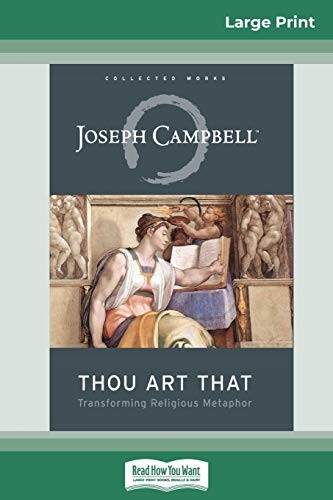
- Campbell, Joseph (2001). Thou Art That: Transforming Religious Metaphor.