 Seba.Health
Key Takeaways
- Ritsema and Karcher's translation recovers the I Ching as a psychological instrument rather than a philosophical text, treating each Chinese character as a force-field of meaning whose multivalence is the oracle's actual mechanism of action—not a deficiency to be smoothed away by grammar.
- By enforcing strict one-to-one character-to-English correspondence and preserving original word order without added syntax, the translation replicates the dream-logic structure of oracular language, making the text function the way the unconscious itself operates: through condensation, displacement, and imagistic resonance rather than propositional sense.
- The book's deepest intervention is its argument that divination is not belief but technique—a structured method for breaking the ego's narrative monopoly over a situation, functioning as what Jung called a synchronistic procedure and what the text's own tradition calls becoming *hsiang* (symbolizing), the active linking of personal crisis to transpersonal image.
The I Ching Is Not a Book of Wisdom but a Technology for Dissolving the Ego’s Grip on Meaning
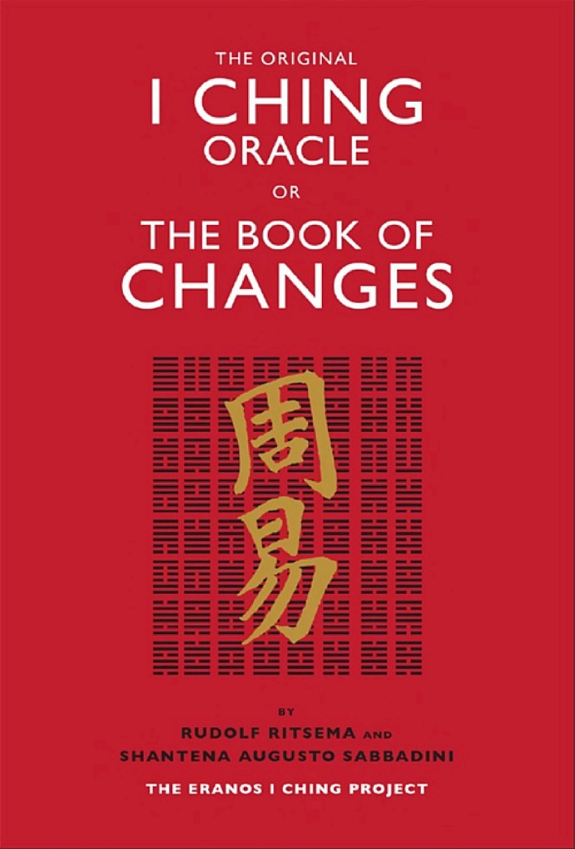
Ritsema and Karcher open with a deceptively simple philological claim that reorganizes everything that follows: the character I does not mean “change” in any orderly or categorical sense. It means versatility—“the ability to remain available to and be moved by the unforeseen demands of time, fate and psyche.” This is not a scholarly footnote. It is a diagnostic reframing. Every prior major English translation, from James Legge’s Victorian rendering to Richard Wilhelm’s Confucian-tinged masterwork, treated the I Ching as a repository of wisdom to be understood. Ritsema and Karcher treat it as an active instrument whose purpose is to undo understanding—to break apart the fixed interpretive frame the ego has imposed on a situation so that something else can speak. The book’s introduction states this without equivocation: “divination gives a voice to what the ego has rejected. It brings up the hidden complement or shadow of the situation in order to link you with the myths and spirits behind it.” The authors are not describing a fortune-telling procedure. They are describing, in precise structural terms, what Jung meant by confrontation with the shadow and what James Hillman would later call “seeing through”—the dissolution of literal readings in favor of imaginal ones. Alfred Huang’s translation, published four years later, explicitly criticizes Western I Ching translations for departing from the original Chinese essence, but Huang’s concern is fidelity to Confucian moral structure. Ritsema and Karcher go in the opposite direction: they strip away the Confucian and imperial commentaries entirely, returning to what they call “the oracular core.”
Strict Word-Order Preservation Is Not Pedantry but a Method for Replicating Dream-Logic
The translation’s most radical formal decision—rendering each Chinese character with one and only one English core-word, preserving exact original word order, adding no prepositions, connectives, or explanatory syntax—has been criticized as producing unreadable English. This criticism misses the point entirely. The method is not a failure of fluency but a deliberate construction of what the authors call “an imaginative space.” Old Chinese permitted “a special oracular language… made up of symbols with no rigid subject-verb, noun-adjective, pronoun or person distinctions. They combine and interact the way dream-images do.” The translation attempts to reproduce this quality in English, creating texts that resist linear interpretation and force the reader into an active, associative engagement identical to what happens in dream analysis. Where Wilhelm’s translation gives you a sentence you can paraphrase, Ritsema and Karcher give you a field of charged images that must be turned in the heart to yield meaning. This is not accidental. The Great Commentary (Hsi tz’u chuan), which the authors treat as the key to the divinatory tradition, instructs the chün tzu to “observe the figure obtained through divination and take joy in its words, turning and rolling them in the heart.” The translation’s refusal of syntactic smoothness is itself an enactment of this instruction. It forces the user into the psychological posture the tradition demands.
Divination as Synchronistic Procedure: The Missing Bridge Between Jung and Active Imagination
Jung’s foreword to the Wilhelm/Baynes edition famously describes the I Ching’s method as operating through “an acausal or synchronistic connective principle,” where the chance fall of coins or division of yarrow stalks creates a gap through which unconscious forces organize themselves into meaningful pattern. Ritsema and Karcher take this further than Jung himself did. Their introduction frames divination not merely as a synchronistic event but as a structured technique for producing one—a “creative way of contacting the spirit” in which “identity becomes fluid and the spirits involve themselves in your life.” The authors draw explicitly on studies of divinatory systems in tribal cultures, noting that such systems consistently provide “information about individual questions, problems and choices for which rational knowledge or common social rules are not enough.” This positions the I Ching alongside active imagination, sandplay, and dream amplification as a method for accessing what Jung called archetypal forces—but with a crucial difference. Where active imagination requires a developed capacity for introspection and where dream work depends on the accident of what the psyche produces during sleep, the I Ching provides an external structure that anyone can use to initiate dialogue with the unconscious. Liu Yiming’s Taoist commentary, translated by Thomas Cleary, reads the hexagrams as a guide to “comprehensive self-realization while living an ordinary life in the world,” but Liu’s framework remains interior and alchemical. Ritsema and Karcher insist that the oracle’s power lies precisely in the interaction—the creative collision between symbol, question, and questioner that “breaks down the old stories you are telling yourself in order to make up more effective ones.”
The Recovery of Hsiang as the Core Psychological Act
The book’s most important theoretical contribution is its recovery of the concept of hsiang—variously translated as “symbol,” “image,” or “to symbolize”—as the fundamental act the I Ching both describes and demands. The tradition holds that the ancient shamans “spontaneously hsiang-ed or symbolized to form the texts and figures as links to important spirits and energies,” and that the user who engages the oracle properly “becomes hsiang or symbolizing, linking the divinatory tools and the spirits connected with I directly to the ruling power of the personality.” This is not metaphor. It is a precise description of what happens when a symbol is experienced rather than merely decoded—when an image seizes the personality and reorganizes its orientation. Jung called this the constellation of an archetype. Hillman called it the move from ego-psychology to soul-making. Ritsema and Karcher, working from the Chinese tradition, arrive at the same insight through a different door: the oracle does not give you meaning; it makes you into a meaning-making being by activating the symbolic function itself. This is why the book matters now. In a therapeutic culture increasingly organized around cognitive reframing and behavioral management, Ritsema and Karcher’s I Ching recovers the oldest technology for what the tradition calls shen ming—“the light of the gods”—a state of creative, clear-seeing connection that no amount of rational analysis can produce, because it operates at the level where rationality is itself constituted.
Sources Cited
- Ritsema, R. & Karcher, S. (1994). I Ching: The Classic Chinese Oracle of Change. Element Books.
- Karcher, S. (2002). Total I Ching: Myths for Change. Time Warner Books.
- Hillman, J. (1975). Re-Visioning Psychology. Harper & Row.
- Corbin, H. (1972). Mundus Imaginalis, or the Imaginary and the Imaginal. Spring: An Annual of Archetypal Psychology and Jungian Thought.