 Seba.Health
Key Takeaways
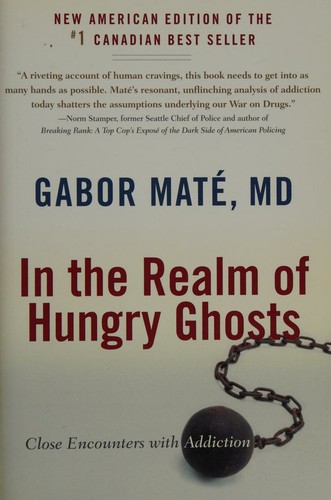
- Maté's central achievement is not adding neuroscience to addiction theory but performing a depth-psychological move: relocating the origin of compulsion from the substance to the wound, thereby making addiction legible as a failed self-care system rather than a moral or pharmacological problem.
- The "hungry ghost" is not a metaphor borrowed for literary color but functions as an archetypal image in the Hillmanian sense — a personification of the psyche's insatiable longing when early relational trauma has severed the connection between need and fulfillment, rendering all substitute objects simultaneously compulsive and insufficient.
- Maté's willingness to confess his own addictive patterns (compulsive classical music purchasing) is structurally essential to the book's argument: it dissolves the clinical boundary between doctor and patient, performing the very de-literalization of "addict" as a fixed identity category that the text theoretically demands.
Addiction Is Not a Disease of the Brain but a Disorder of the Ensouled Body
Gabor Maté opens In the Realm of Hungry Ghosts from the Portland Hotel in Vancouver’s Downtown Eastside, among intravenous drug users with abscessed flesh and HIV, and proceeds to do something no standard addiction textbook accomplishes: he reads their suffering as meaningful. Not meaningful in a redemptive or inspirational sense, but psychologically significant — each patient’s drug of choice, pattern of use, and mode of self-destruction encoding a precise history of early relational devastation. This is where Maté converges, perhaps unknowingly, with Donald Kalsched’s account of the “self-care system” in The Inner World of Trauma. Kalsched demonstrates that the psyche, when overwhelmed in early life, generates a daimonic protector-persecutor that simultaneously guards and imprisons the traumatized self. Maté’s addicts are living inside that structure. The heroin that numbs pain, the cocaine that simulates agency, the methamphetamine that produces a chemically manufactured sense of aliveness — each substance temporarily performs the function that the self-care system was erected to provide but cannot sustain. Maté’s neuroscience (the dopamine-incentive circuits, the stress-hormone dysregulation, the epigenetic imprinting of early neglect) does not explain addiction so much as it provides the biological face of what Kalsched maps mythologically. The convergence is striking and largely unexplored in the secondary literature.
The Hungry Ghost Is an Archetypal Image, Not a Decorative Analogy
Maté draws the book’s title from the Buddhist cosmology of the preta realm — beings with enormous bellies and pinhole mouths, tormented by desire they can never satisfy. Most readers treat this as an apt metaphor. It is more than that. In the tradition of James Hillman’s archetypal psychology, an image earns its status not through conceptual fit but through its capacity to “see through” literal events to their psychic ground. Hillman insists that soul-making is “equated with de-literalizing — that psychological attitude that suspiciously disallows the naive and given level of events in order to search out their shadowy, metaphorical significances for soul.” The hungry ghost performs exactly this de-literalization. It refuses the literalism of the disease model (addiction as brain pathology to be managed pharmacologically) and the literalism of the moral model (addiction as weakness to be punished). Instead it presents addiction as a condition of the soul — an image of insatiable longing that cannot be resolved at the level of substance or behavior because the real deprivation occurred in the relational field before language, before memory, before the ego consolidated itself. When Hillman writes that “pathologizing is a royal road of soul-making” and that symptoms are “death’s solemn ambassadors,” he describes precisely what Maté discovers in the Downtown Eastside: that the addict’s compulsion, far from being mere dysfunction, is a communication from the depths about what was never received and what the soul still demands.
The Autobiographical Confession Performs the Book’s Deepest Argument
Maté’s disclosure of his own compulsive purchasing of classical music CDs — spending thousands, lying to his wife, neglecting patients at critical moments to chase a rare recording — has been called brave, disarming, humanizing. These descriptions miss its structural function. By placing his own addictive behavior on the same continuum as his patients’ heroin use, Maté performs a radical act of depersonalization in Hillman’s sense: he dismantles the fiction that “the addict” is a discrete kind of person, a fixed identity housed in certain bodies and neighborhoods. This is the move Hillman makes when he argues that “the ego has become a delusional system” and that “heightened consciousness now refers to moments of intense uncertainty, moments of ambivalence.” Maté’s confession strips the clinician’s ego of its exemption. The physician who cannot stop buying Bach recordings and the woman injecting heroin in a doorway share an identical psychic structure: a void left by early attachment failure, a neurochemical pathway shaped by stress, and a compulsive reaching toward objects that momentarily simulate the presence that was absent. The difference is one of social position, legal status, and available substitutes — not of kind. This is not a sentimental leveling. It is a diagnostic insight with political consequences: if addiction is a spectrum rooted in developmental trauma rather than a category defined by substance, then criminalization is not a public health strategy but a ritual of scapegoating.
Maté’s Implicit Challenge to the Jungian Tradition
What depth psychology gains from Maté is something it has historically lacked: granular clinical evidence linking archetypal patterns to measurable neurobiological processes. Erich Neumann’s developmental schema in The Origins and History of Consciousness tracks ego-emergence through mythological stages but remains silent about what happens when the infant’s actual environment catastrophically fails the archetypal expectation of holding. Maté fills that silence with cortisol levels, dopamine receptor density, and prefrontal cortex development data. He shows that when the archetypal mother-infant field is disrupted — through parental addiction, abuse, emotional absence, or intergenerational trauma — the biological substrate of selfhood is literally malformed. The brain that should have developed robust stress-regulation circuitry instead develops a permanent orientation toward external regulation: substances, behaviors, anything that temporarily restores chemical equilibrium. This is the material body in which Neumann’s “uroboric” stage goes wrong — not symbolically, but in the flesh. Robert Bosnak’s concept of “embodied imagination,” the recognition that “imagination grows itself a physical body” and that the stooped posture of someone living in a bleak image-environment eventually becomes permanent, finds its most devastating clinical confirmation in Maté’s descriptions of what chronic stress does to developing neural architecture.
Why This Book Is Indispensable for Depth Psychology Now
In the Realm of Hungry Ghosts occupies a unique position: it is the only major work on addiction that simultaneously honors neuroscience, refuses the reductionism of the biomedical model, draws on contemplative tradition, and grounds everything in sustained clinical witness among the most marginalized people in North American society. For readers formed by depth psychology, it provides what the tradition needs and often resists — a bridge between the archetypal and the empirical, between the image and the body, between the mythic wound and the measurable scar. No other book demonstrates so concretely that the soul’s pathologizing, which Hillman celebrated as essential to psychic deepening, can also kill — and that the task of the healer is not to eliminate the symptom but to understand what the symptom is reaching for, and to provide, at last, something real enough that the reaching can stop.
Sources Cited
- Maté, G. (2008). In the Realm of Hungry Ghosts: Close Encounters with Addiction. North Atlantic Books. ISBN 978-1-55643-880-6.
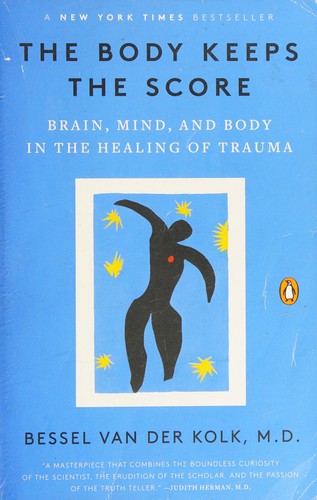
- van der Kolk, B. (2014). The Body Keeps the Score: Brain, Mind, and Body in the Healing of Trauma. Viking. ISBN 978-0-670-78593-3.