 Seba.Health
Key Takeaways
- Abraham's six-stage model of libidinal development is not a refinement of Freud's three-stage schema but a fundamentally different diagnostic architecture, one that maps psychopathology onto precise developmental arrests with a granularity no prior framework achieved.
- The consistent foregrounding of repressed hostility toward the mother — rather than the father — across Abraham's clinical papers constitutes an independent theoretical center of gravity that prefigures object relations theory decades before Melanie Klein systematized it.
- Abraham's applied psychoanalytic work (on Amenhotep IV, Segantini, myths, criminology) demonstrates that the Oedipus complex functions not as a metaphor imported into cultural analysis but as a falsifiable historical hypothesis, a claim far more radical than the cultural psychoanalysis that followed from Rank or Reik.
Abraham’s Developmental Map Is a Diagnostic Grammar, Not a Theoretical Ornament
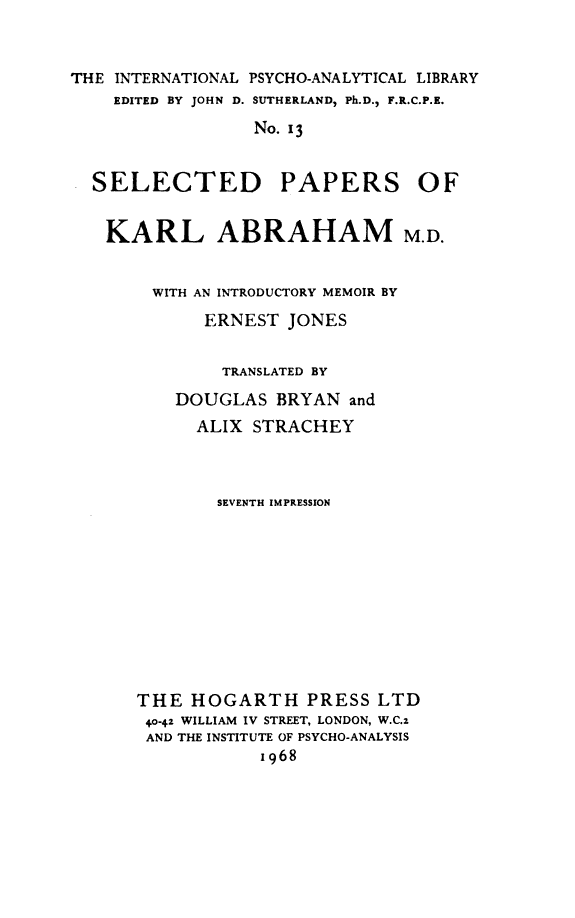
Karl Abraham’s Selected Papers on Psychoanalysis is the single most concentrated attempt in the first generation of psychoanalysis to give the pregenital stages of libidinal development the clinical specificity they demand. Freud sketched oral, anal, and genital phases; Abraham subdivided each into two, yielding six stages — oral-sucking, oral-biting, anal-expulsive, anal-retentive, phallic, and genital-mature — and then demonstrated, with case material of remarkable density, that each stage carries its own logic of object-relation, its own mode of loss, and its own characteristic pathology. The 1924 monograph on the development of the libido, reproduced here as the culminating chapter, is the axis around which the entire volume turns. Ernest Jones’s introductory memoir rightly identifies it as Abraham’s “weightiest contribution,” noting that none of the subdivisions was entirely original but that “the detailed and explicit way in which he analysed them and showed the precise relation of one to the other constitutes a masterly piece of work.” What Jones undersells is the epistemological shift involved. Abraham was not decorating Freud’s theory with finer brushstrokes. He was building a differential diagnostic grammar: if melancholia maps onto the oral-biting stage (where the object is simultaneously loved and devoured), and obsessional neurosis maps onto the anal-retentive stage (where the object is controlled but preserved), then the clinician possesses something no previous nosology offered — a developmental logic for distinguishing psychotic from neurotic depression. Freud’s “Mourning and Melancholia” (1917) opened the question; Abraham answered it structurally. This is the reason Melanie Klein treated Abraham as her primary intellectual ancestor, not Freud: Klein’s paranoid-schizoid and depressive positions are unthinkable without Abraham’s two-phase oral stage and its precise articulation of how the cannibalistic impulse toward the breast generates persecutory anxiety.
The Mother as Primary Antagonist Rewrites the Oedipal Center of Gravity
Jones observes that Abraham’s work is marked by “the element of repressed hate, especially in regard to the mother” and that this theme “far outweighs in extent his contributions in the sphere of love, transference, and akin problems.” This is not a biographical curiosity. It is a theoretical re-centering. Across the papers on oral erotism, manic-depressive insanity, character formation, and even the study of Segantini, Abraham consistently locates the decisive trauma not in the encounter with the paternal prohibition but in the experience of the suckling period — weaning, frustration of oral desire, the arousal of destructive impulses against the feeding mother. The essay on the influence of oral erotism on character formation traces optimism, greed, envy, and avarice to the specific fate of mouth-pleasure in infancy. When disappointment occurs during the biting phase, love is permanently saturated with ambivalence; the cannibalistic attitude toward the mother persists as a structural feature of all later relationships. This is not sublimated Oedipus. It is a pre-Oedipal field of devastation that determines whether the Oedipus complex can even be reached. Donald Winnicott’s later insistence on the “good-enough mother” and the environmental provision required for ego-integration operates on terrain Abraham surveyed first. Similarly, Erich Neumann’s The Great Mother (1955), with its archetypal amplification of the Terrible Mother, reads as a mythological elaboration of what Abraham established clinically: that the mother’s capacity to frustrate at the oral level generates psychic structures — introjection, splitting, incorporation — that are more primitive and more consequential than anything the father’s castration threat can produce.
Clinical Concreteness as Epistemological Discipline
Abraham’s style — Jones calls it “remarkable conciseness” where “every sentence was pregnant with meaning” — is not merely a literary virtue. It is an epistemological commitment. Abraham never moved more than one inference away from his clinical data. His papers on ejaculatio praecox, locomotor anxiety, the spider as dream symbol, the ear as erotogenic zone, and the spending of money in anxiety states each perform the same operation: a clinical observation is presented with specificity, a developmental hypothesis is offered, and the connection to the broader libido theory is drawn without speculative excess. This method stands in sharp contrast to Jung’s procedure in works like Symbols of Transformation (1911–12/1952), where a single patient’s fantasy material generates hundreds of pages of mythological amplification. Abraham’s analysis of Amenhotep IV — applying the Oedipus complex to a historical figure dead twenty-three centuries — might seem to rival Jungian amplification in ambition, but the difference is instructive. Abraham’s conclusions about Echnaton’s iconoclasm as displaced parricide are derived from documented biographical facts (his relationship to his father, his systematic destruction of paternal monuments, his ethical innovations as reaction-formations). Jones notes that “the conclusions he reached will be hard ever to impugn.” Jung’s amplificatory method, by contrast, treats the individual case as a portal to collective patterns, sacrificing diagnostic precision for archetypal depth. Neither method is wrong, but they answer different questions, and Abraham’s insistence on the biological and developmental ground of interpretation gave psychoanalysis the kind of falsifiable specificity it needed to survive as a clinical science rather than dissolve into hermeneutics.
Why Abraham’s Papers Remain Structurally Necessary
For the contemporary reader navigating depth psychology, Abraham’s Selected Papers accomplishes something no other single volume does: it provides the developmental scaffolding — the precise sequence of object-relations from sucking through biting through expelling through retaining to genital maturity — on which the entire tradition of object relations, ego psychology, and Kleinian analysis was subsequently built. Without Abraham’s six-stage map, Klein’s positions float without developmental anchorage, Winnicott’s transitional phenomena lack a libidinal prehistory, and Freud’s own structural model (id, ego, superego) loses its genetic dimension. Abraham is the clinician who made the pregenital unconscious visible as a structured field rather than a chaotic reservoir, and that achievement — quiet, methodical, refusing to theorize beyond the data — is what separates genuine depth psychology from mythologized speculation.
Sources Cited
- Abraham, Karl (1927). Selected Papers on Psychoanalysis.