 Seba.Health
Key Takeaways
- Moore's fourfold model is not a personality typology but a structural map of the archetypal Self in its masculine aspect, extending Jung's "double quaternio" into a diagnostic framework that distinguishes *access* from *possession* — making it the first operationalized Jungian model of masculine maturity.
- The book's most radical claim is that patriarchy is actually "puerarchy" — the rule of boys — and that the feminist critique, when insufficiently nuanced, further wounds an already collapsed masculine structure rather than correcting it, reframing the gender debate as a developmental rather than political problem.
- Moore's bipolar shadow system (each archetype splitting into an active-inflated and passive-deflated pole) provides a more clinically precise instrument than the simple archetype-shadow dyad found in classical Jungian literature, anticipating later structural approaches to narcissistic and borderline dynamics in self psychology.
The Ego Is Not the Enemy but the Chairman of the Board: Moore’s Structural Rehabilitation of Conscious Agency
Moore and Gillette open a line of argument that cuts against a dominant current in post-Jungian thought — the Hillmanian tendency to decenter the ego in favor of a polytheistic psyche. For Moore, the ego is not an obstacle to soul-making but the indispensable executive function that must mediate among archetypal forces. Borrowing Jean Shinoda Bolen’s metaphor, they liken the ego to the chair of a board meeting: each archetype speaks, but the ego casts the deciding vote. This is not inflation; it is structural necessity. Without a strong ego, a man does not access archetypes — he is possessed by them, which is precisely the mechanism that generates the bipolar shadow forms (Tyrant/Weakling, Sadist/Masochist, Detached Manipulator/Denying Innocent One, Addicted Lover/Impotent Lover). Edward Edinger’s Ego and Archetype traces a similar dynamic through the ego-Self axis, where inflation and alienation represent the two poles of a failed relationship between ego and the archetypal ground. Moore operationalizes Edinger’s insight: each shadow pole maps onto either an inflationary fusion with the archetype (the active shadow) or a dissociative alienation from it (the passive shadow). The clinical precision here surpasses anything in Jung’s own typological writings.
Initiation Is Not a Metaphor but a Missing Psychobiological Event
The book’s opening chapters build a case that the contemporary crisis in masculinity is not ideological but ritual — that is, structural and processual. Moore draws on Mircea Eliade and Victor Turner to argue that traditional societies externalized the transition from boy psychology to man psychology through initiatory rites that accomplished a genuine psychic reorganization. The “death” of the Hero archetype — the final structure of boyhood — was enacted ritually so that King, Warrior, Magician, and Lover could come “on line.” Without such process, men remain governed by immature archetypal forms (Divine Child, Precocious Child, Oedipal Child, Hero) that are not evil but developmentally insufficient. Moore’s pyramid-over-pyramid image — mature structures built atop, not replacing, boyhood structures — echoes the Mayan archaeological metaphor he deploys explicitly: earlier temples are not demolished but enclosed within larger constructions. This developmental architecture distinguishes Moore sharply from Robert Bly’s more poetic and mythopoetic approach in Iron John, published the same year. Where Bly narrates through fairy tale, Moore builds a structural model. Where Bly invokes the Wild Man as a single organizing image, Moore distributes masculine energy across four interdependent poles with specifiable shadow pathologies. The two books are complementary but not interchangeable: Bly gives men a story; Moore gives them a diagnostic grid.
Patriarchy as Puerarchy: Reframing the Gender Crisis as Developmental Failure
Moore’s most provocative intervention is the claim that what feminism calls “patriarchy” is better understood as “puerarchy” — the rule of boys, not men. This is not an anti-feminist dodge. Moore explicitly states that “there is too much slandering and wounding of both the masculine and the feminine in patriarchy, as well as in the feminist reaction against patriarchy.” His point is structural: the dominating, disempowering behaviors that feminism correctly identifies are not expressions of mature masculine power but symptoms of its absence. Men possessed by the Tyrant pole of the Shadow King, or the Grandstander Bully pole of the Hero’s shadow, are not accessing masculine fullness — they are compensating for developmental arrest. The solution is not less masculine power but “more of the mature masculine.” This reframing has significant implications for trauma studies. Gabor Maté’s later work on the relationship between developmental wounding and compensatory aggression — and Bessel van der Kolk’s mapping of how unprocessed trauma generates both hyperarousal and dissociative numbing — describe at the neurobiological level exactly the bipolar shadow dynamics Moore identified archetypally. The active shadow (inflation, rage, grandiosity) and the passive shadow (numbness, withdrawal, impotence) are recognizable as trauma responses operating through archetypal channels.
The Four Archetypes as a Dynamic System, Not a Personality Quiz
The most common misreading of this book — and its greatest vulnerability to trivialization — is the reduction of King, Warrior, Magician, and Lover to personality types or preference categories. Moore is explicit that the four energies “all overlap and, ideally, enrich one another. A good King is always also a Warrior, a Magician, and a great Lover.” The model is not classificatory but dynamic and dialectical. Moore identifies two fundamental axes of opposition within the quaternio: King/Magician and Lover/Warrior. The King orders and blesses; the Magician contains and channels. The Lover connects and vitalizes; the Warrior detaches and destroys what must be destroyed. Without the Lover, the other three become “essentially detached from life” and risk sadism. Without the Warrior’s capacity for clean severance, the Lover drowns in undifferentiated sensation. This internal balancing act — not the identification of a “dominant archetype” — is the book’s actual therapeutic prescription. The samurai story Moore tells, in which the warrior sheathes his sword rather than kill from personal anger, illustrates not Warrior energy alone but the Warrior’s subordination to a transpersonal ideal — which is King energy operating through Warrior form. Access without possession, differentiation without dissociation: this is the mature masculine operating as a system.
This book matters today not because it offers men a flattering self-portrait but because it provides the only widely accessible structural model that distinguishes masculine maturity from masculine pathology with clinical specificity. In an era where discussions of masculinity oscillate between celebration and denunciation, Moore supplies something rarer and more useful: a developmental map that shows exactly where and how the masculine goes wrong, and what its fullness would look like if achieved. No other single volume in the depth psychology library does this with comparable precision for the masculine psyche.
Sources Cited
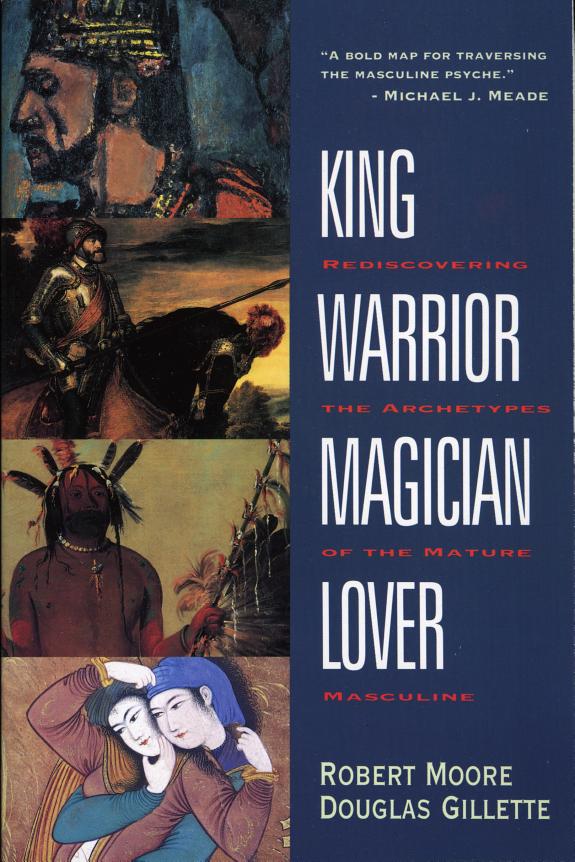
- Moore, R. & Gillette, D. (1990). King, Warrior, Magician, Lover: Rediscovering the Archetypes of the Mature Masculine. HarperCollins.
- Jung, C.G. (1959). The Archetypes and the Collective Unconscious. In Collected Works, Vol. 9i. Princeton University Press.
- Turner, V. (1969). The Ritual Process: Structure and Anti-Structure. Aldine Publishing.