 Seba.Health
Key Takeaways
- Sharp's book recovers typology as a compass for psychological orientation rather than a system of classification, insisting that the model's value lies not in labeling people but in revealing the compensatory dynamics between consciousness and the unconscious that produce neurosis.
- The text's most clinically potent move is linking the inferior function directly to the shadow, establishing that what a person cannot do well is not merely a deficit but the precise location where unlived life accumulates and where individuation must eventually proceed.
- By disclosing his own shifting typology across decades—from blatant thinking type to introverted sensation—Sharp enacts the very principle he explicates: type is not a fixed trait but a dynamic snapshot of consciousness at a given stage of development, making all static type-testing epistemologically suspect.
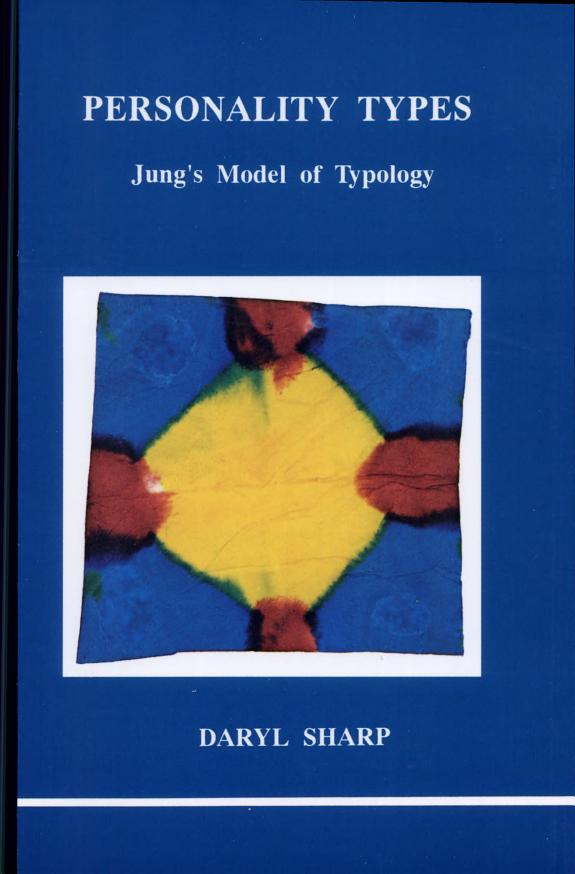
Typology Is a Compass, Not a Map: Sharp Reclaims Jung’s Model from the Classification Industry
Daryl Sharp opens this slim volume with a declaration that should have stopped the personality-testing industry in its tracks: Jung’s model “is not a system of character analysis, nor is it a way of labeling oneself or others.” The analogy Sharp returns to throughout is geographic—typology as compass, not census. Jung himself compared the four functions to cardinal points, “just as arbitrary and just as indispensable,” and Sharp treats this metaphor with total seriousness. The book appeared in 1987, the same year Fortune magazine reported that 1.5 million people had taken the Myers-Briggs Type Indicator, and Sharp’s quiet insistence that type tests are “collectively based and static” reads as a precise diagnosis of the cultural misappropriation already underway. He notes that such instruments ignore “the dynamic nature of the psyche,” say nothing about complexes that distort typological expression, and cannot detect what he calls the “falsified type”—the person forced by familial or environmental pressure into an attitude alien to their nature. John Beebe would later extend this critique into a full archetypal model of the eight function-attitudes, but Sharp’s contribution is more fundamental: he restores the epistemological humility Jung himself embedded in the system. The model is not objectively verifiable; its truth is experiential and, Sharp adds, “psychologically satisfying” precisely because its fourfold structure is archetypal—mandala-like. This is not a weakness. It means the model works the way symbols work: not by mapping reality but by orienting the psyche within it.
The Inferior Function Is Not a Weakness but the Address of the Shadow
The book’s structural center of gravity is not the eight type descriptions, competent as they are, but the final chapter’s synthesis of typology and shadow. Sharp makes explicit what Jung left implicit across scattered passages: since the ego is the dominant complex of consciousness and the shadow comprises “personality characteristics that are not part of one’s usual way of being in the world,” the inferior function and the undeveloped attitude are, by definition, shadow material. This is not metaphor. Sharp means it diagnostically. The inferior function is where “unlived life” accumulates, where compensatory eruptions originate, and where individuation demands engagement. Von Franz’s observation, which Sharp quotes, that people “very often assure you with absolute sincerity that they belong to the type opposite from what they really are” reflects exactly this dynamic—the inferior function “subjectively feels itself to be the real one” because it carries the numinous charge of the unconscious. Naomi Quenk’s later book Was That Really Me? would devote an entire volume to the phenomenology of inferior function eruptions, but Sharp establishes the theoretical scaffold: the shadow “constantly challenges the morality of the persona,” and since the superior function inevitably becomes the persona’s most polished instrument, the inferior function becomes the shadow’s most reliable voice. The practical implication is that asking “What is my greatest cross?” leads more reliably to one’s type than any questionnaire.
Type Is a Developmental Snapshot, Not an Identity
Sharp’s most subversive move is autobiographical. He discloses that after twenty-five years of self-examination, he identifies as “an introverted sensation type—at the moment,” but then catalogs earlier periods when he functioned as a blatant thinking type, an extravert leading a student council, and a person for whom introverted feeling was dominant. This is not confession for its own sake. It is a methodological demonstration that type shifts across the lifespan, and that any instrument measuring type at a single point mistakes a frame for the film. The anecdote of the man with multiple academic degrees who tests as an introverted thinking type but may actually be a repressed extravert whose feeling function is “buried so deeply in his shadow that only a major life crisis, precipitating a nervous breakdown, would uncover it” drives the point home clinically. Lenore Thomson’s later Personality Type: An Owner’s Manual would attempt to reclaim type as a measure of “personal growth and change” rather than prediction, but Sharp already identifies the core problem: static testing cannot detect the compensatory unconscious, and without that detection, the result is a portrait of the persona, not the person. Jung’s own remark that “a falsification of type” leads to neurosis curable “only by developing the attitude consonant with [one’s] nature” makes typological self-knowledge not an academic exercise but a therapeutic imperative.
The Relational Unconscious Speaks Through Type Collisions
Sharp’s retelling of Jung’s castle parable—two youths, one introverted, one extraverted, whose attitudes suddenly invert upon encountering an object that constellates the inferior side—is the book’s most vivid teaching. The introvert, seized by the manuscripts, becomes extraverted in a primitive, socially oblivious way; the extravert, disappointed, turns sullen and moody. Sharp uses this to illustrate that the inferior attitude is autonomous: “What we are not conscious of in ourselves is by definition beyond our control.” He then extends this into the dynamics of marriage, citing Jung’s observation that opposite types “seem created for a symbiosis” that holds only as long as external necessity demands mutual adaptation. When the pressure lifts, “they turn face to face and look for understanding—only to discover that they have never understood one another.” This anticipates the relational focus of contemporary Jungian work on projection and the contrasexual archetypes, and it grounds typology in the field where it matters most: not career placement but the intimate encounter where one’s unlived life collides with another’s.
Sharp’s book matters today not because it introduces typology—dozens of books do that—but because it refuses to let typology become what it has largely become: a sorting mechanism. By binding the inferior function to the shadow, by insisting on the compensatory unconscious as the invisible parameter no test can reach, and by demonstrating in his own person that type is developmental rather than fixed, Sharp produced the one primer that preserves Jung’s original intent. For anyone who has taken a type test and felt simultaneously recognized and reduced, this is the corrective text.
Sources Cited
- Sharp, D. (1987). Personality Types: Jung's Model of Typology. Inner City Books. ISBN 978-0-919123-30-5.
- Jung, C.G. (1921). Psychological Types. Collected Works, Vol. 6. Princeton University Press.
- von Franz, M.-L. & Hillman, J. (1971). Lectures on Jung's Typology. Spring Publications.