 Seba.Health

Key Takeaways
- Cairns demonstrates that *aidos* is not reducible to either "shame" or "honour" but operates as a single cognitive-affective complex that regulates the Greek self's positioning within a field of social and moral evaluation — collapsing the modern dichotomy between internal guilt and external shame that has distorted classical scholarship since Dodds.
- The book reveals that *aidos* functions as a prospective inhibitory emotion — a felt anticipation of how one's action will appear to real or imagined others — making it structurally analogous to what depth psychology calls the internalized Other, and far closer to Lacan's gaze of the big Other than to any simple "fear of punishment."
- By tracking *aidos* from Homer through Euripides, Cairns exposes a developmental arc in Greek ethical consciousness that does not move from "shame culture" to "guilt culture" but instead deepens the same emotion's interiority, suggesting that the Greeks never needed a separate guilt concept because *aidos* already contained self-reflective moral judgment.
Aidos Is Not a Social Reflex but the Greek Psyche’s Primary Organ of Self-Regulation
Douglas Cairns’s Aidos dismantles one of the most persistent frameworks in classical studies: the Doddsian partition of Greek culture into a primitive “shame culture” succeeded by an evolved “guilt culture.” Cairns argues, with exhaustive philological evidence from Homer through the tragedians, that aidos was never a mere fear of public exposure or social ridicule. It is a prospective, inhibitory emotion that arises when a subject imagines how an action — contemplated or performed — will register against the evaluative standards of others, including internalized others. This means aidos already contains what modernity assigns to guilt: self-assessment, moral reflexivity, and an internal tribunal. The Greek did not need a separate “guilt” word because aidos was already doing that work. Cairns’s philological precision here has consequences far beyond classics. When Lacan describes Alcibiades’s confession in the Symposium as driven by “the demon of Aidos, of Shame,” he names the very structure Cairns anatomizes: the subject’s agony at being seen — not merely by present company, but by the tribunal of the Other with a capital O. Alcibiades unveils his failed seduction of Socrates not from simple embarrassment but because the gaze of the assembled witnesses forces a confrontation with his own desire’s structure. Cairns’s analysis provides the philological ground that Lacan’s reading assumes without fully excavating. The “demon of Aidos” is precisely the prospective, inhibitory force that regulates the boundary between the subject’s self-image and the Other’s evaluation.
The Shame-Guilt Binary Is a Modern Fantasy Projected onto Antiquity
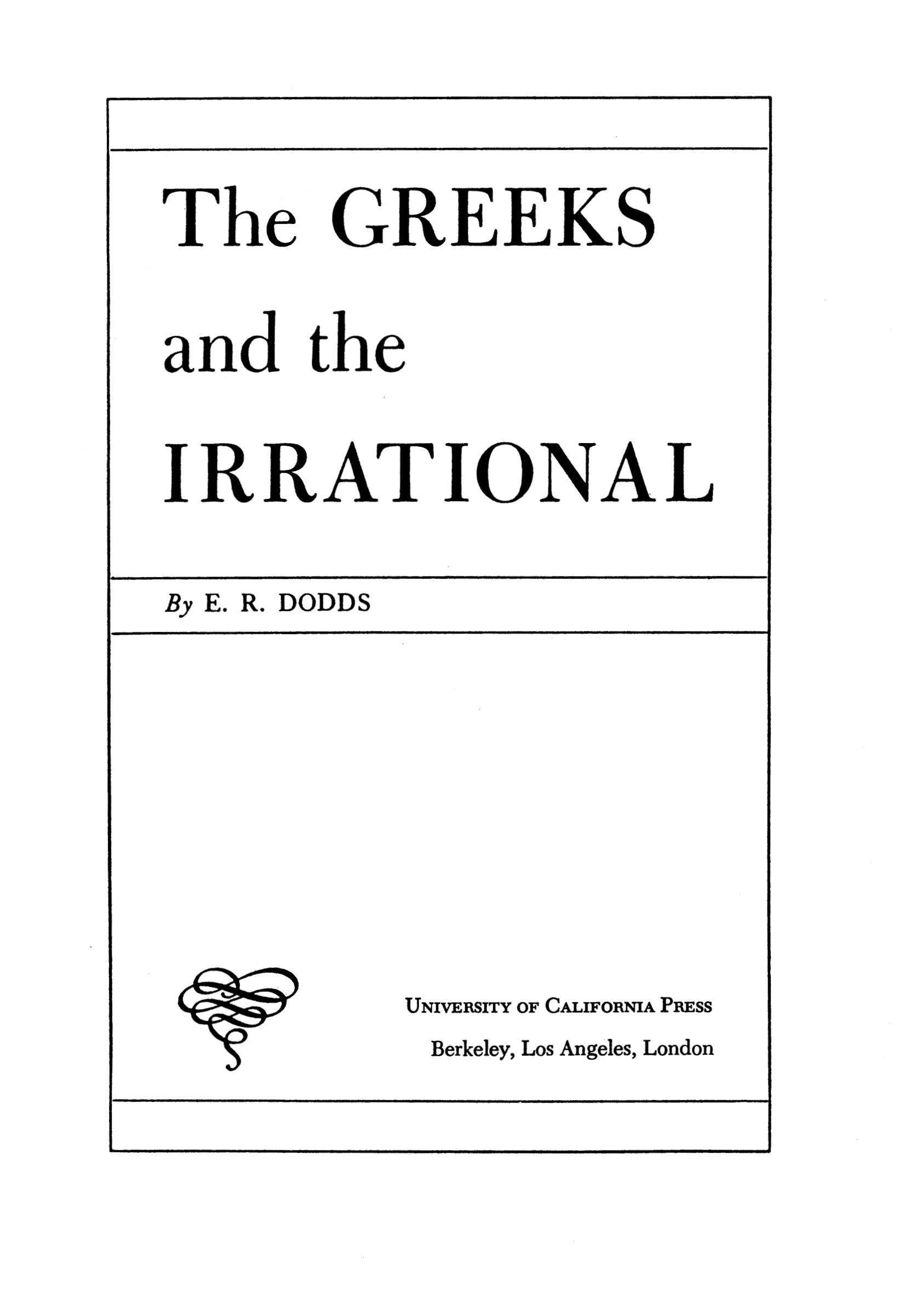
Cairns’s most polemical contribution is his sustained demolition of the shame/guilt dichotomy as applied to ancient Greece. E. R. Dodds’s The Greeks and the Irrational — itself deeply indebted to Ruth Benedict’s anthropological categories — proposed that Homeric society was a “shame culture” in which moral behavior depended entirely on external sanctions, and that the internalization of conscience marked a later, more sophisticated development. Cairns shows this framework to be not merely oversimplified but structurally wrong. Already in the Iliad, aidos operates in contexts where no external observer is present; the hero’s self-evaluation against ideal standards of conduct is itself the source of the inhibition. Ajax’s aidos before his own sense of warrior identity, Hector’s before the imagined judgment of future generations — these are not external but deeply internalized operations. What Cairns uncovers is that the Greek self was never the atomistic, externally-determined ego that the Doddsian model requires. Patricia Berry’s meditation on shame and earth — “I am ashamed before that standing within me which speaks with me” — captures something the Navajo chant shares with Homeric aidos: the sense of being permanently witnessed by a presence that is neither purely external nor purely internal but constitutive. Berry connects this to depth psychology’s service of “the human sense of shame and infirmity, the incomprehensible, the rejected,” arguing that shame is a gateway to psychic ground. Cairns’s philological work provides the classical foundation for exactly this insight: aidos is the emotion that discloses the self to itself as always-already seen.
Aidos Bridges the Gap Between Homeric Honor and Tragic Interiority Without Rupture
One of the book’s most significant moves is tracing aidos across genres — epic, lyric, tragedy — without positing a rupture in Greek moral consciousness. Cairns demonstrates that when Sophocles’s Ajax or Euripides’s Hippolytus experiences aidos, the emotion retains its Homeric structure while gaining new dramatic and philosophical depth. This continuity matters enormously for how we read Greek tragedy and, by extension, for how depth psychology inherits the tragic tradition. Hillman insists in Mythic Figures that “the Greeks knew this so well, and so they had no depth psychology and psychopathology such as we have. They had myths.” Cairns’s work specifies what the Greeks had instead of psychopathology: they had aidos, a single emotion capacious enough to regulate competitive honor, sexual propriety, supplication, religious reverence, and the warrior’s relationship to death. The emotion did not fragment into specialized moral categories because the Greek self did not fragment in the way modernity demands. When Hillman asks how we might imagine therapy through myths other than Oedipus — through Eros and Psyche, through Dionysus, through Persephone — he is gesturing toward a pluralism of psychic governance that the Greeks enacted through a pluralism of aidos-contexts. Cairns shows that the same word and the same felt structure could govern Ajax’s refusal to retreat, Penelope’s veiled descent among the suitors, and a suppliant’s prostration at an altar. The unity is not conceptual but phenomenological: aidos is always the felt awareness of one’s position within a field of value.
Why This Book Is Irreplaceable for Depth Psychology’s Self-Understanding
Cairns’s work matters for depth psychology because it recovers the precise emotional mechanism by which the Greeks regulated what we now partition into ego-ideal, superego, social anxiety, and moral conscience. By refusing the shame/guilt binary, Cairns implicitly challenges the psychoanalytic tradition’s own partition of these functions. If aidos is a single emotion that performs all of these operations — prospective inhibition, self-evaluation, imagined audience, moral reflexivity — then the Greek psyche possessed an integrative capacity that modern psychology has disassembled into competing theoretical modules. Cody Peterson’s account of the “abolished middle” — the loss of the thumos as a site of deliberation between active mastery and passive collapse — finds its affective counterpart in Cairns’s aidos: an emotion that is neither pure agency nor pure subjection but a stance of being-held-before-the-gaze. Anyone working with shame clinically, theoretically, or mythologically needs this book not as background but as foundation. It is the only work that demonstrates, with full philological rigor, that the emotion modern psychology treats as pathology was once the Greeks’ primary instrument of ethical life.
Sources Cited
- Cairns, D.L. (1993). Aidos: The Psychology and Ethics of Honour and Shame in Ancient Greek Literature. Oxford University Press.
- Williams, B. (1993). Shame and Necessity. University of California Press.
- Dodds, E.R. (1951). The Greeks and the Irrational. University of California Press.