 Seba.Health
Key Takeaways
- Dodds did not merely recover the irrational in Greek culture; he dismantled the foundational assumption of classical scholarship that Greek civilization progressed linearly from mythos to logos, revealing instead a psyche perpetually negotiating between archaic possession and rational control.
- The book's concept of the "inherited conglomerate" — the layered, unresolved strata of religious and psychological experience carried forward in Greek culture — functions as a proto-depth-psychological model of the collective unconscious decades before classicists would entertain such frameworks.
- Dodds's treatment of Dionysian maenadism as genuine altered-state experience rather than literary convention became the indispensable bridge through which Hillman, Kerényi, and later archetypal psychologists could reclaim ecstatic states as psychologically normative rather than pathological.
Dodds Returned the Daimon to Classical Scholarship and Gave Depth Psychology Its Greek Passport
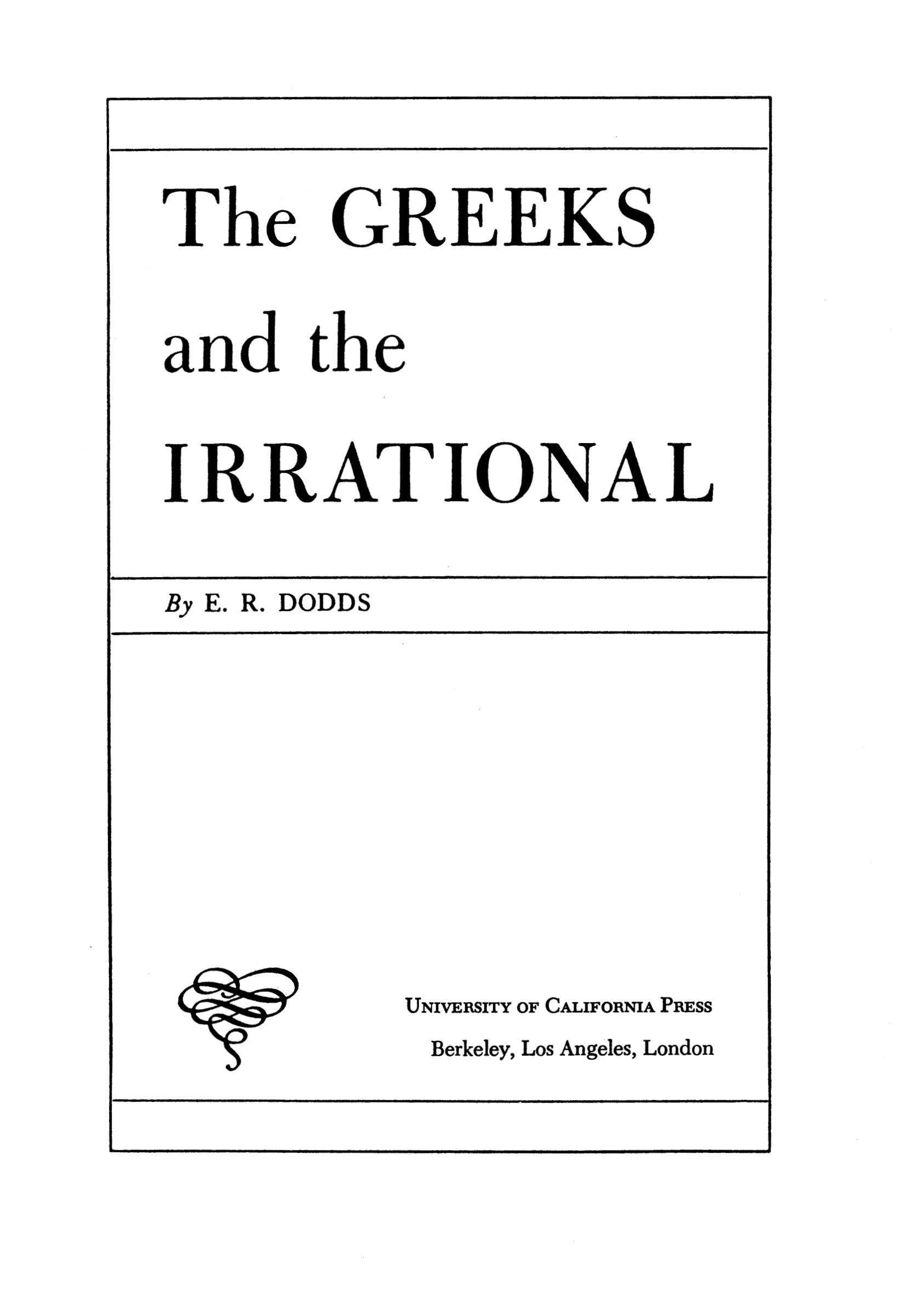
E. R. Dodds’s The Greeks and the Irrational performed an act of intellectual archaeology that classical philology had refused to undertake and depth psychology desperately needed. Drawing on his 1949 Sather Lectures at Berkeley, Dodds systematically demonstrated that the Greeks — those supposed paragons of rational clarity — were saturated with experiences of divine possession, dream incubation, shamanic soul-flight, and guilt-driven anxiety. The book’s decisive move is its first chapter, “Agamemnon’s Apology,” which shows that Homeric heroes did not experience their own decisions as emanating from a unified ego. Agamemnon’s claim that Zeus, Fate, and the Erinys drove him to seize Briseis was not rhetorical excuse-making; it was a phenomenologically accurate report of what Dodds calls “psychic intervention” — the experience of impulse as arriving from outside the self. This is the same phenomenon Hillman, drawing directly on Dodds, identifies as the action of the daimon: a force that “both instigates an abrupt change of behavior pattern and at the same time gives a conscious reason or verbal account.” Hillman explicitly credits Dodds’s analysis of Homeric psychology as foundational for understanding how the psyche was originally experienced not as a unified agent but as a field traversed by powers. The daimon was located in the thymos, the chest-seated center of emotional consciousness — a pre-Cartesian, pre-egoic model of mind that depth psychology has spent a century trying to recover.
The “Inherited Conglomerate” Is the Classical World’s Name for the Collective Unconscious
Dodds’s most structurally significant contribution is his concept of the “inherited conglomerate” — the idea that Greek religion and psychology were not coherent systems but layered deposits of incompatible belief strata, carried forward and never fully reconciled. Archaic shame-culture persisted beneath classical guilt-culture; Olympian religion sat atop chthonic rites; Apollonian rationalism coexisted with Dionysian ecstasy. This is not intellectual history; it is stratigraphy of the psyche. Edinger, in The Psyche in Antiquity, describes exactly this layering when he writes that studying the early Greeks “connects us with our own psychic roots, which reside in the collective unconscious, laid down like geological strata during the evolution of the human psyche.” But where Edinger reads Greek philosophy as a sequence of archetypal ideas undergoing differentiation, Dodds reads Greek culture as a whole organism in which rational differentiation never fully metabolized its irrational substrates. The implications diverge: Edinger tracks the psyche’s ascent through philosophical articulation; Dodds insists on the persistence of what was never articulated, the archaic residue that erupts in crisis. His chapter on the “Return of the Irrational” in the Hellenistic age — where astrology, magic, and theurgy flooded back into a culture exhausted by rationalism — reads as a case study in enantiodromia, Heraclitus’s principle that Edinger himself flags as central to the Western psyche’s self-understanding.
Maenadism Was Not Metaphor: Dodds Made Ecstatic Experience Empirically Credible
The chapter “The Blessings of Madness” is where Dodds opened the door through which archetypal psychology walked. By treating Plato’s four divine manias — prophetic (Apollo), telestic (Dionysus), poetic (the Muses), and erotic (Aphrodite/Eros) — as descriptions of actual psychological states rather than literary conceits, Dodds gave scholarly warrant to what had been either romanticized or pathologized. His treatment of maenadism is the decisive case. Dodds approached the Bacchic evidence anthropologically, comparing Greek ritual possession with cross-cultural data on ecstatic religion, and concluded that the maenads’ experience was real dissociative practice, not Euripidean invention. Hillman seized on this directly. In The Myth of Analysis, Hillman builds an extended comparison between Dionysian maenadism and nineteenth-century hysteria at the Salpêtrière, citing Dodds’s observation that Dionysus “enables you for a short time to stop being yourself.” For Hillman, this is not pathology but the god’s characteristic action: loosening the tyranny of the adapted personality, the “usual ego.” Dodds’s phrase — Dionysus was “at all periods demotikos, a god of the people” — becomes Hillman’s lever for arguing that Apollonic analytical consciousness has systematically disfavored collective, participatory, Dionysian modes of awareness. Without Dodds’s empirical grounding, Hillman’s archetypal claims about Dionysus would float free of the ancient evidence. David Miller’s The New Polytheism likewise depends on the credibility Dodds established: that Greek polytheism was not decorative mythology but “the empowering worlds of our existence,” as Miller puts it, drawing on a tradition Dodds made intellectually respectable.
Dodds Diagnosed the Rationalist Repression That Depth Psychology Exists to Treat
The book’s final chapter, “The Fear of Freedom,” is its most psychologically acute. Dodds argues that the Greeks’ progressive rationalism generated its own backlash — not because irrationality is inherently seductive, but because rationalism, carried far enough, strips away the psychic structures (ritual, myth, communal ecstasy) that make human existence bearable. The parallel to modernity is not stated but unmistakable. Hillman’s entire project in Re-Visioning Psychology — the argument that “Hellenism brings the tradition of the unconscious imagination” while “Hebrewism reconfirms the monotheism of ego-consciousness” — is a philosophical elaboration of what Dodds demonstrated historically. Dodds showed that when the Greeks achieved maximal rational clarity in the late fifth century, the psyche revolted: mystery cults proliferated, oracles regained authority, and philosophy itself, in Plato, had to reintroduce myth to contain what dialectic could not hold. This is the pattern depth psychology encounters daily: the ego’s rational sovereignty generating symptoms, the return of what was excluded.
For anyone entering depth psychology today, The Greeks and the Irrational provides something no other single book does: rigorous classical evidence that the psyche has never been rational, that the gods never left, and that every culture’s proudest intellectual achievement is shadowed by the archaic powers it tried to supersede. It is the scholarly foundation beneath Jung’s intuitions about the collective unconscious, Hillman’s archetypal psychology, and any serious attempt to understand why modern humans remain, in their depths, ancient Greeks.
Sources Cited
- Dodds, E. R. (1951). The Greeks and the Irrational. University of California Press. ISBN 978-0-520-04957-4.
- Snell, B. (1953). The Discovery of the Mind: The Greek Origins of European Thought. Harvard University Press.
- Jung, C. G. (1969). Aion: Researches into the Phenomenology of the Self (CW 9ii). Princeton University Press.