 Seba.Health
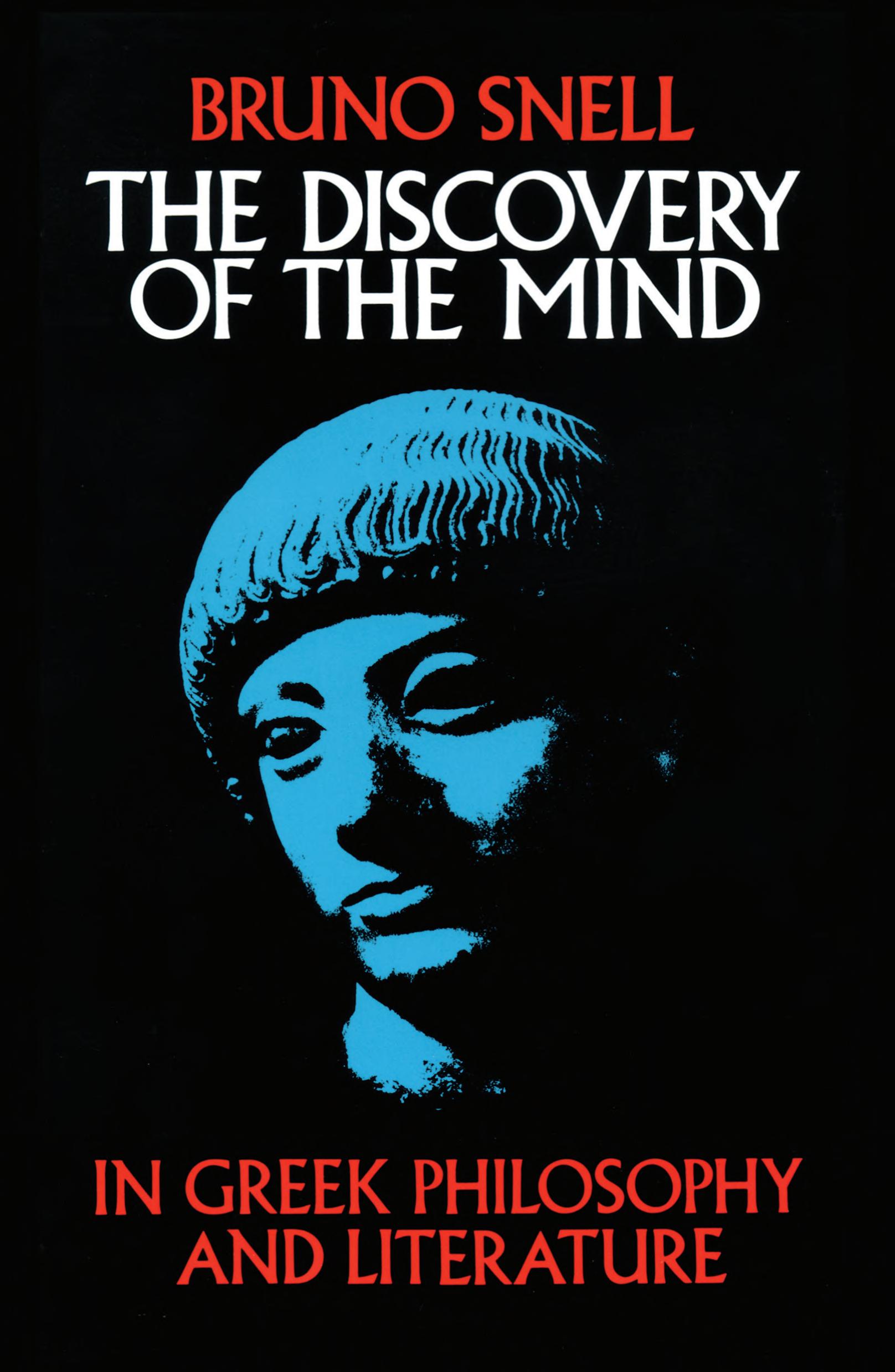
Key Takeaways
- Snell's central thesis is not that the Greeks "invented" subjectivity but that the linguistic and poetic forms available to a culture literally determine which psychic structures can exist for its members — making *The Discovery of the Mind* a theory of consciousness as a product of expressive capacity, not introspection.
- By demonstrating that Homeric Greek lacked a unified word for "body" or "mind," Snell provides the philological foundation that depth psychology requires but rarely articulates: the archetypes do not arrive as finished concepts but crystallize only through the slow pressure of language on pre-conceptual experience.
- Snell's developmental sequence — from Homer's aggregate psyche through lyric self-reflection to philosophical abstraction — is the classical philologist's version of Neumann's *Origins and History of Consciousness*, but grounded in textual evidence rather than mythological amplification, making it both more rigorous and more vulnerable to the charge of teleology.
The Mind Was Not Discovered but Constructed Through the Available Grammar of Experience
Bruno Snell’s The Discovery of the Mind (1953) advances a radical claim disguised as classical scholarship: European consciousness did not emerge through philosophical argument or religious revelation but through shifts in poetic diction. Snell demonstrates that Homeric Greek possessed no single word for the living body as a unified whole — sōma meant “corpse,” and what we call “the body” was rendered as an aggregate of limbs (guia, melea). The same fragmentation applied to mental life: thumos, nous, psychē, and phrēn each named a distinct psychic organ, none of which corresponded to a unified “self” directing experience from within. The Homeric hero does not decide; he is visited by impulses that arrive as divine interventions. What Snell tracks across five centuries of Greek literature is the gradual consolidation of these dispersed functions into something recognizable as an integrated subject. This is not intellectual history in the conventional sense. It is an account of how consciousness becomes possible when language generates the categories through which experience can be reflexively grasped. Cody Peterson’s recent philological work on paschō and thumos in Homer extends precisely this Snellian method, tracing how the Greek vocabulary of suffering constitutes a physics of endurance rather than a mere metaphor for it. Where Peterson shows that thumos is the organ through which divine and mortal experience converge, Snell established the prior point: that such organs are real only insofar as the language that names them permits differentiated experience.
Homer’s Fragmented Psyche Is the Precondition for Depth Psychology, Not Its Opposite
The depth-psychological tradition has drawn on Snell without always understanding the full weight of his contribution. Edward Edinger, in The Psyche in Antiquity, explicitly cites Snell on the evolution of nous — from its etymological root in snu (“to sniff”) through its elaboration by Anaxagoras as cosmic mind — and frames this trajectory as the progressive differentiation of the Self archetype in collective history. Edinger reads the Pre-Socratics as unconscious psychologists, articulating archetypal images that “we still encounter as living organisms in the unconscious.” This is an accurate use of Snell but also a domestication of his most unsettling implication: that the unified psyche Jungian psychology presupposes is itself a historical achievement, not an eternal given. Snell does not merely show that the Greeks discovered mind; he shows that before a certain threshold of linguistic and cultural elaboration, there was no mind to discover — only a collection of divine promptings and somatic reactions that had not yet coalesced into interiority. For depth psychology, this means the archetypes themselves have a developmental history. They do not descend fully formed from a timeless collective unconscious; they crystallize when a culture’s expressive apparatus reaches sufficient complexity to differentiate them from the background noise of undifferentiated experience.
Lyric Poetry, Not Philosophy, Is Where the Subject First Appears
Snell’s most consequential chapter concerns the Greek lyric poets — Sappho, Archilochus, Pindar — whom he positions as the true originators of subjective consciousness. Homer’s characters act; lyric poets feel and know they feel. The shift from epic to lyric is the shift from third-person narration of divine causation to first-person testimony of inner states. Sappho does not report that Aphrodite struck her; she describes the phenomenology of desire from within a body she owns. This is the birth of what James Hillman, in Re-Visioning Psychology, calls “soul-making” — the process by which events deepen into experiences. Hillman traces his ancestral lineage from Heraclitus through Plotinus to Jung, and he explicitly acknowledges Snell’s work as demonstrating that “we are constantly forced to revert to the archetypes of Greek thought.” But Hillman’s emphasis on image and fantasy as the primary data of psyche finds its historical grounding in Snell’s demonstration that image-making — specifically the metaphorical innovations of lyric poetry — is the mechanism through which subjectivity was forged. The “imaginative possibility in our natures” that Hillman identifies as the essence of soul was, in Snell’s account, a Greek invention achieved through the pressure of metaphor on inherited epic vocabulary.
The Teleological Temptation and Its Necessary Correction
Snell’s developmental schema — from Homer’s aggregate psyche through lyric interiority to Socratic self-knowledge — carries an unmistakable teleological momentum: European consciousness marches forward, and the Greeks are its engine. This has drawn justified criticism from classicists who argue that Snell imposes modern categories retroactively, reading absence of unified selfhood where there is merely a different organization of experience. The correction is important but does not invalidate the core insight. What Snell demonstrates is not that Homeric people lacked consciousness but that the concept of a unified inner life — and therefore the capacity to reflect on it, narrate it, and transform it — required specific poetic and philosophical innovations. This is the same structure Jung identified when he observed that “the products of the unconscious are pure nature” but that nature is not, in herself, a guide: conscious realization requires an instrument of mediation. For Snell, that instrument is language itself, operating through the specific formal constraints of hexameter, elegiac couplet, and dialectical prose.
Why This Book Remains Irreplaceable for Practitioners of Depth Psychology
No other single work provides what The Discovery of the Mind provides: a philologically grounded account of how the Western psyche acquired the reflexive capacity that makes depth psychology possible. Edinger tracks the archetypal images that Greek philosophers articulated; Hillman draws on Greek myth for his archetypal psychology; Peterson excavates the Homeric lexicon of suffering. All of them stand on the foundation Snell laid. For the clinician or the serious student of Jung, this book answers a question that analytical psychology tends to leave unasked: if the archetypes are eternal, why did it take a specific historical culture to name them? Snell’s answer — that naming is not labeling but constituting, that the word creates the psychic reality it appears merely to describe — transforms the relationship between language and soul from a philosophical abstraction into a clinical fact. Every analysand who finds a word for a previously inchoate feeling is repeating, in miniature, the civilizational process Snell documents.
Sources Cited
- Snell, B. (1953). The Discovery of the Mind: The Greek Origins of European Thought. Harvard University Press. ISBN 978-0-486-28180-3.
- Onians, R. B. (1951). The Origins of European Thought: About the Body, the Mind, the Soul, the World, Time and Fate. Cambridge University Press.
- Caswell, C. P. (1990). A Study of Thumos in Early Greek Epic. Brill.