 Seba.Health
Key Takeaways
- Onians demonstrates that the foundational categories of Western philosophy—mind, soul, fate, time—did not originate as abstract concepts but as bodily fluids, breath, and anatomical processes, which means the entire trajectory from Presocratic thought through Plato rests on a forgotten physiology that depth psychology must recover to understand its own roots.
- The book provides the philological infrastructure for Hillman's soul/spirit distinction by showing that *psyche* and *pneuma* carried radically different somatic referents in early Greek thought—psyche tied to cerebrospinal fluid and life-breath, pneuma to the chest and thumos—thereby grounding what became a thousand-year theological catastrophe in the material history of language itself.
- Onians's method—treating Homer, Hesiod, and the Presocratics not as literary artifacts but as phenomenological reports on the experience of embodied consciousness—anticipates and outstrips the archetypal psychology project by decades, offering the empirical philological base that Jung's amplificatory method and Hillman's image-centered psychology both presuppose but never themselves supply.
The Body Is the Unconscious Archive of European Metaphysics
Richard Broxton Onians’s 1951 masterwork performs an act of intellectual archaeology so thorough that it permanently alters what we can mean by “depth psychology.” His thesis is deceptively simple: the earliest Greek and Latin concepts for mind, soul, consciousness, fate, and time were not abstractions. They were descriptions of bodily substances and processes—cerebrospinal fluid, breath, semen, the marrow of the bones, the vaporous thumos in the chest. When Homer’s warriors speak of psyche leaving the body, they are not reaching for metaphor. They are reporting the departure of a specific substance associated with the head and the cerebral-spinal column. When aion (the word that will eventually yield “eternity”) appears in early texts, it denotes the liquid of life, the vital marrow, the stuff that courses through the spine. Onians tracks these identifications across hundreds of passages in Homer, Pindar, the tragedians, the Presocratics, and Latin authors, building an edifice of evidence that is as formidable in its classical scholarship as it is revolutionary in its implications for psychology. The book does not merely suggest that Greek philosophy has bodily origins; it proves, passage by passage, that European thought cannot be understood apart from the somatic imagination that generated it. For depth psychology, this is not a footnote—it is a foundation.
Psyche Was Never a Ghost: The Philological Ground of the Soul/Spirit Problem
Hillman, in his 1975 lecture “Peaks and Vales,” traces the catastrophe of Western psychology to the Council of Constantinople in 869, where the tripartite anthropology of body, soul, and spirit collapsed into a dualism. But Onians shows that the confusion runs far deeper than any ecclesiastical decree. Already in Homer, psyche and thumos designated different bodily regions and different experiential registers: psyche was the life-substance associated with the head, the cerebral fluid, the principle that departs at death; thumos was the hot vapor in the chest, the seat of emotion, anger, and desire. When later Greek thought began to conflate psyche with pneuma (breath, wind, spirit), the original somatic precision was lost, and the stage was set for precisely the dualistic confusion Hillman diagnoses. Onians’s philology gives Hillman’s polemic its historical teeth. It is not simply that spirit displaced soul in Christian theology; it is that the words themselves underwent a bodily migration, from distinct anatomical referents to interchangeable abstractions. This is why Hillman cites Onians repeatedly in The Myth of Analysis—because the case for soul as a “third” between body and spirit requires showing that the ancients once knew this distinction in the flesh. Edinger’s The Psyche in Antiquity covers much of the same philosophical terrain but from a Jungian amplificatory angle, treating the Presocratics as anticipations of individuation. Onians’s approach is more radical: he does not read ancient thought through Jung; he reads the bodily substrate beneath the thought that Jung and all subsequent psychology inherited.
Fate, Time, and the Seed: Why the Archaic Body Is the Original Imaginal
One of Onians’s most startling contributions is his demonstration that the Greek concepts of moira (fate), aion (time/eternity), and sperma (seed) share a common root in the experience of generative fluid. Fate is not an external cosmic decree imposed upon the individual; it is bound up with the substance of one’s life, the portion (moira) of vital fluid allotted at birth. Time is not an empty container through which events pass; it is the life-liquid running its course, the aion draining from the body. This cluster of associations—seed, fate, time, vital fluid—constitutes what Onians calls the archaic physiology of consciousness, and it resonates directly with Jung’s concept of the psychoid archetype: a reality that is simultaneously somatic and psychic, neither purely material nor purely imaginal. Hillman’s insistence in Re-Visioning Psychology that “images don’t stand for anything”—that images are the psyche’s own substance—finds its deep historical precedent in Onians’s archaic Greeks, for whom the soul literally was a substance, not a representation of one. The imaginal and the material had not yet been split. Hillman’s essays on the puer aeternus draw heavily on Onians’s analysis of wind, wings, and the generative breath (pneuma as semen-spirit), as the footnotes to “Senex and Puer” make explicit. Without Onians, the archetypal psychology of puer and senex would lack its philological spine.
Why Philology Is a Depth-Psychological Method
What makes Onians irreplaceable is his method. He treats words not as signs but as sedimentations of experience. Every etymological connection he draws is simultaneously a psychological insight: to discover that genius derives from the same root as genu (knee) because the Romans located generative power in the knee-joints is to discover something about the body’s own unconscious self-understanding. This is not intellectual history; it is an excavation of the collective unconscious conducted through language rather than through dreams or myths. Edinger asks us to recognize Presocratic ideas when they appear in modern dreams. Onians asks something prior and more demanding: that we recognize the bodily experiences that generated those ideas in the first place. His work reveals that the entire vocabulary of Western interiority—soul, mind, spirit, fate, time—is a palimpsest written over the body’s original script.
For anyone working seriously in depth psychology today, Onians provides what no other single text does: proof that the psyche’s history is inscribed in the body’s language, and that recovering that inscription is not antiquarian indulgence but the precondition for understanding what we mean—and fail to mean—when we speak of soul at all.
Sources Cited
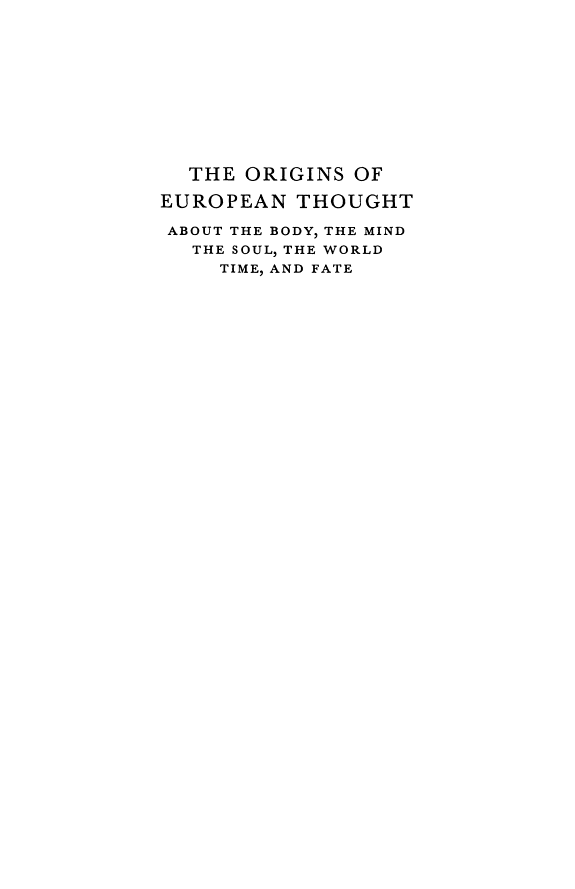
- Onians, R. B. (1951). The Origins of European Thought: About the Body, the Mind, the Soul, the World, Time and Fate. Cambridge University Press. ISBN 978-0-521-34794-5.
- Snell, B. (1953). The Discovery of the Mind: The Greek Origins of European Thought. Harvard University Press.
- Homer. (2023). The Iliad (E. Wilson, Trans.). W. W. Norton.