 Seba.Health
Key Takeaways
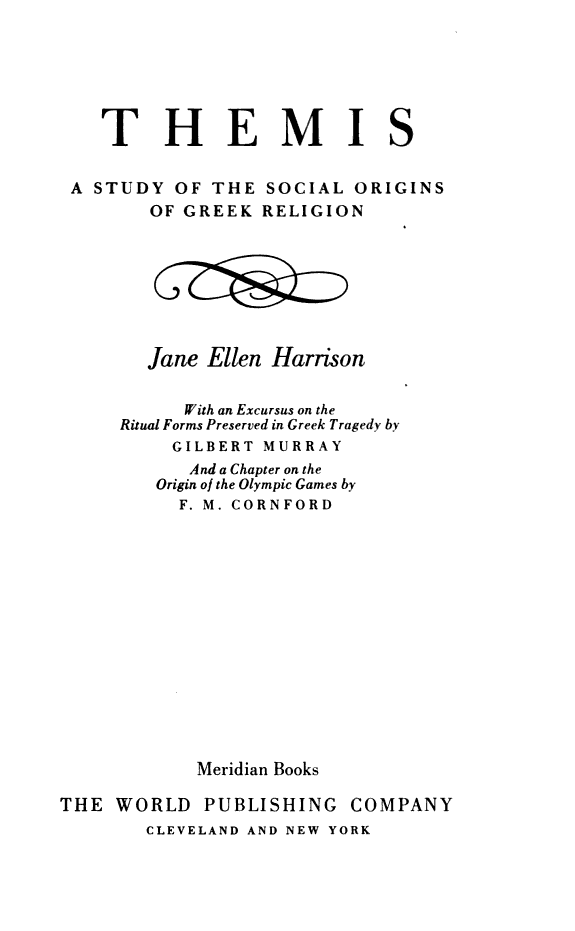
- Harrison's central achievement is not a theory of Greek religion but a demonstration that divinity itself is a secondary crystallization of collective social pressure—Themis, the binding force of the group, precedes and generates every god, including Zeus.
- The distinction between the Eniautos-Daimon and the Olympian maps directly onto Bergson's durée versus analytic intelligence, making *Themis* an unacknowledged bridge between classical philology and process philosophy that anticipates later depth-psychological critiques of ego-consciousness.
- By grounding the doctrine of death-and-rebirth not in "Orphic" mysticism or Oriental influence but in the concrete social institution of initiation rites, Harrison strips the archetype of spiritual rebirth of its theological aura and returns it to the body of the group—a move whose implications Jung and his followers never fully absorbed.
The God Is Not the Origin of Religion but Its Epiphenomenon: Harrison’s Inversion of Theological Thinking
Jane Ellen Harrison’s Themis executes a reversal so total that a century later its implications remain only partially digested. The conventional assumption—shared by Max Müller, Herbert Spencer, and every theologian before Durkheim—was that religion begins with an apprehension of something transcendent: the Infinite, the Supernatural, the Divine. Harrison demolishes this by demonstrating that the Hymn of the Kouretes, discovered at Palaikastro, reveals religion emerging “straight out of a social custom.” The Kouros invoked by the Kouretes is “obviously but a reflection or impersonation of the body of Kouretes”—the young initiates who dance him into being. The god does not precede the group; the god is the group’s emotional projection of its own collective life. Harrison draws explicitly on Durkheim’s definition: religious phenomena consist in “croyances obligatoires connexes de pratiques définies,” and behind the word “obligatoire” stands the only source of obligation available to social man—the collective conscience. This is not an observation about Greek religion; it is a thesis about religion as such. Buddhism knows no god; Australian totemism projects witchetty grubs. What all share is the social imperative, the pressure of “herd instinct” that Harrison names Themis. The Olympians, far from being the summit of Greek piety, are late intellectual products, “a bouquet of cut-flowers whose bloom is brief, because they have been severed from their roots.” Robertson Smith had noted that antique religion was “essentially an affair of the community rather than of individuals,” but Smith still conceived of the god as something existing independently of the group. Harrison takes the final step: the god’s “substance when analysed turns out to be just nothing but the representation, the utterance, the emphasis of these imaginations, these emotions, arising out of particular social conditions.”
The Eniautos-Daimon as Durée: Why the Mystery-God Lives and the Olympian Calcifies
Harrison’s most philosophically ambitious claim—largely ignored by classicists and psychologists alike—is that the distinction between the Eniautos-Daimon and the Olympian maps onto Bergson’s distinction between durée and analytic intelligence. Dionysos, who “really dies and is re-born, because the world of life which he embodies really dies and is re-born,” is an “instinctive attempt to express what Professor Bergson calls durée, that life which is one, indivisible and yet ceaselessly changing.” The Olympian, by contrast, represents conscious reflection, differentiation, fixity: “dead, unmeaning perfection, incapable of movement or change.” Harrison is explicit that the Olympians stand for “articulate consciousness” while the Eniautos-Daimon stands for “the sub-conscious.” This is 1912—two years before Jung’s Wandlungen und Symbole der Libido and decades before Neumann’s The Origins and History of Consciousness. Harrison has already identified the structural polarity that depth psychology would later elaborate as the tension between ego-consciousness and the unconscious, between the individuated concept and the living symbol. Her observation that the mystery-god “was called a bull because he really was a bull—a bull full of vital mana, eaten at a communal feast” anticipates the participatory epistemology that Lévy-Bruhl would formalize and that Jung would absorb through his concept of participation mystique. The Olympian, having “come out from the natural facts that begot him,” becomes an objet d’art; the daimon, refusing idealization, remains a vehicle of transformation.
Themis as the Substrate Beneath Every Archetype: Social Structure as the Mother of Gods
The figure of Themis herself occupies a unique position in Harrison’s architecture. She is not a goddess among goddesses but “the substratum of each and every god,” “above as well as below each and every god, but herself never quite a full-fledged divinity.” This is a remarkable formulation. Themis is the collective conscience made numinous—“the force that brings and binds men together”—and her functions in Homer (convening the assembly, presiding over the sacramental feast) are not the errands of a herald but the operations of social cohesion itself “trembling on the very verge of godhead.” Harrison insists that religion contains two inseparable elements: ritual (custom, collective action) and myth (representation of collective emotion). Art has no incumbencies; morality binds action but leaves thought free; religion alone binds both action and thought through representations that are simultaneously chosen and obligatory—“a great collective hairesis.” This analysis anticipates Durkheim’s Les Formes élémentaires (published the same year) while surpassing it in phenomenological precision. For Harrison, Themis is also the key to understanding why matrilinear and patrilinear social structures produce entirely different theologies: the Mother and Son of the Kouretes versus the Father-god of the Olympian family. Kronos is “king” but never “father”; Zeus is father but rules from the sky, severed from earth. The social structure is not merely reflected in the god—it constitutes the god’s substance. This principle, which Harrison states with extraordinary clarity, has direct bearing on the archetypal psychology of Hillman, who similarly insists that images are not representations of prior metaphysical realities but are themselves the primary psychic facts.
Death-and-Rebirth as Social Institution, Not Mystical Revelation
Harrison’s treatment of the death-and-rebirth motif deserves special attention because it directly challenges the later depth-psychological tendency to treat this pattern as an archetype floating free of social context. The “New Birth” doctrine, “usually held to be late and due to ‘Orphic,’ i.e. quasi Oriental influence,” is shown to originate in initiation ceremonies—concrete rites de passage in which the youth undergoes “mimic death and resurrection” to enter adulthood. The Kouros “grows to maturity” and his growth causes the growth of the natural year; the social and the natural are not analogous but identical, because in totemistic thinking “man and nature form one indivisible whole.” This is precisely the territory that Mircea Eliade would later map in Rites and Symbols of Initiation and that Joseph Campbell would popularize, but Harrison reaches the substrate first, and with greater rigor, because she never loses sight of the social body that generates the rite. When she writes that “a breach of Themis would offend your neighbours and produce quarrels; quite equally it would offend the river or the earth and produce floods or famine,” she identifies the logic of participation that undergirds not only Greek religion but every system in which psychic and material reality are experienced as continuous.
Themis matters today not as a monument of early twentieth-century classics but as an unfulfilled challenge to depth psychology. It demonstrates that the archetypes of death and rebirth, the Great Mother, the divine son, and the tension between ego-consciousness and the unconscious all have their generative matrix in collective social life—not in a transpersonal psyche abstracted from history. Anyone who reads Jung on the collective unconscious, Neumann on the Great Mother, or Hillman on the imaginal without reading Harrison is working with conclusions severed from their evidential roots.
Sources Cited
- Harrison, J. E. (1912). Themis: A Study of the Social Origins of Greek Religion. Cambridge University Press. ISBN 978-0-691-01524-8.
- Durkheim, É. (1912). The Elementary Forms of Religious Life. Free Press.
- Cornford, F. M. (1912). From Religion to Philosophy: A Study in the Origins of Western Speculation. Harper & Row.
- Caswell, C. P. (1990). A Study of Thumos in Early Greek Epic. Brill.