 Seba.Health
Key Takeaways
- Emily Wilson's translation restores Odysseus to his archaic strangeness — not a "hero" in the inflated modern sense but a polytropos consciousness whose defining feature is the wound that has already happened, making the poem legible as an initiation text rather than an adventure narrative.
- The Odyssey is the Western tradition's primary document of senex-et-puer integration: Odysseus resolves the father-son division that Freud elevated to the central explanation of culture, and Wilson's plainspoken English exposes this unity by stripping away the epic grandiosity that earlier translations used to disguise it.
- Read through the depth psychological tradition, Penelope's weaving-and-unraveling is not passive waiting but the active opus of soul-making — the nocturnal undoing that prevents premature closure and keeps the space of transformation open until the journeyer's return.
Odysseus Is Not a Hero but a Scar: Wilson’s Translation Recovers the Wound at the Center of Western Consciousness
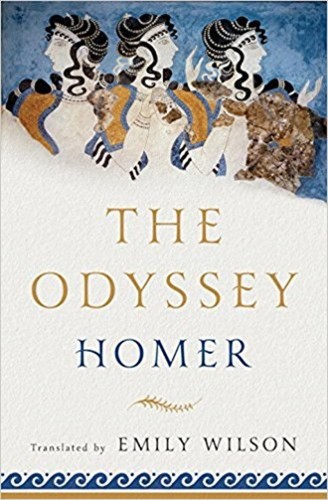
Homer’s first word for Odysseus is polytropos — “complicated,” in Wilson’s lean rendering, where Robert Fagles gave “the man of twists and turns” and Robert Fitzgerald offered “skilled in all ways of contending.” Wilson’s choice matters because it refuses the heroic inflation that has accrued to this figure across twenty-eight centuries of reception. Odysseus is not a man of skill or cunning; he is a man turned many ways, constituted by the turning itself. James Hillman identified the source of this polytropy in the scar on Odysseus’s thigh — a wound received in youth from a boar hunt conducted under his grandfather’s care, a wound that precedes the narrative and belongs to the character’s essence rather than his history. The Latin name Ulixes may derive from oulos (wound) and ischea (thigh): the man is literally named for his injury. Wilson’s translation, by refusing to ornament Odysseus with epithets of grandeur, returns us to this primal fact. Her Odysseus is tired, hungry, weeping on beaches, clinging to wreckage. He is, as Hillman wrote, “a man of little power” who “proceeds by means of depression.” The scar is not incidental to his survival; it is the condition of it. Where Achilles begins invulnerable and must be fatally pierced, Odysseus begins already opened, already marked. This is the difference between a hero and an initiated consciousness. Wilson’s plain, iambic pentameter line — the first English translation of the Odyssey by a woman — strips the poem of the accumulated varnish of Victorian and mid-century heroic diction and reveals what was always underneath: a man whose flesh has become wound.
The Father Who Is at Sea: Odysseus as the Soul’s Paternal Odyssey
Thomas Moore read the Odyssey as the foundational Western narrative of fatherhood-through-initiation. The poem begins not with the father but with the son’s distress — Telemachus surrounded by suitors who devour his patrimony. Moore’s insight is structural: “at that very moment when we feel the confusion of a fatherless life and wonder where he could be, the father has been evoked.” Odysseus is not absent from Ithaca because the gods are cruel; the ten-year sea-wandering is the making of the father. He must encounter the lotus-eaters (the danger of oblivion), the Cyclops (lawlessness without culture), Circe and Calypso (eros in its enchanting and detaining forms), and above all the land of the dead, where he speaks with Tiresias, his mother Anticlea, and the shades of his comrades. This is not adventure; it is initiation. Moore argued that “true fatherhood is evoked not by a flexing of muscle but by initiation into family and culture in a profound, transformative way.” Wilson’s translation makes this legible in a new way because her Odysseus lacks the muscular rhetorical authority of previous versions. When he speaks to Telemachus — “I am your father” — in Wilson’s English the line carries the vulnerability of a man who must prove his identity through scars and stories rather than command it through presence. The father-on-the-sea is also Karl Kerényi’s “journeyer” as distinguished from the mere “traveler”: a figure defined not by destinations but by existential suspension, moving continuously through zones where life and death interpenetrate. Kerényi insisted the Odyssey is “the poem of a kind of life that is permeated with death, in which death is continuously and incessantly present.” Wilson captures this permeation in her refusal of epic buoyancy; her Odysseus is heavy with mortality.
The Union of Sames: How the Odyssey Resolves the Puer-Senex Split That Haunts the Western Psyche
Hillman’s most consequential claim about the Odyssey is that Odysseus resolves “a morbid division fundamental to the Western psyche” — the war between father and son, senex and puer, that Freud universalized as the Oedipal complex and Christianity attempted to heal through the doctrine of Father-Son unity. The genealogical myth of Uranos-Kronos-Zeus is a chain of castrations and devourings; the Biblical patriarchs repeat the pattern. Odysseus escapes this dilemma because the scar holds both poles simultaneously. He is puer — restless, nostalgic, loved by women he leaves, always in danger of drowning — and senex — patient, counseling, enduring, disguised as a beggar. The wound healed into a scar prevents the one-sidedness that would produce either the reckless boy who flames out (Icarus, Phaëthon) or the rigid old man who devours his children (Kronos, Saturn). Robert Bly extended this reading through the lens of male initiation: the boar hunt under the grandfather’s supervision transforms a ritual that once killed the uninitiated boy into one that merely scars him. “There are men who do not survive an encounter with the negative side of the Great Mother, and there are men who do.” The scar is the evidence of survival, and Wilson’s translation — by making Eurycleia’s recognition scene in Book 19 as plain and domestic as a homecoming — lets the initiatory weight of the moment register without mythological pomp. Cody Peterson’s recent work on the “Middle Voice” in Homeric Greek adds another dimension: Odysseus’s address to his own kradiē in Book 20 (“Endure now, my heart”) is neither active mastery nor passive collapse but a third grammatical and psychological operation — the subject situated interior to its own suffering. Wilson translates this as “Bear this, my heart,” preserving the directness of self-address that Peterson identifies as the lost syntax of the thūmos.
The Feminine as Differentiated Presence, Not Magnified Enemy
Hillman observed that the Odyssey presents the feminine in a way no other Greek epic does — not as the Great Mother to be battled or worshipped, but as a differentiated field of individual figures: Athena (goddess-guide), Calypso (detaining mistress), Circe (enchantress), Nausicaa (anima-renewal), Anticlea (personal mother), Eurycleia (nurse-recognizer), Penelope (wife-weaver). Wilson’s translation is the first to render these women with full psychological interiority rather than as decorative or threatening archetypes. Her Penelope is shrewd, exhausted, politically strategic; her Calypso is angry at the double standard of the gods; her Circe is practical. This matters because, as Hillman argued, when the feminine is kept in proportion — neither magnified into dragon nor idealized into savior — it can “weave together puer and senex, rather than divide them further.” Penelope’s nightly unraveling of the shroud she weaves by day is the poem’s deepest image of soul-work: the refusal of premature completion, the insistence that the opus cannot be finished until the transformation is genuine. Wilson renders this not as passive deception but as active, exhausting labor — a woman holding open the space of possibility against enormous pressure to close it.
Why This Translation Matters Now
Wilson’s Odyssey matters for the depth psychological tradition not because it is “accessible” — the usual praise — but because its linguistic austerity forces a confrontation with the poem’s actual psychological content. Previous translations inflated Odysseus into the hero our culture wanted; Wilson returns him to the wounded, weeping, complicated man Homer composed. For readers of Hillman, Kerényi, Moore, and Bly, this translation is the first in English that makes their interpretations feel self-evident rather than imposed. It is the Odyssey that depth psychology always knew was there, finally audible in its own tongue.
Sources Cited
- Homer. (2017). The Odyssey (E. Wilson, Trans.). W. W. Norton. ISBN 978-0-393-35625-0.
- Pucci, P. (1987). Odysseus Polutropos: Intertextual Readings in the Odyssey and the Iliad. Cornell University Press.
- Detienne, M., & Vernant, J.-P. (1978). Cunning Intelligence in Greek Culture and Society. University of Chicago Press.