 Seba.Health
Key Takeaways
- Jaynes does not merely propose a theory of consciousness but dismantles the assumption that subjective interiority is a biological constant, forcing depth psychology to confront the possibility that the "unconscious" is not a timeless structure but a historical residue of a prior mode of mind.
- The bicameral mind is not a primitive deficiency but a fully functional psychic architecture in which auditory hallucination served the same organizing role that ego-consciousness later assumed—making Jaynes's "gods" structurally equivalent to what Jung called archetypes operating autonomously before the ego's consolidation.
- Jaynes's account of consciousness as a learned, linguistically constructed metaphor-space inverts the Jungian developmental narrative: where Neumann sees consciousness emerging organically through archetypal stages, Jaynes sees it as a catastrophic cultural invention born from the collapse of authoritative hallucination under historical stress.
The Gods Were Not Symbols but Operating Systems, and Their Silence Created the Psyche
Julian Jaynes’s central provocation is not that ancient peoples heard voices—anthropology and psychiatry already knew that—but that these voices were the governing executive function of the mind before subjective consciousness existed. The bicameral mind, as Jaynes reconstructs it, operated through a right-hemisphere auditory command system that humans experienced as divine speech. There was no introspection, no narratizing self, no internal “I” deliberating among options. The gods spoke and the body obeyed. This is not a metaphor for religious experience; it is a structural claim about cognition. The Iliad, Jaynes demonstrates with painstaking philological analysis, contains no words for subjective mental states. Agamemnon does not “decide” to take Briseis; a god tells him to act. What Jaynes recovers in Homer is not poetic convention but the residual grammar of a mind without an interior narrator.
The implications for depth psychology are seismic. Erich Neumann, in The Origins and History of Consciousness, constructs an evolutionary account of ego-emergence through archetypal stages—uroboros, Great Mother, hero—treating the collective unconscious as a permanent substrate from which consciousness differentiates organically. Jung himself, in his foreword to Neumann, celebrates this as placing “the concepts of analytical psychology on a firm evolutionary basis.” Jaynes shatters this framework by proposing that the archetypal voices Neumann and Jung treat as eternal psychic structures were once the only mode of mental operation, not a layer beneath consciousness but consciousness’s predecessor. The unconscious, on Jaynes’s account, is not an underworld that was always there; it is what remains after the executive hallucinations stopped. The gods did not retreat into the unconscious—the unconscious was created by their departure. This inversion is the book’s deepest challenge to Jungian thought: the archetypes may not be primordial so much as orphaned.
Consciousness as Metaphor-Space Exposes the Constructed Nature of the Ego That Depth Psychology Takes for Granted
Jaynes’s second radical move is his theory of consciousness itself. Subjective awareness, he argues, is not perception, not sensation, not even learning—all of which bicameral humans possessed. Consciousness is specifically the capacity to generate an analog “I” that narratizes experience within an internally constructed metaphor-space. It depends entirely on language, specifically on the metaphorical extension of spatial and physical terms into mental vocabulary. We “see” a point, “grasp” an idea, “feel” our way through a problem. This metaphor-space is not the brain; it is a culturally transmitted linguistic construction that arose, Jaynes argues, in the centuries between the collapse of the Bronze Age palatial civilizations and the emergence of Greek philosophical thought—roughly 1200 to 600 BCE.
This thesis puts Jaynes in direct, if unintended, dialogue with James Hillman’s assault on ego-centered psychology. In Re-Visioning Psychology, Hillman insists that “ego consciousness as we used to know it no longer reflects reality” and that the ego “has become a delusional system.” Hillman pathologizes the ego’s claim to centrality from within the tradition; Jaynes historicizes it from outside. If consciousness is a metaphor-space that humans learned to inhabit only three thousand years ago, then the heroic ego that Neumann charts emerging through mythological stages is not an archetypal inevitability but a specific cultural technology—one that could, in principle, be superseded or dissolved. Hillman’s call to move beyond the “heroic age in psychology” and into the “vale of Soul-making” acquires unexpected empirical grounding in Jaynes’s chronology. The gods that Hillman wants to “release from the complexes” were, for Jaynes, never in the complexes—they were the original inhabitants of the mind, and the complexes are their tombs.
The Breakdown Was Not a Fall but a Trauma, and Depth Psychology Is Its Therapy
Jaynes dates the breakdown of bicamerality to specific historical catastrophes: volcanic eruptions, invasions, mass migrations, the collapse of hierarchical theocratic states that had sustained the bicameral social order. When the voices stopped being reliable—when the god of a destroyed city could no longer command its displaced refugees—humans were forced to develop the interior narratizing self as a substitute executive. Consciousness, in this reading, is an emergency adaptation, born not from growth but from catastrophe. The parallels to trauma theory are unmistakable: the dissociative voices heard by trauma survivors, the hallucinatory commands, the loss of narrative coherence—these are not merely analogies but potential vestiges of a prior cognitive architecture reactivating under stress.
Richard Tarnas, in Cosmos and Psyche, describes the modern predicament as a “primal rupture” between self and world, subject and object, psyche and cosmos—a chasm that depth psychology has struggled to bridge. Jaynes’s work suggests this rupture has a precise historical origin: it is the scar left by the breakdown of bicamerality. The entire enterprise of depth psychology—from Freud’s discovery of the unconscious through Jung’s encounter with autonomous psychic contents to Hillman’s insistence on the reality of imaginal persons—can be read as a sustained, if largely unwitting, attempt to reconnect with what was lost when the gods fell silent. Robert Bosnak’s work on embodied imagination, with its insistence that dream figures are “beings in their own right, with their own intentions,” echoes Jaynes’s description of bicameral hallucinations as autonomous agents that the subject experienced as wholly other. Bosnak’s teacher Henry Corbin mourned the disappearance of “substantive Images” from Western awareness around the thirteenth century; Jaynes pushes that disappearance back two millennia further, to the Bronze Age collapse itself.
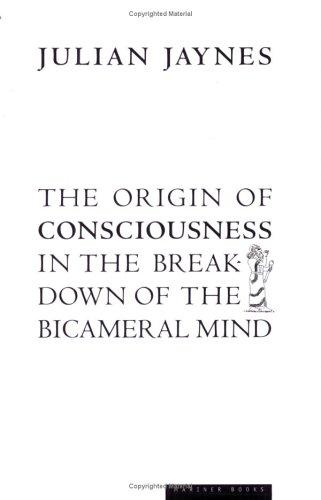
What makes The Origin of Consciousness in the Breakdown of the Bicameral Mind irreplaceable is not its correctness—much of its neuroscience is outdated, and its philological claims remain contested—but its capacity to denaturalize consciousness itself. No other book in the depth psychological orbit performs this operation with such specificity. Where Jung and Neumann treat the emergence of consciousness as a mythological narrative to be amplified, and where Hillman treats ego-consciousness as an imaginative stance to be relativized, Jaynes treats it as an invention with a date, a cause, and a set of historical consequences that are still unfolding. For anyone working within depth psychology today, this book poses the question that the tradition has circled but never directly confronted: What if the psyche’s deepest longing is not for wholeness but for the return of the voices that once made wholeness unnecessary?
Sources Cited
- Jaynes, J. (1976). The Origin of Consciousness in the Breakdown of the Bicameral Mind. Houghton Mifflin. ISBN 978-0-618-05707-8.
- Snell, B. (1953). The Discovery of the Mind: The Greek Origins of European Thought. Harvard University Press.
- McGilchrist, I. (2009). The Master and His Emissary: The Divided Brain and the Making of the Western World. Yale University Press.