 Seba.Health
Key Takeaways
- Nussbaum's central argument is not that luck undermines ethics but that the philosophical tradition from Plato onward constitutes a sustained campaign to make the soul invulnerable to fortune—and that Greek tragedy preserves precisely the ethical knowledge this campaign destroys.
- The book reframes the entire history of Greek moral philosophy as a contest between two incompatible models of human excellence: one that requires exposure to contingency (tragic) and one that demands immunity from it (Platonic-Stoic), making it a diagnosis of Western philosophy's foundational neurosis.
- By rehabilitating Aristotle as the thinker who refused to choose between vulnerability and rationality, Nussbaum offers a philosophical anthropology remarkably consonant with depth psychology's insistence that the soul is forged through what it cannot control—not despite it.
The Philosophical War Against Vulnerability Is the Origin Story of Western Psychology’s Deepest Pathology
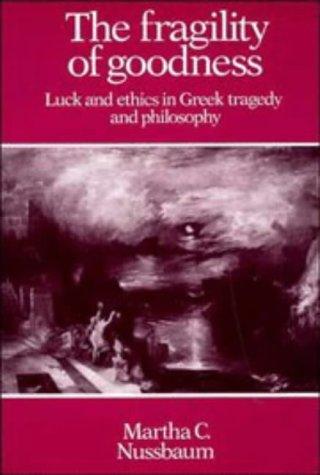
Martha Nussbaum’s The Fragility of Goodness accomplishes something rare in academic philosophy: it identifies a pathology operating at the root of the Western ethical tradition and traces its etiology with the precision of a clinician. The pathology is the drive toward invulnerability—the conviction, first articulated by Plato and later perfected by the Stoics, that the truly good human life must be rendered immune to luck, circumstance, loss, and the uncontrollable actions of others. Nussbaum demonstrates that this drive is not a neutral philosophical preference but an active mutilation of moral experience, one that severs ethical life from the very conditions—love, political engagement, embodied perception, dependence on others—that give it content. The book reads Greek tragedy not as a primitive predecessor to philosophical ethics but as its most sophisticated rival, one that insists human goodness is constitutively fragile: it requires exposure to forces that can destroy it. Aeschylus’s Agamemnon faces a genuinely impossible choice; Euripides’ Hecuba is undone not by moral failure but by catastrophic fortune. These are not illustrations of ethical weakness. They are demonstrations that certain forms of human excellence—loyalty, love, practical wisdom—cannot exist without the vulnerability that also makes ruin possible. Nussbaum’s argument converges strikingly with what Cody Peterson calls the “Three Constraints” of mortality—permanent loss, radical uncertainty, utter powerlessness—and with his claim that the soul is “the residue of convergence, what remains when the fire has passed through and the vessel has held.” Where Peterson locates this insight in Homeric grammar, Nussbaum locates it in the structure of Greek tragic plot.
Plato’s Republic Is Not a Political Text but a Therapeutic Fantasy of Escape from Tuchē
Nussbaum’s reading of Plato is the most provocative and least appreciated dimension of the book. She argues that the middle dialogues—especially the Republic and Symposium—represent a systematic attempt to redesign the human soul so that it no longer depends on anything it cannot control. The philosopher-king’s education is designed to eliminate attachment to particular persons, sensory beauty, and political fortune. The ascent in the Symposium moves from love of a single beautiful body to love of Beauty itself—a progression that explicitly requires the lover to abandon the particular beloved. Nussbaum reads this not as spiritual elevation but as a defense mechanism of extraordinary philosophical sophistication. Plato saw clearly that love of particulars exposes the soul to devastation; his solution was to redirect eros toward objects that cannot be lost. This is the philosophical equivalent of what Hillman diagnosed as the ego’s Apollonic resistance to Dionysian dissolution—the compulsive drive to impose structure, hierarchy, and order on psychic life precisely where the soul demands multiplicity, vulnerability, and immersion in the concrete. Hillman’s insistence that “psychological polytheism” reflects the soul’s actual condition more accurately than monotheistic wholeness parallels Nussbaum’s claim that the tragic poets understood ethical life more deeply than the philosopher who sought to transcend it. Plato’s metaphysics, in Nussbaum’s reading, is not a discovery of eternal truth but a flight from tuchē—from the irreducible role of fortune in human flourishing.
Aristotle’s Refusal to Choose Between Reason and Vulnerability Is the Philosophical Ground of Depth Psychology
The book’s deepest contribution lies in its rehabilitation of Aristotle as the thinker who held both truths simultaneously: that practical wisdom is the highest human activity and that it requires exposure to conditions the wise person cannot guarantee. Aristotle’s concept of eudaimonia is not “happiness” in any modern hedonic sense but a life of excellent activity that remains structurally dependent on external goods—friends, political stability, health, children who do not die before you. Nussbaum shows that Aristotle refuses both the tragic fatalism that would make human excellence entirely hostage to fortune and the Platonic flight that would make it entirely independent of fortune. This refusal to collapse into either pole is precisely what Peterson identifies as the Middle Voice: the stance that emerges when neither mastery nor submission remains available. Aristotle’s phronimos—the person of practical wisdom—does not transcend contingency; he perceives correctly within it. His excellence consists in a quality of responsiveness to the particular situation that no rule or algorithm can capture. This is why Nussbaum insists that emotions are forms of ethical perception, not obstacles to it: grief at a friend’s death is not a failure of reason but a recognition of value that only a vulnerable soul can register. Edinger’s account of Greek philosophy as the tracking of “living psychic organisms” that undergo “differentiation and evolution as various minds grapple with them” applies directly here—Aristotle’s ethics is one of the few ancient systems that preserves the living, felt dimension of moral life rather than desiccating it into abstraction.
Tragedy Is Not a Genre but an Epistemology, and Its Loss Impoverishes Modern Psychology
Nussbaum’s account of katharsis deserves particular attention. Against the standard purgation reading—where tragedy cleanses the audience of dangerous emotions—she argues that the term’s “primary, ongoing, central meaning is roughly one of ‘clearing up’ or ‘clarification.’” Hillman cites this interpretation directly in his Oedipus Variations, recognizing its significance for archetypal psychology. If tragedy clarifies rather than purges, then the emotions it arouses—pity, fear, grief—are not toxins to be expelled but instruments of understanding. The tragic audience learns something about human life through its emotional response that could not be learned any other way. This epistemological claim has enormous consequences for depth psychology. It means that the painful affects encountered in analysis are not symptoms to be resolved but perceptions to be sharpened. Liz Greene’s account of Moira as the “minion of justice”—fate understood not as arbitrary doom but as the inexorable pattern connecting beginnings to their necessary ends—captures the same insight from the astrological tradition. The Greek tragic poets knew that the soul’s education requires submission to forces that the ego would prefer to master or flee. Nussbaum gives this knowledge its fullest philosophical articulation.
For anyone working within depth psychology today, The Fragility of Goodness provides something no psychological text alone can offer: a rigorous philosophical demonstration that the Western ethical tradition’s deepest pathology—the compulsion to render the soul invulnerable—is not a modern invention but a 2,400-year-old project initiated by Plato and still operating in every therapeutic framework that treats suffering as a problem to be solved rather than a condition of being fully human. Nussbaum proves, with the full apparatus of classical scholarship, that the tragic poets understood what the philosophers forgot: that goodness without fragility is not goodness at all but a sophisticated form of death.
Sources Cited
- Nussbaum, M. C. (1986). The Fragility of Goodness: Luck and Ethics in Greek Tragedy and Philosophy. Cambridge University Press.
- Aristotle. Nicomachean Ethics (various editions).
- Williams, B. (1981). Moral Luck. Cambridge University Press.