 Seba.Health
Key Takeaways
- Armstrong's central intervention is not comparative theology but a demonstration that every "God" ever worshipped is a human artifact of the creative imagination — and that this fact, far from diminishing the divine, is precisely what the most sophisticated monotheists across all three Abrahamic traditions have always understood.
- The book reveals that the so-called "death of God" in Western modernity was not the death of the divine but the collapse of a single, historically aberrant theological strategy: treating God as an empirically verifiable object — a strategy that mystics in Judaism, Christianity, and Islam had warned against for centuries.
- Armstrong quietly dismantles the secularist assumption that religion was imposed on a "primordially secular" human nature, reframing Homo sapiens as Homo religiosus and positioning modern secularism itself as an untested experimental condition whose psychological consequences remain unknown.
The God That Dies Is Always an Idol: Armstrong’s History as Depth-Psychological Diagnosis
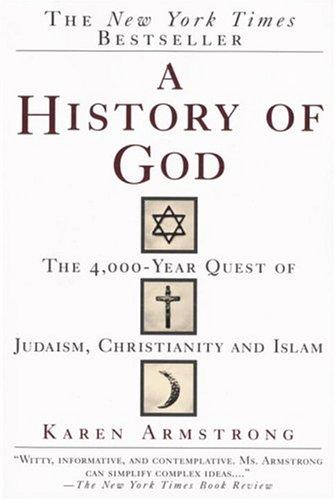
Karen Armstrong’s A History of God operates on a deceptively simple premise: the word “God” has never referred to one stable reality, and tracing its shifting referents across 4,000 years of Jewish, Christian, and Islamic thought reveals more about the structure of human consciousness than about any transcendent being. Armstrong states this with characteristic directness: “The statement ‘I believe in God’ has no objective meaning, as such, but like any other statement only means something in context, when proclaimed by a particular community.” This is not relativism. It is the recognition that God-concepts are psychic productions — images created by the human imagination to symbolize an experience of transcendence that, by definition, exceeds every image. The mystics knew this. Ibn al-Arabi spoke of the imagination creating its own experience of the uncreated. The Kabbalists insisted the Ein Sof could not be named. The apophatic theologians of Eastern Christianity built silence into the heart of their method. Armstrong’s history is, at its core, the story of how this insight was repeatedly gained, lost, and regained — and of what happens when a civilization forgets it entirely. Read alongside Edward Edinger’s The Creation of Consciousness, the parallel is striking: what Edinger calls the ego-Self axis — the fragile, dynamic relationship between finite awareness and the transpersonal ground — is precisely the theological relationship Armstrong describes between the human concept and the ineffable reality it symbolizes. When that relationship collapses into identification, the result is idolatry. When it dissolves entirely, the result is the nihilistic despair Armstrong identifies at the close of her book.
The Western God Was Killed by His Own Theologians, Not by His Enemies
Armstrong’s most devastating argument concerns the Enlightenment, but her real target is the centuries of Western Christian theology that made the Enlightenment’s atheism inevitable. She traces a fateful trajectory: beginning with the Greek philosophical tradition absorbed by Christianity, Western theologians increasingly treated God as a being among beings — “one of the things that existed” — who could be demonstrated through rational argument and empirical evidence. The God of the design argument, the God of Newton’s absolute space, the God invoked to fill gaps in scientific knowledge: all of these were, Armstrong shows, betrayals of the apophatic tradition that Jews, Muslims, and Eastern Christians had maintained. When Diderot, Holbach, and Laplace dismantled these arguments, they “came to the same conclusion as the more extreme mystics: there was nothing out there.” The irony is exquisite. The Enlightenment atheists were not wrong; they were demolishing an idol that the mystics had already refused to worship. Armstrong quotes Holbach’s savage characterization — God as “un homme puissant,” a divine despot terrorizing his human creators — and recognizes it as a precise description of the projected, anthropomorphic deity that the Sufi, Kabbalistic, and hesychast traditions had spent centuries transcending. This resonates powerfully with Jung’s warning in Answer to Job that a God-image unredeemed by conscious differentiation becomes demonic. The Western God was not murdered by secularism; he was suffocated by literalism.
Homo Religiosus and the Vacuum That Fundamentalism Fills
Armstrong’s framing of the human being as Homo religiosus — “spiritual animals” who created religions simultaneously with works of art — places her work in direct conversation with Joseph Campbell’s mythological corpus, which she explicitly references, and with the archetypal psychology of James Hillman. But Armstrong goes further than Campbell in one crucial respect: she treats the modern secular experiment not as liberation but as a condition of unprecedented psychological risk. “Our current secularism is an entirely new experiment, unprecedented in human history. We have yet to see how it will work.” The closing pages of the book are haunted by the evidence that it is not working well. The “God-shaped hole” she describes is not a sentimental metaphor but a diagnostic observation: the escalating rates of addiction, anomie, and violence in ostensibly religious America, the “growing blankness” in secular Europe, the rise of fundamentalism as a desperate attempt to fill the vacuum with rigid, literalist idols. Armstrong is explicit that “human beings cannot endure emptiness and desolation; they will fill the vacuum by creating a new focus of meaning.” This aligns precisely with Gabor Maté’s analysis in In the Realm of Hungry Ghosts, where addiction is understood not as moral failure but as the predictable response of a meaning-deprived organism. The hunger is the same; only the substances differ. Armstrong’s history suggests that when a culture loses the capacity to create and sustain living symbols of transcendence, the psyche does not become secular — it becomes desperate.
What Makes This Book Irreplaceable
The book’s final and perhaps most radical claim is that the creative imagination is not the enemy of authentic spirituality but its primary instrument. Armstrong learned this from the mystics she studied: “I should deliberately create a sense of him for myself.” God is, in the most rigorous sense, a work of art — not a falsehood but a disciplined act of imaginative engagement with a reality that cannot be apprehended any other way. This places Armstrong’s work alongside Keats’s doctrine of Negative Capability and Wordsworth’s “wise passiveness,” both of which she discusses at length, but it also connects her to Jung’s concept of active imagination as the bridge between ego-consciousness and the archetypal unconscious. No other single volume covers the full 4,000-year arc of monotheistic God-making with this particular lens: not theological apologetics, not reductive debunking, but a careful phenomenology of the human imagination at work on the deepest question it has ever posed. For anyone working in depth psychology, trauma studies, or addiction research, Armstrong’s history is indispensable not because it tells you what God is, but because it shows you what happens — historically, culturally, psychologically — when the symbol-making capacity atrophies, and the living God hardens into a dead idol or dissolves into nothing at all.
Sources Cited
- Armstrong, K. (1993). A History of God: The 4,000-Year Quest of Judaism, Christianity and Islam. Knopf. ISBN 978-0-345-38456-0.
- Jung, C. G. (1952). Answer to Job (CW 11). Princeton University Press.
- Otto, R. (1917). The Idea of the Holy (J. W. Harvey, Trans.). Oxford University Press.