 Seba.Health
Key Takeaways
- Turner's central achievement is not the concept of liminality itself but the demonstration that anti-structure is generative—that the dissolution of social classification is the precondition for symbolic, artistic, and religious creativity, making communitas the psychic birthplace of culture rather than its negation.
- The binary of structure and communitas maps directly onto the tension between ego-consolidation and ego-dissolution that drives depth psychology, positioning Turner's ethnographic work as an independent discovery of the same dialectic Jung theorized as the ego-Self axis and Neumann charted as the stages of consciousness.
- Turner's distinction between spontaneous, normative, and ideological communitas provides the missing sociological grammar for understanding why every transformative psychological or spiritual movement—from Franciscan poverty to the counterculture—inevitably "declines and falls" into the very structure it arose to transcend.
Anti-Structure Is Not Disorder but the Generative Ground of Symbolic Life
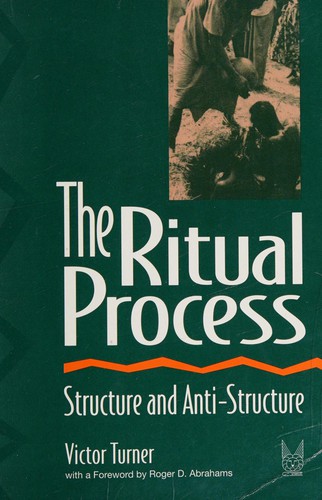
Victor Turner’s The Ritual Process is routinely cited for its vocabulary—liminality, communitas, anti-structure—yet the book’s true argument is far more radical than the portable terms suggest. Turner does not merely identify a phase in ritual sequence; he demonstrates that the dissolution of social classification is itself the engine of cultural production. His binary table contrasting liminality with the status system—totality/partiality, homogeneity/heterogeneity, nakedness/distinctions of clothing, foolishness/sagacity—is not a description of temporary chaos. It is an anatomy of the conditions under which myth, symbol, ritual, and art come into existence. “Rules that abolish minutiae of structural differentiation… liberate the human structural propensity and give it free reign in the cultural realm of myth, ritual, and symbol.” This is the book’s foundational claim: that where social structure simplifies, symbolic structure amplifies. The liminal space is not a void but a crucible. Turner here converges with Jung’s insight that the collapse of persona—the social mask, the structural role—is the precondition for encounter with the deeper psyche. Where Jung describes the confrontation with the shadow and the emergence of archetypal imagery during the dissolution of conscious attitudes, Turner describes the identical process operating at the collective, ritual level among the Ndembu. The mukanda seclusion lodge and the Jungian night sea journey are structurally homologous: both strip the subject of name, rank, and property in order to produce symbolic knowledge inaccessible from within the everyday status system.
Communitas Is the Sociological Name for What Depth Psychology Calls the Numinous
Turner’s invocation of Buber’s I-Thou relation to characterize communitas is not decorative philosophical window-dressing. It marks the precise point where his anthropology intersects the phenomenology of the sacred. Communitas, he insists, “has an existential quality; it involves the whole man in his relation to other whole men,” and it generates “symbols and metaphors and comparisons; art and religion are their products rather than legal and political structures.” This is, in different terminology, Rudolf Otto’s mysterium tremendum—the overwhelming encounter with a reality that exceeds categorical thought. It is also what Erich Neumann, in The Origins and History of Consciousness, identifies as the participation mystique that precedes ego-differentiation: the undifferentiated matrix out of which structured consciousness crystallizes and to which it must periodically return for renewal. Turner’s genius is to show this return operating not only in individual psychic development but in the institutional life of societies through calendrical rites, status reversals, and initiation sequences. The Ashanti Apo ceremony, in which commoners publicly berate chiefs and the “high must submit to being humbled,” is not mere social catharsis. It is the ritual mechanism by which a society re-contacts its own communitas ground—the felt sense of undifferentiated human solidarity beneath hierarchical classification. The old high priest’s explanation that speaking one’s grievances “cools” the sunsum (soul) of both speaker and target reads like a clinical description of what James Hillman would call the psyche’s insistence on moving image and affect through relationship rather than containing them in isolated interiority.
The Decline of Communitas into Structure Is the Central Tragedy Turner Identifies—and the One Depth Psychology Perpetually Reenacts
Turner’s threefold typology—spontaneous communitas, normative communitas, ideological communitas—carries a melancholic teleology. Spontaneous communitas is “William Blake’s ‘winged moment as it flies’”; normative communitas is its bureaucratization; ideological communitas is its rationalization into utopian blueprint. “It is the fate of all spontaneous communitas in history to undergo what most people see as a ‘decline and fall’ into structure and law.” This trajectory maps with uncanny precision onto the routinization of charisma Weber described, but Turner localizes it in embodied ritual experience rather than political sociology. More provocatively, it describes the fate of every depth-psychological movement. Jung’s original circle at Küsnacht—its atmosphere of mutual discovery, its liminal seminars, its Buber-like confrontations between whole persons—calcified into the institutional structures of Jungian training institutes, complete with hierarchies, credentialing systems, and orthodoxies. The same pattern governs Alcoholics Anonymous, whose early meetings embodied the raw communitas of shared vulnerability before hardening into the normative structure of twelve-step protocol. Turner would recognize in Bill Wilson’s Oxford Group origins the identical dynamic he traced in the early Franciscans: Francis of Assisi’s radical poverty as spontaneous communitas, the Franciscan Rule as normative communitas, and the later theological justifications of mendicancy as ideological communitas. The structural iron law applies: every attempt to institutionalize the liminal destroys its transformative potency while preserving its outward form.
Turner Reveals That the Permanently Weak Carry the Culture’s Regenerative Power
The book’s most politically charged and psychologically resonant claim concerns the relationship between structural inferiority and sacred power. “Communitas breaks in through the interstices of structure, in liminality; at the edges of structure, in marginality; and from beneath structure, in inferiority.” Prophets and artists are “liminal and marginal people, ‘edgemen,’ who strive with a passionate sincerity to rid themselves of the clichés associated with status incumbency.” This is not romantic primitivism. Turner grounds it in specific ethnographic data: the Zulu umkubulwana ceremony where young women usurp male authority to restore cosmic balance disrupted by the structural dissensions of powerful men; the Ndembu chief-elect reduced to slave status before installation. The pattern recurs across cultures because it addresses a psychic necessity that no amount of structural sophistication eliminates. Neumann’s The Great Mother documents the same principle archetypally: the chthonic feminine, structurally subordinated, carries the regenerative power that the solar-heroic ego cannot generate from within its own differentiated position. Turner provides the social-ritual evidence for what depth psychology has theorized intrapsychically.
For readers formed in the depth-psychological tradition, The Ritual Process accomplishes something no purely clinical or mythological text can: it shows the psyche’s transformative mechanisms operating in full social context, with real political consequences and real communal stakes. Turner demonstrates that the dialectic between structure and anti-structure is not a metaphor borrowed from social science to decorate psychological theory—it is the living process through which human communities generate meaning, renew themselves, and confront the terrifying creative potential that lies beneath every stable identity. No other single work so precisely bridges the gap between Jungian individuation theory and the anthropological reality of how cultures metabolize crisis through ritual form.
Sources Cited
- Turner, Victor (1969). The Ritual Process: Structure and Anti-Structure. Aldine Publishing.
- Van Gennep, Arnold (1909). The Rites of Passage. Trans. M.B. Vizedom and G.L. Caffee. University of Chicago Press, 1960.