 Seba.Health
Key Takeaways
- Craig's *How Do You Feel?* provides the neuroscientific substrate for what Jung intuited a century ago: that feeling is not a derivative of cognition but a primary mode of conscious representation rooted in the body's homeostatic architecture, vindicating the Jungian insistence on feeling as a rational function equal to thinking.
- The book's identification of the anterior insular cortex as the neural seat of subjective feeling states reframes the entire debate between Hillman's critique of "feeling as God" and von Franz's call for a "therapy of feeling"—neither personal confession nor imaginal dissolution, but an embodied interoceptive awareness that is neither ego nor archetype but the material condition for both.
- Craig's homeostatic model of sentience inadvertently resolves a tension within depth psychology: the claim that feelings are "not ours" (Hillman, von Franz) finds anatomical grounding in the discovery that subjective feeling emerges from phylogenetically ancient sensory pathways shared across primates, making the collective and transpersonal dimension of feeling a neurobiological fact rather than a metaphysical assertion.
Feeling Is Not an Epiphenomenon but the Foundation of Sentience, and Neuroscience Finally Caught Up to Jung
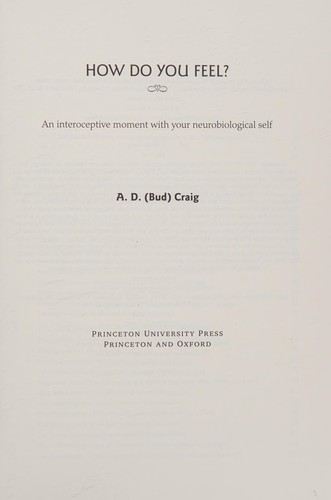
A.D. (Bud) Craig’s How Do You Feel? An Interoceptive Moment with Your Neurobiological Self (2015) is the most consequential neuroscientific treatise on subjective feeling published in this century, and it arrives as an unwitting vindication of a claim C.G. Jung made in 1921: that feeling is a rational function of consciousness, not a primitive eruption from below. Craig, a neuroanatomist at the Barrow Neurological Institute, spent decades tracing the lamina I spinothalamocortical pathway—the afferent system that carries signals about the physiological condition of the body (temperature, pain, itch, visceral sensations, muscle effort) to the posterior insular cortex, and thence, through progressive re-representation, to the anterior insular cortex, where these signals become conscious feeling states. The thesis is stark: subjective awareness of “how you feel” at any given moment is not an add-on to cognition but the evolutionary basis of sentience itself. Feeling, in Craig’s model, is what consciousness fundamentally is—an integrated homeostatic representation of the organism’s state. This resonates directly with what Hillman and von Franz argued in their joint lectures on feeling: that “feeling has lain like a buried continent in the collective psyche,” and that psychology’s great failure has been to reduce it to hedonic tone, to like-dislike, to the confessional outpourings of encounter groups. Craig provides the anatomical map of that buried continent. Where Jung differentiated feeling from sensation, intuition, and thinking through clinical observation and the word-association experiment, Craig differentiates interoception from exteroception at the level of neural architecture, showing that the pathways for “how the body feels” are categorically distinct from those for “what is out there.” The convergence is not incidental; it is structural.
The Anterior Insular Cortex Is the Organ of What Jung Called the Feeling Function
Craig’s central anatomical claim is that the anterior insular cortex (AIC) integrates all interoceptive, affective, and motivational signals into a unified “global emotional moment”—a felt sense of the self-in-the-world that updates roughly every 125 milliseconds. This is not emotion in the pop-psychological sense. It is closer to what von Franz described as the “time sense connected with the feeling function,” that “feel” to each discrete moment which “turns a case history into a soul history, a chain of events into a patterned rhythm.” Craig’s imaging data show that the AIC activates during every experience that involves subjective evaluation: aesthetic judgment, moral decision, empathic response, awareness of one’s own heartbeat, the recognition that something matters. The function Craig describes is precisely what Jung called feeling: “a process of evaluation according to subjective criteria.” The difference is that Craig can show where it happens in the brain, and he can show that it operates as a Gestalt—not a string of hedonic simples but an integrated melody of body-state awareness. This directly supports Hillman’s insistence, drawn from von Franz, that “feeling plays its tune, and a different tune in accord with each situation and with the values implicit in the situation itself.” The neuroscience and the depth psychology describe the same phenomenon from opposite ends of the epistemological corridor.
Craig Dissolves the Cartesian Split That Hillman Diagnosed but Could Not Anatomically Ground
Hillman’s critique in Re-Visioning Psychology targeted the identification of psyche with personal feeling—the “little self-important man at the great sea’s edge, turning to himself to ask how he feels today, filling in his questionnaire.” Hillman saw this as a degenerate Romanticism, a collapse of soul into ego-feeling. Craig’s work provides a surprising resolution. The interoceptive self that Craig describes is not the ego. It is not the narrative self of autobiography. It is a pre-reflective, body-based awareness that exists in all sentient creatures with a lamina I pathway—primates, certainly, but elements of it in all mammals. This means the feeling-self is phylogenetically older and structurally deeper than the ego. When Hillman argued that feelings “are not merely personal but belong to imaginal reality,” and when von Franz insisted that “feelings are not only personal; they reflect historical and universal phenomena,” they were groping toward a truth that Craig’s neuroanatomy makes explicit: the substrate of feeling is shared, species-wide, and operates beneath the level of personal ownership. The “delusion of ownership of emotion” that Hillman diagnosed as the great pathology of humanistic psychology turns out to have an anatomical correlate: the AIC generates a sense of feeling that is always already transpersonal in its origins, even as it is experienced as intimately “mine.” Craig does not use depth-psychological language, but his model implies that the ego’s claim on feeling is a secondary appropriation of a primary organismic process—precisely the “satanic selfhood” Hillman warned against when he wrote that “the ego who owns what is archetypal” commits a psychological sin.
Why This Book Matters for Depth Psychology Now
Craig’s work matters for anyone encountering depth psychology today because it closes a gap that has haunted the tradition since Jung first proposed feeling as a rational function. That proposal was dismissed by academic psychology as mystical, subjective, unfalsifiable. Craig has falsified the dismissal. The feeling function is not a metaphor; it has a neural address, a developmental trajectory, a comparative anatomy across species, and a pathology (alexithymia, depersonalization, anorexia) that maps onto disruptions in the interoceptive pathway. For clinicians working in the Jungian or post-Jungian tradition, this means the “therapy of feeling” that Hillman called for—not therapy through feeling but therapy of feeling—now has a neuroscientific partner. The education of the feeling function that von Franz described as the great unfinished project of Western culture can be understood not only as a cultural or imaginal task but as a matter of interoceptive training, of learning to attend to the body’s homeostatic signals with the same precision one might bring to thinking or sensation. Craig’s book does not replace the depth-psychological account; it grounds it in flesh, in lamina I fibers, in the insular cortex’s progressive elaboration of what it feels like to be alive. No other work in contemporary neuroscience accomplishes this with equivalent rigor or equivalent relevance to the psyche.
Sources Cited
- Craig, A.D. (2015). How Do You Feel? An Interoceptive Moment with Your Neurobiological Self. Princeton University Press. ISBN 978-0-691-15676-7.
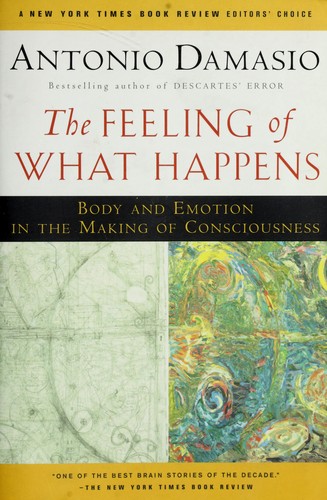
- Damasio, A. (1999). The Feeling of What Happens: Body and Emotion in the Making of Consciousness. Harcourt.
- Craig, A.D. (2009). How do you feel — now? The anterior insula and human awareness. Nature Reviews Neuroscience, 10(1), 59–70.