 Seba.Health
Key Takeaways
- Damasio's nested model of proto-self, core consciousness, and extended consciousness provides neuroscience with what Jung's type theory attempted philosophically: a structural account of how the organism becomes a subject capable of knowing that it knows.
- The book's central thesis—that emotion is not opposed to reason but constitutive of it—dismantles the Cartesian split not through phenomenological argument but through lesion studies and somatic marker evidence, grounding what Hillman called "feeling consciousness" in verifiable neural architecture.
- By locating the origins of selfhood in the body's homeostatic regulation rather than in cortical narrative, Damasio inadvertently provides biological scaffolding for the depth psychological claim that the psyche is not "in" the head but distributed through the sensing, feeling organism—a vindication of embodied imagination as described by Bosnak and the anima mundi tradition Hillman championed.
Consciousness Is Not a Light Switched On but a Feeling Generated by the Body Mapping Itself
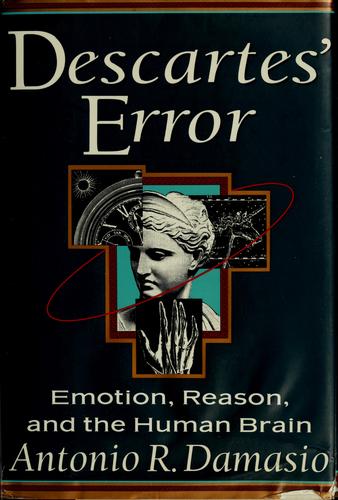
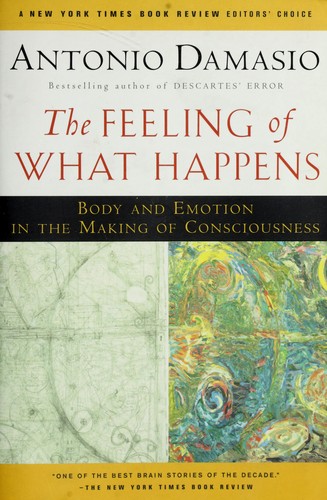
Damasio’s central provocation in The Feeling of What Happens is deceptively simple: consciousness arises not from thought but from feeling, and feeling arises not from cognition but from the body’s continuous self-representation. The “feeling of what happens” is not an epiphenomenal glow atop neural computation; it is the mechanism by which an organism first becomes a self at all. Damasio constructs a three-tiered architecture—proto-self, core self, and autobiographical self—in which consciousness emerges through successively more complex maps of the organism’s internal states. The proto-self is a pre-conscious, moment-to-moment neural mapping of the body’s viscera, musculature, and internal milieu. Core consciousness ignites when the organism registers that its own proto-self has been modified by an encounter with an object: a second-order representation, a feeling about a change in feeling. Extended consciousness then weaves these transient pulses into the narrative continuity we call identity. What makes this radical is the sequence: the body comes first, emotion is the bridge, and the narrating “I” arrives last. This directly overturns the Cartesian assumption—still ambient in cognitive science—that consciousness begins with thinking and that feeling is its unreliable byproduct. Damasio’s patients with ventromedial prefrontal damage, who retain full intellectual capacity but lose the ability to feel their way through decisions, are his most devastating evidence. Reason without feeling does not produce a purer rationality; it produces catastrophic decision-making. The somatic marker hypothesis, introduced in his earlier Descartes’ Error and deepened here, insists that gut feelings are not noise but signal—the organism’s accumulated bodily wisdom channeled into the cognitive present.
Feeling Is Not Emotion: Damasio’s Distinction Recovers What Depth Psychology Always Knew but Could Not Prove
One of the book’s most consequential moves is the sharp distinction between emotion and feeling. Emotions, for Damasio, are public, bodily, automated response programs—changes in heart rate, skin conductance, hormonal cascades, facial musculature—that evolved as survival mechanisms and can be observed externally. Feelings are the private, subjective experience of those bodily changes: the mind’s reading of the body’s emotional script. This is not a trivial parsing. It means that the organism can be in an emotional state without conscious awareness of it—a claim with enormous implications for trauma theory, addiction, and psychotherapy. It also resonates powerfully with the distinction von Franz and Hillman draw when they insist that the feeling function “cannot be simplified to fit a pain-pleasure or like-dislike system.” Von Franz describes feeling as a complex evaluative process, a Gestalt “like music” rather than “a string of primary tones.” Damasio’s neuroscience confirms this: feeling is not a binary hedonic toggle but a multi-dimensional reading of the body’s state, layered with context, memory, and anticipation. Where von Franz had to argue this philosophically against reductive models, Damasio demonstrates it with lesion data and imaging studies. The convergence is striking and largely unremarked in the secondary literature. Jung’s feeling function, often trivialized as mere preference, finds in Damasio’s framework a biological substrate that validates its complexity and cognitive weight.
The Proto-Self as the Biological Ground of Hillman’s Anima Mundi and Bosnak’s Embodied Imagination
Damasio’s proto-self—a wordless, image-based, continuously updated neural map of the body’s interior—bears a structural resemblance to what Robert Bosnak calls the quasi-physical substrate of embodied imagination. Bosnak, drawing on Corbin, argues that creative imagination is not disembodied ideation but a felt, spatial, emotionally saturated experience that “takes a body to perceive.” Damasio, from the opposite disciplinary pole, arrives at a compatible conclusion: the most primordial form of selfhood is not conceptual but imagistic, not linguistic but somatic, not cortical but brainstem-rooted. The proto-self generates what Damasio calls “primordial feelings”—a continuous, low-level felt sense of being alive—before any object is encountered, before any narrative is constructed. This is consciousness before the ego, subjectivity before identity. Hillman’s insistence in Re-Visioning Psychology that “the psyche is not in me, but I am in the psyche” finds an unexpected neurobiological echo here. Damasio shows that the self does not generate its body-sense; the body-sense generates the self. The organism is immersed in its own somatic field before any “I” crystallizes to claim ownership. When Hillman attacks the literalization of “in”—soul confined inside skull, mind inside skin—Damasio’s architecture quietly supports the critique: the proto-self is not localized in a single brain region but distributed across brainstem nuclei, hypothalamus, insular cortex, and somatosensory maps. Selfhood is an emergent property of the body’s conversation with itself, not a homunculus sitting behind the eyes.
Why the Autobiographical Self Is Not the Self That Matters Most
The book’s most therapeutically potent insight may be its insistence that core consciousness—the transient, pre-narrative pulse of knowing—is more fundamental than the autobiographical self that clinicians and patients typically identify as “me.” Patients with severe damage to autobiographical memory (certain amnesias, advanced Alzheimer’s) retain core consciousness: they still feel, still register the world, still experience a momentary self encountering objects. Patients who lose core consciousness lose everything—they enter vegetative states. This hierarchy reframes the therapeutic project. If the autobiographical self is a late construction layered atop a more primordial felt selfhood, then psychotherapy’s fixation on narrative coherence—making sense of one’s story—may address only the outermost layer of consciousness. The deeper healing may involve what Damasio’s framework implies and what somatic and imaginal therapies have long practiced: restoring the organism’s capacity to feel itself accurately. Richard Tarnas, tracing the arc from Copernicus through Freud to Jung, describes depth psychology as the “inward-turning descent and deconstruction of the self.” Damasio’s contribution is to show that this descent has a neural floor—not bedrock meaning nihilistic reduction, but a living, feeling, image-generating substrate that is the biological precondition for all meaning-making.
For anyone navigating the intersection of depth psychology and neuroscience, The Feeling of What Happens remains the single most important book for understanding why the body is not a metaphor for the psyche but its literal origin. It gives the imaginal tradition—from Jung’s feeling function through Hillman’s pathologized consciousness to Bosnak’s embodied dreaming—a foundation in neural architecture that neither reduces their insights to mechanism nor leaves them floating in untethered phenomenology. No other book occupies this exact position: scientifically rigorous, philosophically literate, and inadvertently confirming what the depth tradition has argued for a century—that consciousness begins not in the light of reason but in the dark, wet, ceaselessly feeling body.
Sources Cited
- Damasio, A. (1999). The Feeling of What Happens: Body and Emotion in the Making of Consciousness. Harcourt. ISBN 978-0-15-601075-7.
- Damasio, A. (1994). Descartes' Error: Emotion, Reason, and the Human Brain. Putnam.
- Craig, A.D. (2015). How Do You Feel? An Interoceptive Moment with Your Neurobiological Self. Princeton University Press.