 Seba.Health
Key Takeaways
- Fogel's central contribution is reframing interoception not as a passive registering of bodily states but as a form of awareness that must be actively cultivated—a claim that positions the body as an organ of consciousness rather than an object consciousness inspects.
- *Body Sense* provides the developmental and neurophysiological scaffolding that depth psychology's body traditions—from Marion Woodman's "body as unconscious" to Hillman's "subtle body"—have always lacked, grounding their intuitions in embodied self-awareness research without reducing them to mechanism.
- Fogel's distinction between conceptual self-awareness and embodied self-awareness maps with startling precision onto the split between ego-consciousness and psyche-as-lived-experience that animates the entire post-Jungian tradition, offering empirical language for what clinicians have long called dissociation from the instinctual body.
The Body Is Not an Object to Be Reclaimed but a Mode of Knowing That Has Been Abandoned
Alan Fogel’s Body Sense operates at a fault line that most somatic psychology texts merely gesture toward. The book’s governing distinction—between “conceptual self-awareness” (thinking about the body from a detached, evaluative stance) and “embodied self-awareness” (perceiving sensation, emotion, and movement from within the body as they unfold in present time)—is not a clinical nicety. It is a diagnosis of modern consciousness. Fogel argues that the Western cognitive-linguistic apparatus has so thoroughly colonized awareness that most adults experience their bodies primarily through concepts: names for sensations, judgments about appearance, narratives about health. The actual felt sense—what the body knows before language arrives—has been systematically trained out. This is not metaphor for Fogel; he marshals developmental research showing that infants begin life in a state of rich embodied self-awareness, attuned to proprioceptive and interoceptive signals, and that socialization progressively layers conceptual frames over this primary mode. The loss is not dramatic; it is incremental, and therefore invisible. Hillman, writing in The Dream and the Underworld and elsewhere, identified a cognate problem from the imaginal side: consciousness trapped in what he called “the naturalistic perspective,” where “body” becomes a brute, dumb, unarticulated mass—a tub, a container, an “it.” Hillman’s solution was to differentiate body through animal images and archetypal fantasy. Fogel’s solution is complementary but distinct: restore the body’s own first-person phenomenology through sustained interoceptive attention. Where Hillman moves psyche through the body via image, Fogel moves awareness into the body via sensation. The two trajectories converge on the same insight—that “body” as modern culture conceives it is an abstraction that has replaced a living, intelligent, self-knowing presence.
Embodied Self-Awareness Is the Developmental Ground That Depth Psychology Keeps Rediscovering
What makes Fogel’s framework indispensable to the depth tradition is its developmental precision. Marion Woodman declared that “the body is the unconscious in its most immediate and continuous form” and built her entire clinical practice around the conviction that releasing the body into spontaneous movement “constellates the unconscious in precisely the same way as does a dream.” Woodman intuited the mechanism; Fogel supplies it. His research on the Rosen Method, on infant-caregiver attunement, and on the neuroscience of interoception demonstrates that embodied self-awareness operates through the same right-hemisphere, subcortical, and autonomic pathways that process emotion, implicit memory, and relational information. The body does not merely store trauma, as the popular formulation has it. The body is a continuously operating awareness system whose signals—muscle tension, visceral shifts, postural changes, breath rhythms—constitute a parallel stream of meaning-making that runs beneath and alongside verbal cognition. When Fogel describes clients who, through sustained somatic attention, suddenly access grief, rage, or memory without any verbal prompt, he is describing what Woodman called “the body’s consciousness of itself” and what Robert Bosnak, in Embodiment, theorized as the quasi-physical states produced by embodied imagination. Bosnak’s complexity-theory framework—wherein conflicting body-states held simultaneously in awareness reorganize into more elastic patterns—finds empirical resonance in Fogel’s accounts of therapeutic change through interoceptive practice. The body, in both frameworks, is not healed by interpretation but by the expansion of awareness to include what has been exiled from it.
Fogel Exposes the Violence Hidden in “Body Positivity” and Somatic Idealism Alike
A subtler and more radical strand in Body Sense concerns the cultural forces that sever embodied self-awareness. Fogel does not romanticize the body. He is explicit that embodied self-awareness can be painful, disorienting, and threatening to the ego’s narrative coherence—which is precisely why it gets suppressed. The book identifies not only trauma and abuse as causes of somatic dissociation but also ordinary cultural practices: educational systems that demand stillness, medical paradigms that treat the body as a machine to be monitored from outside, and even wellness cultures that substitute performative body-attention (exercise regimens, mindfulness apps, aesthetic optimization) for genuine interoceptive presence. This analysis resonates powerfully with Clarissa Pinkola Estés’s treatment of the “body as sculpture” problem in Women Who Run With the Wolves, where she insists the body’s purpose is “to protect, contain, support, and fire the spirit and soul within it” rather than to conform to external standards. But where Estés writes mythologically—the body as “a series of doors and dreams and poems”—Fogel writes phenomenologically, showing how the evaluative gaze (whether of fashion culture or medical objectification) literally reorganizes neural pathways away from interoception and toward conceptual monitoring. The body does not lose its wisdom through one catastrophic event; it loses it through a thousand small moments in which felt experience is overridden by external authority. Hillman’s observation that “consciousness trapped in the naturalistic perspective” treats the body as an object “albeit a precious one—yes, even ‘mine,’ but unfortunately not the real ‘me,’ somehow still an ‘it’” is the exact phenomenological condition Fogel documents and proposes to reverse.
The Clinical Implications Exceed Any Single Modality
Fogel’s therapeutic framework—gentle, sustained, non-interpretive attention to bodily sensation within a relational field—is deceptively simple. Its power lies in what it refuses to do: it refuses to interpret sensation symbolically, refuses to impose narrative, refuses to treat the body as a text to be decoded. This restraint distinguishes Fogel from both the Jungian active imagination tradition (where body movement becomes a vehicle for archetypal encounter) and from mainstream somatic therapies that seek to “release” stored emotion. For Fogel, the therapeutic action is awareness itself—not awareness directed toward an object, but awareness as a mode of being in which the body’s own intelligence can reorganize without interference from the conceptual mind. This is closer to what Adorisio, writing on authentic movement in the Jungian tradition, calls the paradox of “moving and letting oneself be moved”—but stripped of its mythological apparatus and grounded in the neuroscience of self-regulation.
For anyone approaching depth psychology today, Body Sense provides something no other single volume offers: a rigorous, empirically grounded account of how the body knows, why that knowing gets suppressed, and what the restoration of embodied self-awareness actually looks like in clinical practice. It is the missing bridge between the somatic intuitions of Woodman, Hillman, and Bosnak and the developmental and neuroscientific research that can make those intuitions clinically precise. Without Fogel, depth psychology’s body talk risks remaining poetic assertion. With him, it becomes testable phenomenology.
Sources Cited
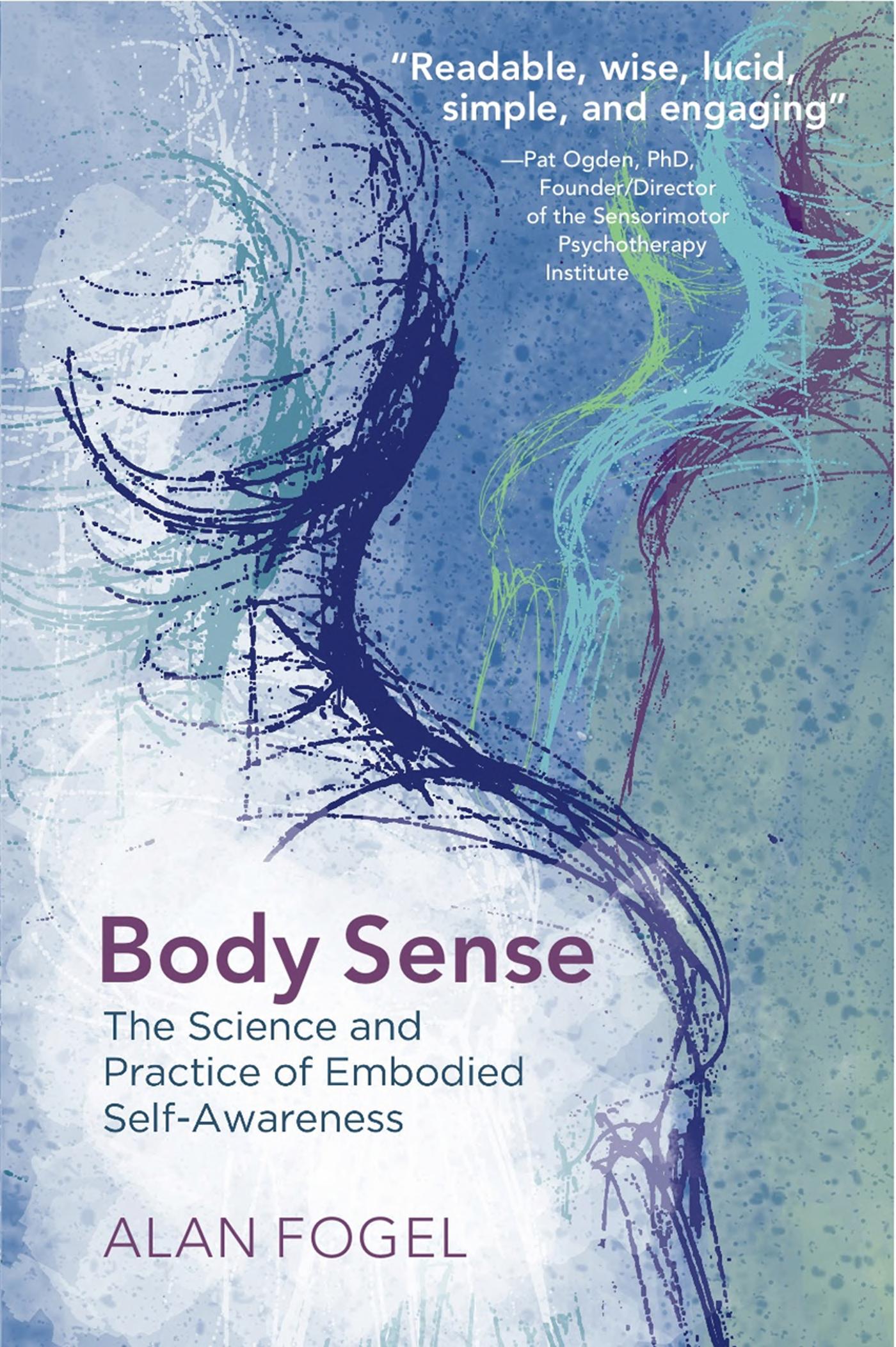
- Fogel, A. (2009). Body Sense: The Science and Practice of Embodied Self-Awareness. Norton. ISBN 978-0-393-70837-0.
- Craig, A.D. (2015). How Do You Feel? An Interoceptive Moment with Your Neurobiological Self. Princeton University Press.
- Stern, D. (1985). The Interpersonal World of the Infant: A View from Psychoanalysis and Developmental Psychology. Basic Books.
- Gendlin, E. (1978). Focusing. Everest House.