 Seba.Health
Key Takeaways
- Hillman's central move is not to found a new school but to convert "archetypal" from a noun (a thing to be found) into an adjective (a quality of attention), thereby dissolving the empirical quest for archetypes into a discipline of imaginal response — a shift that rewrites the epistemological ground of Jungian psychology.
- The book installs Henry Corbin as co-equal to Jung in the genealogy of depth psychology, arguing that without the *mundus imaginalis* the archetype remains trapped in either Kantian idealism or biological reductionism — a philosophical repair that Jung himself never completed.
- By insisting that "the mind is poetic to begin with," Hillman collapses the developmental hierarchy that places rational consciousness above imagination, rendering every clinical interpretation an aesthetic act and every dream image a self-sufficient datum that refuses translation into ego-language.
“Archetypal” Is a Verb Disguised as an Adjective: Hillman’s Dissolution of the Archetype-as-Entity
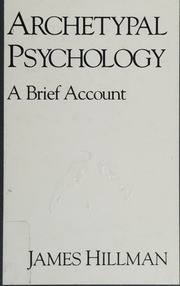
The decisive gesture of Archetypal Psychology is grammatical before it is philosophical. Hillman takes the word “archetypal” and strips it of its nominal authority. Where Jung maintained a radical distinction between the unknowable archetype per se and its phenomenal manifestation as image, Hillman refuses even to speculate about a nonpresented archetype. The result: “‘Archetypal’ here refers to a move one makes rather than to a thing that is.” This is not semantic play. It dismantles the metaphysical scaffolding that had allowed Jungian psychology to speak of archetypes as if they were quasi-biological organs or Platonic forms housed in a collective unconscious. Instead, “archetypal” becomes a valuative operation — something one does to an image when one attends to it with sufficient depth. Any image can be archetypal if the response to it amplifies and depersonalizes, opening it toward universal significance. The Postscript makes this explicit: archetypal psychology “means a psychology not based on things called archetypes as much as a revaluation of psychology itself as an archetypal activity.” This is a Copernican inversion within the Jungian tradition. Where Erich Neumann’s The Origins and History of Consciousness posits archetypes as developmental stages through which ego-consciousness evolves, Hillman flattens that evolutionary ladder. Consciousness does not ascend through archetypes; it is constituted by them at every moment. There is no primitive base from which complexity later emerges, because “the mind is poetic to begin with.”
Corbin’s Mundus Imaginalis Solves Jung’s Unfinished Epistemology
Hillman names two “immediate fathers” of archetypal psychology: Jung and Henry Corbin. The pairing is deliberate and strategic. Jung bequeathed the concept of the archetype but located it ambiguously — sometimes in biology (instinct), sometimes in metaphysics (the psychoid), sometimes in Kantian transcendentalism (categories of apprehension). Corbin’s mundus imaginalis resolves this oscillation by providing a third ontological region: neither the sensory-empirical world nor the purely spiritual-noetic realm, but a distinct field of imaginal realities accessible through imagination and requiring its own perceptual faculties. This move frees the archetype from the burden of proof demanded by empirical science and from the theological inflation risked by metaphysical speculation. The mundus imaginalis is where images are real without being literal, where they possess “theophanic nature” and “virtuality” that is always “ontologically more than actuality.” Hillman draws from this a double consequence: the fundamental nature of the archetype is accessible to imagination first, and therefore the entire method of archetypal psychology must be imaginative — “its exposition must be rhetorical and poetic, its reasoning not logical.” This is why the book reads as it does: dense, allusive, built on compressed aphorisms rather than argued syllogisms. The form enacts the thesis. Compare this with Edward Edinger’s Ego and Archetype, which retains the diagnostic and structural language of classical Jungian analysis, mapping ego-Self relations with geometric precision. Hillman’s text refuses that precision as itself a fantasy — the fantasy of “objective data.”
“Stick to the Image” as Anti-Hermeneutic Discipline
The golden rule of archetypal psychology — “stick to the image,” attributed to López-Pedraza and grounded in Jung’s own counsel (CW 16: 320) — operates as a radical constraint on interpretation. Most therapeutic hermeneutics treat the dream image as a sign pointing elsewhere: to a repressed wish (Freud), to a compensatory function (classical Jung), to a developmental stage (Neumann). Hillman inverts this. The image is not a sign but a presence, an “affecting presence” that demands response on its own terms. Patricia Berry’s formulation is precise: “the depth of the image — its limitless ambiguities — can only be partly grasped as implications. To expand upon the dream image is also to narrow it.” This is anti-amplification in the classical Jungian sense. Where amplification in the hands of Marie-Louise von Franz might trace a dream motif through parallel myths to arrive at a developmental meaning — her reading of the puer through the mother complex being a case Hillman explicitly contests — Hillman’s method stays with the image’s internal complexity: “a self-limiting multiple relationship of meanings, moods, historical events, qualitative details, and expressive possibilities.” The craftsman analogy is telling: the question is not “what does this image mean?” but “how well has the image worked; does the image release and refine further imagining?” This reframes psychotherapy as an aesthetic practice rather than a diagnostic one, and it has radical implications for how pathology is understood — not as deviation from a norm but as the soul’s own deepening activity.
Polytheism as Epistemological Principle, Not Theological Preference
Hillman’s polytheistic psychology is routinely misread as a celebration of plurality for its own sake. The text is more precise. Polytheism names an epistemological stance: the refusal of “monotheistic notions of unity” that impose a single organizing principle — whether that principle is the Self (Jung), the ego (Freud), or any developmental telos. The psyche’s “polysemantic complexity bespeaks a polytheistic psychology of personifications analogous with Jung’s theory of complexes as the multiple consciousness at the base of psychic life.” Each complex is itself a perspective, a partial personality, an “animal” with its own intentionality. The self is not the conductor of an orchestra but one voice in a choir that has no conductor. This is why Hillman’s puer-senex work resists the classical Jungian prescription of “grounding” the puer through return to ordinary life. Grounding is a monotheistic demand — the insistence that one archetype (senex, earth, mother) should govern another. Hillman’s alternative is “the marriage to psyche — reflection, depth, and complication,” a return not to literal ground but to psychic ground. The parallel with Wolfgang Giegerich’s later critique of Jung’s “psychology with a soul” is instructive: both thinkers refuse to let psychology serve any master outside its own imaginal logic.
This book matters for depth psychology today because it remains the only text that simultaneously provides the philosophical foundations of a post-Jungian imaginal psychology and demonstrates its method in the act of writing. It is not a textbook; it is a manifesto compressed into encyclopedia-entry form, and its compression is its power. Every sentence performs the “seeing through” it advocates. For anyone who has read Jung and felt the pull of the images but the weight of the system, Hillman’s Archetypal Psychology names what was missing: permission to let the image lead, and the intellectual architecture to justify that permission without surrendering rigor.
Sources Cited
- Hillman, J. (1983). Archetypal Psychology: A Brief Account. Spring Publications. ISBN 978-0-88214-077-1.
- Jung, C.G. (1959). The Archetypes and the Collective Unconscious. In Collected Works, Vol. 9i. Princeton University Press.
- Corbin, H. (1972). Mundus Imaginalis, or the Imaginary and the Imaginal. Spring.