 Seba.Health
Key Takeaways
- Romanyshyn transforms the wound from a biographical accident the researcher must "bracket" into the epistemological engine of the entire research act — the wound does not bias the inquiry, it is the inquiry.
- The book recasts the relationship between researcher and topic as a transference field, making depth-psychological research structurally identical to analysis rather than merely analogous to it.
- By positioning the "ancestors" and "angels" of a research project as autonomous psychic presences that claim the researcher, Romanyshyn dismantles the Cartesian fiction of the detached investigator more radically than any phenomenological or hermeneutic critique before him.
The Wound Is Not a Confession but a Method
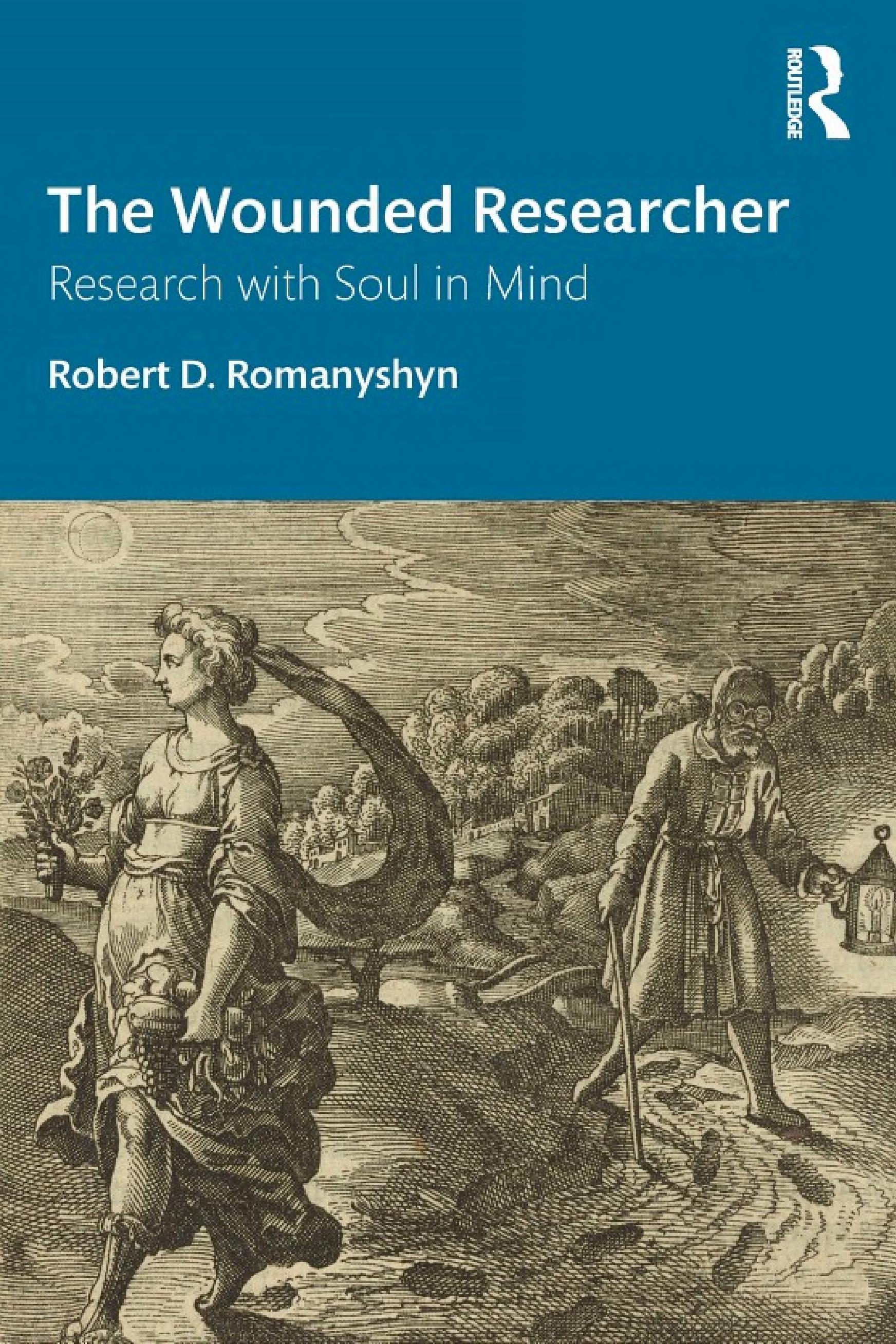
Robert Romanyshyn’s The Wounded Researcher (2007) does something no other methodology text in depth psychology attempts: it turns woundedness itself into a rigorous epistemological stance. Where conventional qualitative research demands that the investigator disclose bias and then neutralize it, and where even sympathetic hermeneutic approaches treat the researcher’s subjectivity as a lens to be cleaned, Romanyshyn argues that the researcher’s unfinished psychological business — the wound — is the very organ through which a topic discloses itself. The work that “calls” a researcher does so precisely through the gap in the researcher’s psyche, the place where meaning has not yet been metabolized. This is not sentimentality about suffering. It is a methodological claim with structural teeth: if you remove the wound, you lose access to the phenomenon. Hillman’s essay on the puer’s wound makes the same point from the archetypal side — “the wound announces impossibility and impotence… this anatomical gap is an inherent part of me” — but Romanyshyn gives it procedural form. He asks: what would a research protocol look like if it honored that gap as its primary instrument? The answer is a method he calls “research with soul in mind,” in which the researcher’s dreams, symptoms, reveries, and transferential entanglements with the material become data of the first order.
Research as Transference Field Dissolves the Subject-Object Split
The book’s most consequential move is to reframe the researcher-topic relationship as a transference field. The topic is not an inert object awaiting investigation; it is a psychic presence that acts upon the researcher, selecting them, haunting them, refusing to let go. Romanyshyn draws explicitly on the analytic situation: just as the analysand’s wound constellates the analyst’s countertransference, the research topic constellates unconscious material in the researcher that must be worked through rather than controlled. This places The Wounded Researcher in direct dialogue with Jan Wiener’s work on transference in the therapeutic relationship, where she describes countertransference as “a form of creative active imagination” operating at the level of the collective unconscious. But Romanyshyn extends this beyond the consulting room into the scholarly act itself. The implication is severe: every dissertation, every monograph, every theoretical paper in depth psychology is already a transference document, whether the author knows it or not. The only question is whether the researcher will engage that transference consciously or be unconsciously possessed by it. Richard Tarnas’s framing of the modern predicament — the “seemingly irresolvable tension of opposites” between objectivist cosmology and subjectivist psychology — finds in Romanyshyn’s method a practical dissolution. The researcher does not stand outside the world examining it; the researcher is claimed by a piece of the world’s unfinished psychic life.
The Ancestors of a Work Are Not Metaphors but Autonomous Presences
Romanyshyn introduces a concept that has no real precedent in research methodology: the “ancestors” and “angels” of a research project. These are the figures — historical, mythological, personal — who gather around a topic and press it toward articulation. They are not rhetorical ornaments. They are autonomous complexes operating through the researcher’s psyche, shaping the direction of inquiry in ways the ego cannot fully control. This is where Romanyshyn parts company not only with mainstream social science but with most post-Jungian scholarship, which typically invokes the imaginal as a theoretical framework rather than living it as a methodological practice. Hillman’s insistence in Re-Visioning Psychology that “fantasy-images are the basic givens of psychic life, self-originating, inventive, spontaneous, complete, and organized in archetypal patterns” provides the philosophical warrant. But Romanyshyn operationalizes it: the researcher must attend to the images that visit the work — in dreams, in unbidden associations, in the strange detours and resistances that mark every serious intellectual project — as communications from the work’s own psychic life. Erich Neumann’s evolutionary model of consciousness, in which the ego passes through a series of “eternal images” and is transformed in the passage, maps the developmental arc that Romanyshyn envisions for the researcher: one does not emerge from a depth-psychological research project the same person who entered it.
Alchemical Hermeneutics as the Third Position Between Positivism and Relativism
The specific method Romanyshyn develops — “alchemical hermeneutics” — borrows from Jung’s reading of alchemy as a projection of psychic transformation onto matter. In alchemical hermeneutics, the researcher’s psychological material and the research material undergo mutual transformation, a process Romanyshyn likens to the alchemical opus. The text changes the researcher; the researcher’s changing consciousness reveals new dimensions of the text. This recursive loop resists both the positivist fantasy of objective extraction and the postmodern collapse into pure subjectivity. It is hermeneutics with a teleology — the work wants to become something, and the researcher is its vessel. Hillman’s observation that “the opus is not in Jerusalem; it is right here in our own wounds” crystallizes what Romanyshyn builds into procedure. The researcher’s wound is not an obstacle to objectivity but the alchemical prima materia from which genuine understanding is distilled.
For anyone working in depth psychology today — writing a dissertation at Pacifica, crafting a clinical paper, or attempting to articulate what analytical work actually does — The Wounded Researcher is the only text that takes the unconscious dimensions of scholarship itself as seriously as depth psychology takes the unconscious dimensions of the psyche. It does not merely argue that research should be soulful; it provides a disciplined framework for recognizing when the soul is already at work in the research, and what happens when the researcher refuses that recognition. No other book in the field makes this specific contribution.
Sources Cited
- Romanyshyn, R.D. (2007). The Wounded Researcher: Research with Soul in Mind. Spring Publications. ISBN 978-0-415-41287-8.
- Hillman, J. (1972). The Myth of Analysis: Three Essays in Archetypal Psychology. Northwestern University Press.
- Corbin, H. (1972). Mundus Imaginalis, or the Imaginary and the Imaginal. Spring.
- Jung, C.G. (1961). Memories, Dreams, Reflections. Ed. A. Jaffé. Vintage Books.