 Seba.Health
Key Takeaways
- Autenrieth's dictionary is not a neutral reference tool but an inadvertent map of the Homeric psyche's internal architecture—every entry on θυμός, νόος, or ψυχή encodes a pre-Platonic psychology that depth psychology spent the twentieth century trying to reconstruct without knowing its lexicon.
- By isolating the semantic fields of Homeric vocabulary from later Attic usage, the dictionary preserves a moment before the soul was unified into a single metaphysical substance—making it an indispensable counter-text to every modern psychology that assumes a monolithic self.
- The dictionary's philological precision inadvertently demonstrates that the Greek Middle Voice and its associated verb forms (μυθέομαι, βούλομαι, σέβομαι) are not grammatical curiosities but records of psychological operations that have no equivalent in English—operations that Jung's Active Imagination and Hillman's imaginal psychology labored to reinvent from scratch.
The Homeric Dictionary Is a Lost Anatomy of the Pre-Platonic Soul
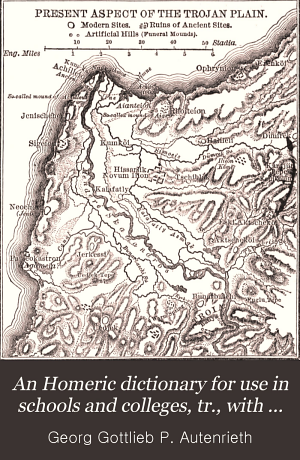
Georg Autenrieth’s Homeric Dictionary (1891) presents itself as a modest school lexicon, keyed exclusively to the vocabulary of the Iliad and Odyssey. Its entries are terse, its tone utilitarian, its audience the German and American gymnasium student parsing hexameters. Yet precisely because it restricts itself to Homeric usage and refuses to import later Attic or Hellenistic meanings, the dictionary preserves something extraordinary: the semantic skeleton of a psychology that predates the philosophical unification of the soul. Every entry on thumos, noos, phrenes, kradie, and psyche maps a distinct organ of interior life—not metaphors layered onto a unitary self, but genuinely independent centers of agency that Homer’s heroes address, consult, and argue with. As Cody Peterson’s work on the Middle Voice makes explicit, the Homeric self “is not a monolith; it is a relation,” and the thumos operates as “a semi-autonomous agent with whom [the hero] must negotiate the terms of existence.” Autenrieth’s lexicon, by cataloguing the precise collocations and syntactic environments in which these terms appear—thumos with verbs of deliberation and appetite, noos with perception and plan, psyche only with death and departure—provides the raw philological data for that claim. John Beebe, drawing on Norman Austin and E. R. Dodds, traces the origin of “psychical polycentricity” to Homer’s “plurality of centers of psychic awareness,” each with “discrete names to connote distinct manifestations of the ‘life-force.’” Autenrieth is the dictionary that makes those names precise.
Philological Containment as Psychological Method: What Autenrieth Excludes Matters as Much as What He Includes
The dictionary’s deepest contribution is negative. By excluding post-Homeric usage, Autenrieth blocks the anachronistic conflation that has plagued every psychological reading of Homer from Plato onward. When a modern reader encounters psyche in the Iliad, the gravitational pull of twenty-five centuries of philosophy drags the word toward “soul” in the Christian or Cartesian sense—an immortal, unified, consciousness-bearing substance. Autenrieth’s entry resists this. His psyche is what leaves the body at death, what flutters to Hades as a shade; it is emphatically not the seat of thought, emotion, or will during life. That work belongs to thumos, noos, and phrenes, distributed across the chest and diaphragm. This philological containment has immense consequences for depth psychology. Hillman’s entire project of “re-visioning” psychology depends on recovering a notion of soul that is imagistic, plural, and irreducible to ego-consciousness. In Re-Visioning Psychology, he traces this line back through Heraclitus: “You could not discover the limits of the soul, even if you traveled every road to do so; such is the depth of its meaning.” But between Heraclitus and Hillman stands Homer, and between Homer and the modern reader stands the lexicon. Autenrieth’s refusal to let psyche mean what Plato or Augustine or Descartes needed it to mean is itself an act of psychological hygiene—a quarantine against the inflation of the soul-concept that Hillman spent his career diagnosing.
The Dictionary as Grammar of the Internal Interlocutor
Peterson’s identification of the formula ochthēsas d’ ara eipe pros hon megalētora thumon (“deeply vexed, he spoke to his mighty thumos”) as a diagnostic marker of the mortal condition depends entirely on the kind of granular lexical evidence Autenrieth compiles. The dictionary’s entries on mytheomai, dialegomai, and related speech-verbs reveal a crucial distinction: gods use the active mythēsato when addressing their thumos (a monologue, a closed-loop recitation of will), while mortals use the aorist middle dielexato (a genuine dialogue, a rupture in which the self convenes an inner parliament). Autenrieth records these verb forms and their Homeric contexts without psychological commentary—he is a philologist, not an analyst—but the data he catalogues is the forensic evidence for what Jung would later call Active Imagination: the technique of engaging the unconscious not as object but as interlocutor. As Peterson argues, “Jung’s method of Active Imagination is nothing less than a resurrection of the dielexato formula.” The dictionary does not make this argument. It does something more foundational: it preserves the linguistic evidence without which the argument cannot be made.
Karl Kerényi insisted that mythology, to be understood in its true nature, “must be translated back into its medium”—into the resonance of living narration. Autenrieth’s dictionary serves this translation at the most fundamental level: word by word, usage by usage, it recovers the medium in which Homer’s psychology was articulated. Thomas Moore’s reading of the Odyssey as a narrative of soul-fathering—“a deeply felt, risky, unpredictable tour of the soul”—and Hillman’s reading of Odysseus as the figure who resolves “a morbid division fundamental to the Western psyche” by holding senex and puer together: these interpretations gain their traction from the precise semantic distinctions that Autenrieth’s lexicon maps. Without knowing what polytropos meant in Homeric usage as distinct from later Greek, without tracking the specific verbs Homer assigns to mortal versus divine self-address, the depth-psychological reading of epic becomes impressionistic rather than grounded.
Why This Dictionary Matters Now: The Lexicon as Antidote to Psychological Monism
For the contemporary reader of depth psychology, the Homeric Dictionary is not an antiquarian curiosity but a corrective instrument. Every therapeutic model that assumes a single, unified self—whether the ego psychology of Hartmann, the mindfulness frameworks of cognitive-behavioral therapy, or even insufficiently rigorous readings of Jung’s individuation as the construction of a monolithic Self—runs aground on the Homeric evidence. Homer’s heroes do not “have” a self that processes emotions; they inhabit a distributed field of agencies that must be negotiated, persuaded, and sometimes overruled. Autenrieth’s dictionary is the lexical proof that this polycentric psychology once had its own precise vocabulary—a vocabulary that was lost not through ignorance but through the philosophical and theological consolidation of the soul into a single substance. No other book in the depth psychology library performs this specific function: it gives the reader the linguistic tools to hear what Homer actually said before Plato, Augustine, and Descartes decided what the soul was allowed to be.
Sources Cited
- Autenrieth, G. (1891). A Homeric Dictionary for Schools and Colleges. Trans. Robert P. Keep, rev. Isaac Flagg. Harper & Brothers.
- Cunliffe, R.J. (1924). A Lexicon of the Homeric Dialect. Blackie and Son.
- Liddell, H.G. and Scott, R. (1940). A Greek-English Lexicon. 9th ed. Oxford University Press.