 Seba.Health
Key Takeaways
- Nagy demonstrates that the concept of "hero" in archaic Greek poetry is not a character type but a system of differential meaning-making, where the "best" (aristos) is always constituted through opposition, death, and cult—a finding that dismantles every modern psychology that treats the hero as a developmental stage to be outgrown or an ego function to be strengthened.
- The book's central argument—that Achilles and Odysseus define heroism through mutually exclusive poetic traditions (Iliadic kleos versus Odyssean nostos)—provides the philological foundation for what Hillman intuited in "Senex and Puer": that the hero's death and the hero's return are not sequential phases but rival archetypal grammars that cannot be synthesized without loss.
- Nagy's treatment of the hero's cult status as predicated on death—not merely accompanied by it—offers the most rigorous classical grounding for the depth-psychological insight that heroic consciousness is always a posthumous phenomenon, a "revenant" animating the living through ritual and projection rather than direct experience.
The Hero Is a Dead Man’s Name: Nagy’s Demolition of the Living Hero
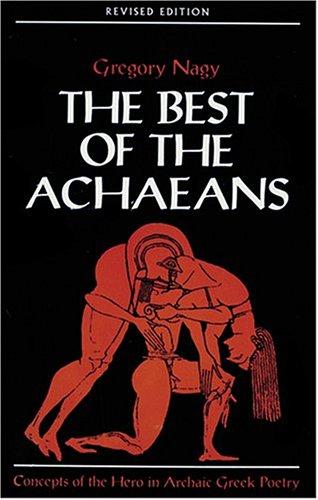
Gregory Nagy’s The Best of the Achaeans performs an act of philological archaeology so precise it reshapes everything depth psychology believes about heroism. The book’s governing thesis is that the Greek word hērōs is inseparable from the institution of hero cult—a practice centered on the veneration of the dead at specific burial sites. The hero, in archaic Greek poetry, is not a living agent performing valorous deeds. He is a figure whose meaning crystallizes only through death, through the community’s retrospective consecration of a life that has ended. This is not a metaphor Nagy is constructing; it is a linguistic and institutional fact he recovers from the earliest strata of Greek epic. The implications for psychology are seismic. When James Hillman writes that “to be a hero one must be ‘dead’” and that “the hero is a revenant, providing a fantasy for what the complex can do with itself,” he is articulating in archetypal-psychological language exactly what Nagy demonstrates through comparative philology. But Nagy goes further than Hillman by showing that the opposition is not merely between heroic consciousness and some other mode—it is internal to the heroic tradition itself. The Iliad and the Odyssey encode rival value systems (kleos aphthiton—imperishable glory—versus nostos—homecoming) that define each other by mutual exclusion. Achilles chooses glory and forfeits return; Odysseus chooses return and forfeits the kind of glory that the Iliad celebrates. This is not two men making different choices. It is the poetic tradition itself thinking through the irreconcilable demands of heroic meaning.
Achilles and Odysseus Are Not Two Heroes but Two Grammars of the Soul
The most consequential move in Nagy’s book is his demonstration that the opposition between Achilles and Odysseus is not characterological but structural—it belongs to the deep grammar of oral poetic tradition. Achilles is the figure through whom the tradition explores what it means to achieve kleos at the cost of life; Odysseus is the figure through whom it explores what it means to preserve life at the cost of a certain kind of kleos. Nagy shows, through meticulous analysis of formulaic diction and theme, that these two trajectories are not merely different but diacritically opposed—each gains its meaning precisely by not being the other. This insight has radical consequences for how we read the depth-psychological tradition on heroism. Robert Moore and Douglas Gillette, in King, Warrior, Magician, Lover, treat the Hero as a single archetype with a shadow dyad (Grandstander Bully / Coward), to be transcended on the way to mature masculine wholeness. But Nagy’s philology reveals that the Greeks themselves never operated with a unitary hero concept. The tradition required two incompatible hero-logics to articulate what a single figure could not contain. Hillman grasped this intuitively when he distinguished the hero’s death (“because of the mother”) from the puer’s death (“independent of the mother”) and from the son’s death (“for the mother”). But Nagy provides the textual mechanism: it is not psychology that generates these distinctions—it is the oral-formulaic tradition’s own system of differential meaning. The poems are not illustrating psychological types; they are generating the very categories through which psychology later learns to think.
The Scar of Odysseus and the Wound of Achilles: Two Ontologies of Suffering
Nagy’s treatment of sēma (sign, mark, tomb) as simultaneously the hero’s identifying wound and the marker of his cult site opens a profound dialogue with Hillman’s extended meditation on the scar of Odysseus in Senex and Puer. Hillman argues that the scar—the healed wound—is what differentiates Odysseus from every other Greek hero: it is “built into his existence in the leg that carries him,” making him “the personification of pathologized consciousness.” Nagy provides the structural explanation for why this matters at the level of tradition itself. The sēma that identifies Odysseus to his nurse Eurycleia is cognate with the sēma that marks a hero’s grave. Recognition and death are linguistically twinned. The scar is not merely a narrative device; it is a cultic sign, a marker of the threshold between life and death that the hero inhabits. Achilles, by contrast, is defined by his invulnerability—and therefore by the single catastrophic point where that invulnerability fails. His heel is not a scar but an absence of protection, a gap that the mother’s hand created precisely by trying to close it. As Hillman observes, “his ultimate cause of death was precisely where she had touched and held him.” Achilles’ wound is fatal because it has never been integrated; Odysseus’ wound is salvific because it has been carried, metabolized, scarred over. Nagy’s contribution is to show that this distinction is not a psychological interpretation imposed on the text—it is encoded in the tradition’s own formulaic system. Robert Bly, drawing on this same scene in Iron John, reads the boar-scar as evidence of an initiatory wound “administered by old men which we have forgotten,” a wound that, “when accomplished ritually, strengthened young men.” Bly is reaching for the cultic dimension that Nagy formally identifies: the scar functions as a sēma of initiation, a sign that the bearer has passed through death without being consumed by it.
Why Philology Is Depth Psychology’s Missing Discipline
Karl Kerényi insisted that mythology, properly approached, “will itself have the same effect as the most direct psychology—the effect, indeed, of an activity of the psyche externalised in images.” Nagy’s Best of the Achaeans fulfills this claim with a rigor Kerényi himself rarely achieved. By demonstrating that the hero concept is not a universal archetype hovering above history but a specific product of oral-formulaic tradition’s differential meaning-making, Nagy gives depth psychology something it desperately needs: a method for distinguishing between what the tradition actually says and what we project onto it. Moore’s developmental hero, Hillman’s revenant hero, Campbell’s monomythic hero—each captures a genuine dimension of the Greek material, but none accounts for the tradition’s own internal logic of opposition and mutual definition. Nagy does. His book is not a resource for psychologists looking to decorate their theories with classical references. It is a corrective to every psychology that treats myth as a storehouse of symbols rather than as a living system of thought with its own grammar, its own arguments, and its own capacity to generate meaning that exceeds any single interpretive framework. For anyone working at the intersection of classical tradition and the care of souls, The Best of the Achaeans is not supplementary reading—it is the philological bedrock without which psychological interpretation of Greek heroism remains, in Nagy’s own idiom, a tradition that has lost track of its own sēmata.
Sources Cited
- Nagy, G. (1979). The Best of the Achaeans: Concepts of the Hero in Archaic Greek Poetry. Johns Hopkins University Press. ISBN 978-0-8018-6015-7.
- Parry, M. (1971). The Making of Homeric Verse: The Collected Papers of Milman Parry. Oxford University Press.
- Lord, A. B. (1960). The Singer of Tales. Harvard University Press.
- Caswell, C. P. (1990). A Study of Thumos in Early Greek Epic. Brill.