 Seba.Health
Key Takeaways
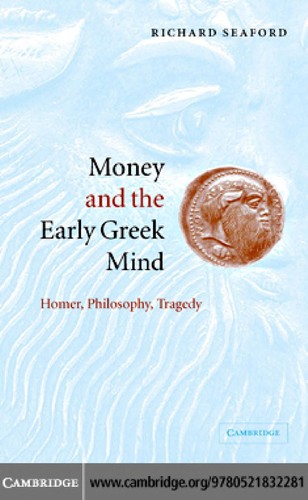
- Seaford demonstrates that the invention of coinage did not merely change Greek commerce but restructured Greek metaphysics: the abstract universality required to treat a coin as equivalent to any commodity is the same cognitive operation that produced Presocratic monism, Platonic Forms, and tragic reversal.
- The book reframes tragedy not as a dramatization of moral failure but as a ritual processing of the crisis that monetization inflicted on reciprocal social bonds—Dionysiac dissolution on stage is the communal attempt to metabolize the psychic violence of impersonal exchange.
- Seaford's thesis exposes a blind spot in depth psychology's engagement with antiquity: Hillman, Edinger, and others treat Greek philosophical concepts as archetypal emergences from the collective unconscious while ignoring the material substrate—coined money—that made those very abstractions thinkable in the first place.
Coined Money Is the Unacknowledged Origin of Western Abstract Thought
Richard Seaford’s central provocation is that the emergence of coined money in the sixth century BCE did not merely accompany the birth of Greek philosophy—it caused it. The Milesian leap from mythos to logos, the sudden capacity to posit a single underlying substance (water, air, the apeiron) beneath the multiplicity of phenomena, replicates the cognitive structure that coinage demands. A coin abstracts from the qualitative specificity of goods; it posits a universal equivalent that renders all things commensurable. Thales’ declaration that “all is water” performs an identical operation on the plane of ontology. Seaford meticulously traces how Anaximander’s apeiron—the unlimited, undifferentiated source from which all determinate things emerge and to which they return—mirrors the logic of money as a substance that is nothing specific yet potentially everything. This is not analogy; it is homology. The mental habit of universal abstraction was forged in the marketplace before it appeared in the philosophical fragment. Edward Edinger, reading the Presocratics through Jung, treats these monistic intuitions as encounters with the Self—“living psychic organisms” that undergo differentiation as various minds grapple with them. Seaford’s intervention forces a harder question: what if the psychic organism that gripped Thales was not the Self unveiling itself but the specific social technology of coined money reorganizing the structures of cognition? Edinger’s claim that “Jungian psychology redeems the relevance of ancient philosophy” needs to be complicated by the recognition that what ancient philosophy itself redeems—or fails to redeem—is the crisis of abstraction that money inaugurated.
Tragedy Is the Ritual Metabolism of Monetized Selfhood
Seaford’s treatment of Attic tragedy is where his argument achieves its deepest resonance. He reads the Oresteia, the Bacchae, and Sophoclean drama not primarily as explorations of fate, family, or heroic downfall but as communal rituals for processing the psychic rupture caused by the monetization of social bonds. In pre-monetary Greek society, identity was constituted through reciprocal exchange—gift, sacrifice, obligation. The self was relational, embedded in networks of mutual debt that were qualitative and particular. Coined money dissolved these bonds by introducing a medium that is impersonal, quantitative, and infinitely transferable. The Dionysiac festivals in which tragedy was performed enact a controlled dissolution of individual boundaries—the very boundaries that monetized selfhood was simultaneously hardening. The sparagmos of Pentheus in the Bacchae is not merely a mythic punishment; it is the ritual dramatization of a self torn apart by the contradiction between archaic reciprocity and the new regime of abstract equivalence. James Hillman, writing on tragedy and the Greek achievement, insists that “the recognition of the intimate and subtly differentiated connection between myths and pain, between the gods and diseases is the greatest of all achievements of the Greek mind.” Seaford supplies the missing material ground for this insight: the specific disease that Greek tragedy diagnoses is the monetization of human relations, and the specific myth it deploys is Dionysiac dissolution as pharmakon. Hillman’s archetypal method, by his own admission, is “shamefacedly syncretistic” and gives “scant attention to the historical time-frame.” Seaford provides exactly the historical specificity that archetypal psychology needs but refuses to seek.
The Fiduciary Self and the Crisis of Intrinsic Value
Seaford’s argument converges with Hillman’s meditation on money and psyche in a way neither author makes explicit. Hillman laments that money “has long lost this silver backing” and become “the bottom line of anti-reflection”—a purely functional counter stripped of intrinsic worth. But Seaford shows that this trajectory was already present at the origin. Greek coinage carried the images of gods and embodied civic pride, yet its revolutionary power lay precisely in its capacity to abstract from those particularities—to function as universal equivalent regardless of the image stamped upon it. The tension Hillman identifies between money as “aesthetic joy, a standard of value, and a tribute to the gods” and money as “wholly outside the psyche” is not a modern degeneration but the founding paradox of coinage itself. Seaford demonstrates that the Presocratics, the tragedians, and Plato were all, in different registers, attempting to resolve this paradox. Plato’s theory of Forms can be read as the philosophical apotheosis of the coin’s logic: a realm of abstract, self-identical, imperishable value that grounds the mutable world of appearances, just as the monetary standard grounds the fluctuating world of commodities. Cody Peterson’s account of Plato’s “catastrophic misreading” of Homeric psychology—the demotion of the thūmos from sovereign partner to obedient auxiliary—gains a new material dimension through Seaford’s lens. The Platonic soul is not merely a product of intellectual ambition; it is the soul restructured by the regime of coined money, in which abstract reason (like abstract value) must govern the spirited and appetitive parts as a monetary authority governs circulation.
Why Seaford’s Materialism Completes Rather Than Negates Depth Psychology
The standard objection from depth psychology would be that Seaford commits what Hillman calls “the economic fallacy”—reducing psychic reality to material conditions. But this misreads Seaford’s achievement. He does not claim that money caused philosophy in the way a billiard ball causes motion. He demonstrates that a specific social technology created the conditions of possibility for a specific mode of abstraction—and that the Greeks themselves registered this transformation as a crisis requiring ritual, philosophical, and dramatic response. For readers formed by the depth tradition, Seaford’s book is indispensable because it supplies the missing third term between archetype and psyche: the historical artifact. Without understanding coined money, we cannot understand why the Greek psyche took the specific forms it did—why monism emerged when it did, why tragedy achieved its particular intensity in fifth-century Athens, why Plato’s metaphysics carries the structure it does. No other single volume so precisely identifies the material catalyst of the Western mind’s defining abstractions, and no reader of Hillman, Edinger, or Peterson can afford to ignore the challenge Seaford poses to any purely intrapsychic account of how the Greek soul came to think the way it thought.
Sources Cited
- Seaford, R. (2004). Money and the Early Greek Mind: Homer, Philosophy, Tragedy. Cambridge University Press. ISBN 978-0-521-53992-0.
- Onians, R. B. (1951). The Origins of European Thought: About the Body, the Mind, the Soul, the World, Time and Fate. Cambridge University Press.
- Kurke, L. (1999). Coins, Bodies, Games, and Gold: The Politics of Meaning in Archaic Greece. Princeton University Press.
- Snell, B. (1953). The Discovery of the Mind: The Greek Origins of European Thought. Harvard University Press.