 Seba.Health

Key Takeaways
- Sullivan's lexical method reveals that archaic Greek psychological vocabulary — *thumos*, *noos*, *phrēn*, *psychē* — does not map onto any single modern concept of "mind" or "soul," exposing the anachronism that haunts every depth-psychological appropriation of Greek thought from Jung through Hillman.
- The book demonstrates that ethical reasoning in early Greek literature is inseparable from bodily and emotional experience — what we now partition as cognition, affect, and morality existed as a unified field within the archaic psyche, a finding that corroborates Hillman's insistence that "soul" is a perspective rather than a substance but challenges his selective mythological method.
- By treating Homer, Hesiod, and the lyric poets as primary psychological documents rather than philosophical precursors, Sullivan inverts the standard genealogy that runs from Thales forward, showing that the richest phenomenology of inner life preceded — and was partly obscured by — the birth of Greek philosophy.
The Archaic Greeks Had a Psychology Before They Had Philosophy, and Sullivan Proves It Lexically
Shirley Darcus Sullivan’s Psychological and Ethical Ideas: What Early Greeks Say (1995) performs an act of disciplined recovery that no Jungian or archetypal psychologist has managed with comparable philological rigor. Where Edinger’s The Psyche in Antiquity treats the early Greek philosophers as vessels for archetypal images — “trailing clouds of glory” from a state of participation mystique — Sullivan works upstream, into the literary and poetic sources that Edinger and his tradition largely skip. Her subject is the actual vocabulary of inner life in Homer, Hesiod, the Homeric Hymns, and the early lyric poets: terms like thumos, noos, phrēn, kardia, psychē, and kēr. She traces each term across hundreds of textual instances, mapping not abstract philosophical concepts but the lived phenomenology of experience as the Greeks themselves articulated it. The result is a corrective of the first order. When Edinger writes that the early philosophers “had no epistemological criticism of the metaphysical doctrines they spun out,” he is describing the pre-Socratics. Sullivan shows that the pre-philosophical poets already possessed an extraordinarily differentiated psychological vocabulary — one that did not need epistemological criticism because it was not making metaphysical claims. It was describing what happens inside a person who deliberates, rages, grieves, desires, or decides. This is psychology as phenomenology before phenomenology had a name.
Greek “Soul-Words” Refuse the Mind-Body Split That Modern Psychology Assumes
Sullivan’s most consequential finding is that the archaic Greek terms for psychic life resist every modern partition. Thumos is not “emotion” as opposed to “reason”; it is the seat of deliberation, anger, courage, and appetite simultaneously. Noos is not “intellect” in any Cartesian sense; it perceives, plans, and intends in a single act that includes sensory and evaluative dimensions. Phrēn (and its plural phrenes) encompasses thought, feeling, and moral judgment as aspects of one organ-function. Sullivan’s lexical evidence demonstrates that in the archaic Greek psyche, what we now call cognition, affect, and ethical evaluation were not three faculties but three faces of a single activity. This finding has direct implications for depth psychology. When Hillman, in Re-Visioning Psychology, defines soul as “a perspective rather than a substance” and insists that “the dimension of soul is depth,” he is recovering something the archaic Greeks never lost. Sullivan’s data shows that the Homeric heroes already inhabited a world where psychological life was perspectival, situated, and irreducibly multiple — what John Beebe, drawing on Dodds and Hillman, calls Homer’s recognition of “a plurality of centers of psychic awareness.” But Sullivan adds lexical precision to what Hillman handles mythically. She shows how the multiplicity was organized: not through a pantheon of divine figures but through a vocabulary of psychic organs, each with distinct but overlapping functional domains. The “interior society” that Norman Austin identified in Homer is, in Sullivan’s account, not a metaphor but a documented linguistic structure.
Ethics in Early Greek Thought Is Embedded in Embodied Psychological Experience, Not Abstracted from It
Sullivan’s treatment of ethical ideas is equally subversive. She demonstrates that moral vocabulary in early Greek poetry — words for shame (aidōs), justice (dikē), excess (hubris), and fate (moira) — is always anchored in psychological and bodily experience. Shame is not a rule imposed from outside; it is felt in the phrenes. Justice is not a Platonic Form; it is a pattern of right relation experienced through thumos and recognized by noos. This means that ethical reasoning in the archaic period was inherently psychological reasoning — a unity that Greek philosophy would later dissolve by abstracting moral principles from their experiential ground. For readers of David Miller’s The New Polytheism and Hillman’s archetypal psychology, Sullivan’s work supplies the missing empirical foundation. Miller argues that polytheistic consciousness corresponds to the multiplicity of the psyche; Hillman insists that the gods are “the empowering worlds of our existence, the deepest structures of reality.” Sullivan shows that before the gods became philosophical problems or archetypal images, the Greeks had already developed a non-theological vocabulary for psychic multiplicity — one rooted not in myth but in the grammar of felt experience. This does not diminish the mythological approach; it grounds it in something prior and more primary.
Sullivan Fills the Gap Between Philological Scholarship and Depth Psychology That Both Traditions Pretend Does Not Exist
The book’s deepest contribution is methodological. Hillman confesses in his work on Orpheus that his psychological method is “shamefacedly syncretistic” and may “offend the patient devotion to scholarly research.” Edinger openly states that the early Greeks’ metaphysical doctrines were “almost pure psychology.” Both positions, however brilliant, operate at a remove from the texts themselves. Sullivan closes that remove. Her method is neither syncretistic nor confessional; it is lexicographic, contextual, and exhaustive. She reads every surviving instance of a psychic term in the archaic corpus, tracks its semantic range across genres and centuries, and builds her psychological conclusions from the evidence upward. For anyone working within depth psychology today — whether Jungian, archetypal, or otherwise — this book provides something irreplaceable: proof that the psychological sophistication of the archaic Greeks was not a projection of modern interpreters but a documented reality of the texts. It is the philological foundation that Edinger’s amplifications assume but never supply, and the empirical anchor that Hillman’s mythological psychology needs but rarely seeks. No other single volume performs this specific work with this level of classical training brought to bear on questions that matter to the practicing psychologist.
Sources Cited
- Sullivan, S. D. (1995). Psychological and Ethical Ideas: What Early Greeks Say. Brill. Mnemosyne Supplementum 144.
- Claus, D. B. (1981). Toward the Soul: An Inquiry into the Meaning of Psyche Before Plato. Yale University Press.
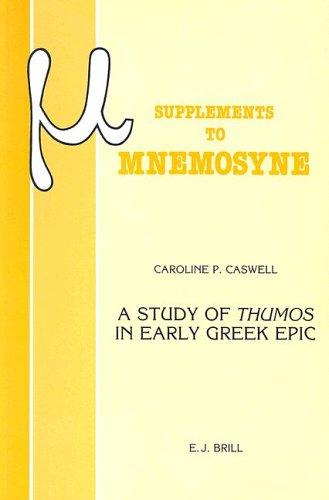
- Caswell, C. P. (2004). A Study of Thumos in Early Greek Epic. Brill. Mnemosyne Supplementum 114.