 Seba.Health
Key Takeaways
- Caswell's philological mapping of thumos across Homeric and Hesiodic usage reveals not a single "emotion organ" but a shifting field of psychic agency — one that anticipates Jung's complex theory by twenty-five centuries, grounding the autonomous complex in pre-philosophical Greek anthropology rather than clinical observation.
- The book demonstrates that thumos operates as a genuine internal interlocutor — the hero addresses it, deliberates with it, is sometimes overruled by it — establishing that the dialogical self is not a modern theoretical invention but an archaic experiential fact embedded in the grammar of epic.
- By insisting on close lexical analysis over grand mythological synthesis, Caswell implicitly challenges the Hillman-Dodds tradition of reading Homer psychologically through the gods alone, showing that the intra-psychic drama of the Homeric hero unfolds as much through the mortal thumos as through divine intervention.
Thumos Is Not a Metaphor but a Psychic Agent: Caswell Recovers the Autonomy Homer Granted the Soul’s Interior
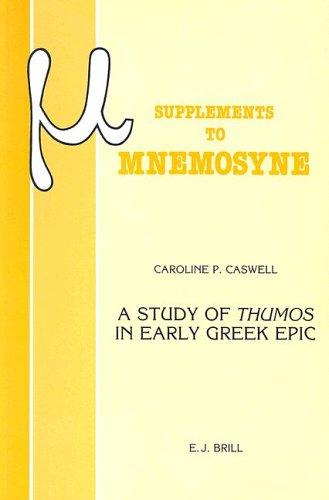
Caroline Caswell’s A Study of Thumos in Early Greek Epic performs a task that depth psychology has needed but never executed with sufficient philological discipline: a rigorous, passage-by-passage examination of what thumos actually does in Homer and Hesiod. The standard approach — exemplified by E. R. Dodds in The Greeks and the Irrational and extended by Hillman in The Myth of Analysis and Re-Visioning Psychology — treats the Homeric psychic vocabulary as evidence for a pre-rational, polytheistic consciousness in which the gods serve as externalizations of inner states. Caswell does not contest this framework, but she shifts the center of gravity. Her contribution is to show that thumos itself, without recourse to divine machinery, already functions as an autonomous agent within the hero. Achilles’ thumos proposes courses of action; Odysseus addresses his thumos in the second person, rebukes it, bargains with it. This is not figurative speech or poetic convention. Caswell’s lexical evidence demonstrates that thumos behaves in Homeric epic exactly as Jung’s complexes behave in clinical practice: it possesses intentionality, emotional coloring, and a degree of independence from the ego’s will. John Beebe’s discussion of “psychical polycentricity” in his archetypal model of the dialogical self draws on Norman Austin and Parkes to note that Homer recognized “a plurality of centers of psychic awareness,” each with its own name and image — thumos, noos, kradie. Caswell’s study is the philological foundation that makes such psychological claims defensible rather than merely suggestive.
The Deliberation Formula Proves the Psyche Was Never Singular
The most consequential finding in Caswell’s work concerns the deliberation scenes — those moments when a hero stands at a crisis point and thumos rises as an interlocutor. The formula in which a hero speaks to his own thumos, or thumos “urges” or “commands” the hero, is not decoration. It is a structural feature of epic decision-making. Cody Peterson, in The Iron Thūmos, identifies this as the dielexato formula — the act of deliberating with the soul rather than upon it — and connects it to the grammatical Middle Voice, that linguistic structure in which the subject is neither pure agent nor pure patient but is constituted by the action itself. Caswell’s philological work makes Peterson’s philosophical extension possible. Without her demonstration that thumos consistently appears as a second voice in scenes of moral and strategic choice, the claim that Homeric psychology preserves a “middle” stance between active mastery and passive collapse would remain speculation. Peterson’s argument that Jung’s Active Imagination is “nothing less than a resurrection of the dielexato formula” gains its historical anchor in Caswell’s lexical cataloguing. The hero who consults his thumos is performing, in archaic terms, exactly what the analysand does when engaging the unconscious as a partner rather than an object.
Against Reductive Readings: Thumos Is Neither Emotion Nor Cognition but a Third Thing
One of Caswell’s persistent concerns is to resist the modern temptation to translate thumos into a single English equivalent — “spirit,” “passion,” “will,” “desire.” Each translation collapses the term into one dimension of a dichotomy (reason/emotion, thought/feeling) that did not exist for Homer. Thumos is the seat of anger, yes, but also of deliberation; it is where grief is felt, but also where plans are formed. This refusal of binary classification places Caswell’s work in direct alignment with Hillman’s insistence, developed across The Myth of Analysis and Re-Visioning Psychology, that the psyche cannot be divided into Apollonic reason and Dionysian passion without doing violence to its actual operations. Hillman wrote that “the heroic age in psychology is past” and that the hero of consciousness must now “find his female soul.” Caswell’s thumos occupies precisely the territory Hillman sought to recover — a psychic reality that is neither the commanding ego nor the chaotic unconscious, but an intermediate agency that participates in both. Liz Greene’s exploration of Moira and the feminine dimensions of fate in The Astrology of Fate similarly insists that the Greek psyche operated under a logic of necessity and order that Western dualism has rendered invisible. Thumos, in Caswell’s reading, is the organ through which the hero registers fate’s claims while still exercising agency — the precise intersection where freedom and necessity meet without resolution.
Why the Philological Ground Matters for Psychological Practice
Patricia Berry once argued that depth psychology “serves the ground of the mother” by giving support to shame, infirmity, and the incomprehensible. Caswell’s study serves a different but equally essential ground: it demonstrates that the psyche’s polyphonic structure is not a theoretical construct imposed by modern clinicians but an empirical feature of the oldest Western literature. When Hillman called for “psychological polytheism” — the abandonment of the ego-self axis as the sole organizing principle — he was making a theological and aesthetic argument. Caswell provides the philological evidence. Her work shows that the Homeric hero already lived in a psyche with multiple centers of agency, that the dialogue between self and soul was the normative condition of consciousness, not a symptom of dissociation. This matters for clinical practice because it reframes the therapeutic goal: the analysand who hears competing inner voices is not fragmenting but returning to the original architecture of the psyche.
For anyone working at the intersection of classical studies and depth psychology — or for any clinician who senses that the modern vocabulary of “parts,” “modes,” and “subpersonalities” lacks historical depth — Caswell’s monograph is irreplaceable. It is the only work that submits the full range of thumos usage in early Greek epic to systematic philological analysis while remaining legible to readers outside Classics. It does not theorize about what Homer might mean for psychology; it establishes, word by word, what Homer actually said about the structure of the soul, and in doing so provides the evidentiary bedrock on which Hillman’s archetypal revisioning, Peterson’s Middle Voice thesis, and Beebe’s dialogical self all ultimately depend.
Sources Cited
- Caswell, C.P. (1990). A Study of Thumos in Early Greek Epic. Mnemosyne Supplement 114. Brill.
- Onians, R.B. (1951). The Origins of European Thought. Cambridge University Press.
- Snell, B. (1953). The Discovery of the Mind. Harvard University Press.