 Seba.Health
Key Takeaways
- Abrams does not merely trace Romantic secularization of Christian narrative; he demonstrates that the Romantics performed a *structural* transposition of salvation history into a psychology of consciousness—making them, in effect, the first depth psychologists without a clinical apparatus.
- The spiral pattern Abrams identifies in Romantic thought—unity, fall, return at a higher level—is not a literary motif but the deep grammar that later animates Jung's individuation, Hillman's soul-making, and Edinger's ego-Self axis, revealing Romanticism as the unacknowledged philosophical infrastructure of the entire depth psychological tradition.
- By naming the project "natural supernaturalism," Abrams exposes the precise mechanism by which the modern West preserved religious experience after the death of God: not by abandoning transcendence but by relocating it within the creative imagination, a move whose consequences extend directly through Nietzsche to Freud and Jung.
Romanticism Did Not Secularize Christianity—It Internalized Salvation History as a Psychology of Consciousness
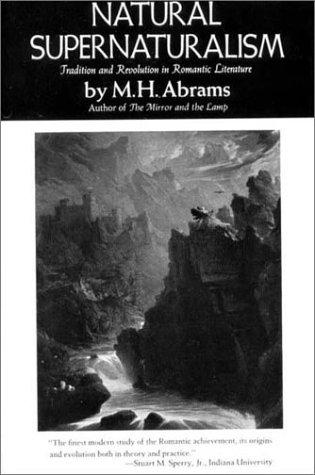
M.H. Abrams’s Natural Supernaturalism (1971) makes an argument that literary criticism has never fully absorbed because its implications reach far beyond literature. The book demonstrates that the major Romantic poets and philosophers—Wordsworth, Blake, Hölderlin, Schelling, Hegel, Novalis—did not discard the Christian narrative of paradise, fall, and redemption. They transposed it. The theological drama that had been projected onto cosmic history was relocated into the odyssey of individual consciousness: the mind’s original unity with nature, its alienation through reflexive self-awareness, and its potential return to a higher, self-conscious integration. This is not secularization in any reductive sense. It is a deliberate, systematic re-mapping of soteriological structure onto psychological experience. As Karen Armstrong observes in A History of God, this “reconstituted theology translated the old themes of hell and heaven, rebirth and redemption into an idiom that made them intellectually acceptable to the post-Enlightenment, depriving them of their association with a supernatural Reality ‘out there.’” Abrams’s genius is to show that this translation was not loss but metamorphosis—the salvific pattern survived intact, now operating within the terrain of the psyche. The Romantics, in effect, built the conceptual architecture that depth psychology would later inhabit without always acknowledging its landlord.
The Spiral of Return Is the Hidden Blueprint of Individuation
The structural spine of Abrams’s argument is the pattern he traces from Plotinus through Christian Neoplatonism to German Idealism and English Romanticism: the circuitous journey, the spiral in which consciousness departs from an original wholeness, traverses alienation, and returns to unity—but now self-aware, enriched by the passage through division. This is not ornamental intellectual history. It is the deep grammar of what Jung would later call individuation: the ego’s necessary separation from the unconscious totality (the Self), its confrontation with shadow, anima, and the fragmented multiplicity of psychic life, and its eventual reintegration at a level that includes conscious relationship to what was formerly only unconsciously given. Edward Edinger’s reading of Wordsworth’s “Intimations Ode” in his lectures on Greek philosophy makes the link explicit: Wordsworth’s “trailing clouds of glory” describes precisely the ego emerging from participation mystique with the archetypal psyche, the numinous wholeness that precedes differentiated consciousness. Abrams’s contribution is to show that this pattern was not invented by any single Romantic thinker but was a collective intellectual achievement, a civilizational response to the Enlightenment’s disenchantment of the cosmos. Richard Tarnas, in Cosmos and Psyche, places depth psychology at “the precise intersection of the two great polarities of the modern sensibility, the Enlightenment and Romanticism.” Abrams’s book is the most rigorous demonstration of what that Romantic polarity actually contained: not vague sentiment, but a fully articulated metaphysics of consciousness operating through narrative form.
The Imagination Replaces Grace—And This Replacement Has Consequences Depth Psychology Still Negotiates
Central to Abrams’s thesis is the Romantic elevation of the creative imagination to the status previously held by divine grace. In the older theological framework, fallen humanity required an external saving intervention. In the Romantic framework, the imagination itself becomes the redemptive faculty—the power that reconciles subject and object, mind and nature, finite and infinite. Keats’s declaration that “the imagination seizes as beauty must be truth” and Wordsworth’s account of the “blessed mood” in which “we see into the life of things” are not aesthetic preferences; they are epistemological claims of the highest order, assertions that a mode of knowing beyond discursive reason can disclose reality. Jung’s seminar discussions on Romanticism confirm this reading with striking directness. He describes the Romantic encounter with the unconscious as an event in which “vital contents that had got lost through the Enlightenment were forced upon them with such force that they exerted a heating and vaporizing influence on consciousness.” The Romantics perceived, Jung argues, “the reality of the existence of these inner states and contrasted it with outer reality”—which is to say, they discovered psychic reality. But Jung also notes their failure: “A real attempt to conceptualize these things was never made.” Hillman picks up exactly this thread in The Soul’s Code when he declares his intention to “set psychology back two hundred years, to the time when Romantic enthusiasm was breaking up the Age of Reason,” seeking to recover the Romantic insistence that the poetic imagination is psychology’s proper organ. Abrams shows that this was not naïveté on the Romantics’ part but a deliberate philosophical program—one that Hillman’s archetypal psychology and Jung’s analytical psychology both continue, whether they acknowledge the lineage or not.
Why Natural Supernaturalism Remains the Indispensable Bridge Between Literary and Psychological Traditions
Abrams’s work matters to depth psychology because it provides what depth psychology itself has largely failed to articulate: a precise intellectual genealogy for its own foundational assumptions. The idea that consciousness develops through a spiral of alienation and return, that the imagination is a faculty of knowledge rather than mere fancy, that religious experience can be preserved within a post-theistic framework without being reduced to pathology—these are not Jungian inventions or Hillmanian provocations. They are Romantic inheritances, and Abrams traces them with a philological rigor that no depth psychologist has matched. Stephan Hoeller’s account in The Gnostic Jung of the Pansophic tradition flowing from Gnosticism through alchemy to depth psychology names the esoteric lineage; Abrams supplies the exoteric, philosophical one. Tarnas rightly observes that depth psychology “took up the enduring passions and concerns of the Romantic project,” but Natural Supernaturalism is the book that maps those passions with sufficient granularity to show exactly what was taken up, what was transformed, and what was lost. For anyone working within the depth tradition today, Abrams’s book is not background reading—it is the mirror in which the tradition can finally see the shape of its own face.
Sources Cited
- Abrams, M.H. (1971). Natural Supernaturalism: Tradition and Revolution in Romantic Literature. W.W. Norton.
- Abrams, M.H. (1953). The Mirror and the Lamp: Romantic Theory and the Critical Tradition. Oxford University Press.