 Seba.Health
Key Takeaways
- Arroyo's central achievement is not popularizing astrology but providing a phenomenological grammar for lived experience that bridges Jung's four functions and the elemental typology without collapsing either into the other—making the elements operational categories for psychotherapy, not merely classificatory labels for personality.
- The book dismantles the fatalistic tradition of "good" and "bad" planetary placements by grounding astrology in the language of energy flow and blockage, effectively translating what Dane Rudhyar theorized as "harmonic astrology" into a clinically usable framework for counseling practice.
- By insisting that the four elements describe modes of energy exchange rather than fixed character types, Arroyo quietly resolves the tension between Rudhyar's structural formalism and Liz Greene's depth-psychological approach, positioning the birth chart as a map of dynamic process rather than a portrait of static identity.
The Four Elements as Phenomenology of Energy, Not Taxonomy of Character
Stephen Arroyo’s Astrology, Psychology, and the Four Elements performs a deceptively simple maneuver that reconfigures how astrology interfaces with depth psychology: it redefines the elements—Fire, Earth, Air, Water—not as personality categories but as modes of energy exchange between the individual psyche and its environment. Where traditional astrology inherited the Aristotelian-Galenic model of the four temperaments as fixed constitutional types, and where popular sun-sign astrology reduced them further to caricature, Arroyo treats each element as a field of experience through which consciousness flows. Fire is not “the aggressive type”; it is the mode by which intuition and will encounter life as creative impulse. Water is not “the emotional type”; it is the psychic medium through which feeling and unconscious imagery operate. This reframing has enormous consequences. It means that an “imbalance” in the elements—say, a chart lacking Water—does not predict a deficit of emotion but describes a specific energetic pattern in which the feeling function must find alternative channels, often through compensation, projection, or somatic expression. Arroyo’s elemental psychology thereby converges with Jung’s theory of the inferior function without being reducible to it. Jung mapped four functions (Thinking, Feeling, Sensation, Intuition) as orientations of consciousness; Arroyo maps four elements as fields of lived energy that include but exceed the psychological. The distinction matters: Arroyo’s framework encompasses the body, the interpersonal field, and the transpersonal dimension in ways Jung’s purely intrapsychic model does not.
Rudhyar’s Structural Vision Made Therapeutically Concrete
Arroyo’s debt to Dane Rudhyar is immense but rarely articulated with precision. Rudhyar, in The Astrology of Personality (1936), insisted that astrology is “an art of interpretation” rather than a science of prediction, that the birth chart reveals “the morphology of the soul,” and that its symbols must serve “the process of individuation.” Rudhyar’s vision was grand, philosophically sophisticated, and deliberately abstract—he compared astrology to algebra, a formal system requiring “psychological analysis” to supply its “substantial contents.” Arroyo takes this algebraic framework and gives it clinical flesh. Where Rudhyar speaks of form and archetype, Arroyo speaks of how a person with dominant Fire and minimal Earth actually lives: the restlessness, the inability to sustain routine, the craving for meaning at the expense of material stability. Where Rudhyar theorizes that “astrology is the male element” and “psychology is the female element” in a complementary marriage, Arroyo performs that marriage in practice, integrating Jungian developmental psychology, humanistic counseling principles, and elemental analysis into a unified interpretive act. The result is a book that functions as a practitioner’s manual without sacrificing philosophical depth—something Rudhyar’s own work, for all its brilliance, never quite achieved.
The Elemental Balance as Diagnostic of Psychic Splits
Liz Greene, writing in Relating and in her seminars with Howard Sasportas at the Centre for Psychological Astrology, would later elaborate extensively on what she called “splits in the psyche” as revealed by elemental imbalance in the birth chart. Greene describes a person with eight planets in Air and nothing in Water as someone who “will identify very strongly with the rational side of the psyche and will have great problems accommodating and accepting his or her feelings.” This clinical observation is precisely the territory Arroyo opened. His contribution was to establish that elemental distribution is not a secondary or decorative feature of chart interpretation but a primary diagnostic: the first thing a psychological astrologer should assess. The distribution of planets across Fire, Earth, Air, and Water tells you how a person’s energy is structured before you examine any single aspect or house placement. Arroyo understood that this elemental ground—what he calls the person’s “energy pattern”—determines how all other chart factors will be experienced. A Saturn square to the Moon means something categorically different in a chart dominated by Water than in one dominated by Air. Greene’s later elaborations, and indeed Richard Tarnas’s insistence in Cosmos and Psyche that astrological archetypes are “multivalent” and “participatory,” are downstream consequences of Arroyo’s foundational move: making the elements the irreducible substrate of astrological-psychological interpretation.
Energy as the Missing Bridge Between Archetype and Experience
The concept of energy is Arroyo’s quiet revolution. Traditional astrology spoke of “influences”; Rudhyar spoke of “symbols”; Jung spoke of “archetypes.” Arroyo speaks of energy—and in doing so, he provides a term that is simultaneously psychological, somatic, and relational. When he describes Fire as “radiating energy outward” or Water as “absorbing and containing energy,” he is not being metaphorical. He is describing phenomenological realities that any therapist, bodyworker, or attentive human being can verify. This language of energy allowed Arroyo to sidestep the metaphysical debates that had paralyzed astrological theory—is astrology causal or synchronistic? Are planets agents or symbols?—by focusing on what actually happens in human experience. Energy flows, gets blocked, compensates, erupts. The birth chart maps these patterns. Therapy, self-awareness, and conscious living consist in working with these patterns rather than against them. Tarnas would later articulate the philosophical framework for this participatory cosmology with extraordinary rigor in Cosmos and Psyche, but Arroyo had already built the experiential foundation: the elements as fields of lived energy through which archetypal dynamics become palpable.
For anyone encountering depth psychology through the astrological tradition today, Arroyo’s book remains the indispensable bridge text—the work that demonstrates, with practical clarity, that the birth chart is not a fate document but an energy map, and that reading it well requires not technical mastery alone but a psychologically literate understanding of how human beings actually organize, express, and repress the elemental forces that constitute their lives. No other single volume makes this case with comparable directness, accessibility, and therapeutic utility.
Sources Cited
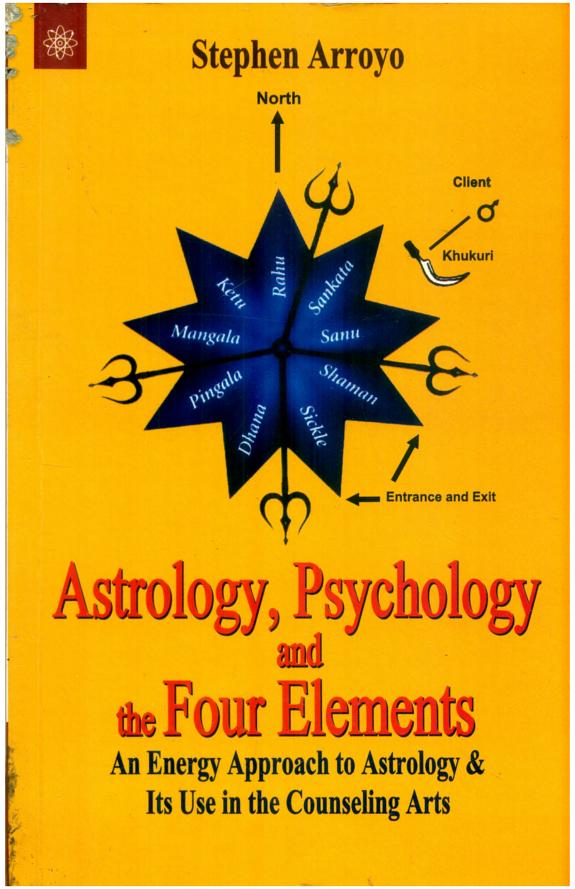
- Arroyo, S. (1975). Astrology, Psychology, and the Four Elements: An Energy Approach to Astrology and Its Use in the Counseling Arts. CRCS Publications.
- Jung, C.G. (1971). Psychological Types. Collected Works, Vol. 6. Princeton University Press.
- Rudhyar, D. (1936). The Astrology of Personality. Aurora Press.
- Greene, L. (1976). Saturn: A New Look at an Old Devil. Weiser Books.