 Seba.Health
Key Takeaways
- Otto's central achievement is not a new interpretation of Dionysus but a demolition of the epistemological framework that made all previous interpretations possible — the assumption that cult is instrumental and myth is ornamental, rather than both being immediate expressions of divine encounter.
- The book's insistence that madness is not a symptom to be explained but a cult form intrinsic to Dionysus's nature directly anticipates and exceeds Hillman's later critique of psychology's pathologizing impulse, grounding the defense of madness not in therapeutic theory but in theological ontology.
- Otto's treatment of the Apollo-Dionysus duality as a mutual necessity rather than a dialectical opposition reveals a structure of psychic wholeness that operates outside Hegelian synthesis — closer to Jung's coincidentia oppositorum than to Nietzsche's agonistic model, yet beholden to neither.
Cult Is Not Ritual but Ontological Testimony: Otto’s Destruction of the Functionalist Premise
Walter F. Otto opens Dionysus: Myth and Cult not with the god but with the question of method — and this is the book’s most radical gesture. Before a single myth is recounted, Otto dismantles the entire apparatus of nineteenth- and early twentieth-century scholarship that treated cult as utilitarian practice and myth as decorative rationalization. “If myths and cults did not come into the world as idle tales and as actions geared to a useful purpose but as creations of a monumental nature like buildings and sculptures, then we must criticize the process of their formation in the same way in which creative processes must be criticized.” This sentence rewrites the rules of engagement. Cult is not magic performed for agricultural yield; it is the body’s immediate sculptural response to divine encounter. The ram carried around Tanagra is not a germ-absorbing sponge but a living re-enactment of Hermes’ protective walk. The women who search for Dionysus at the Agrionia are not performing symbolic theater; they are the mythic nurses, activated by “the primal force of divine revelation.” Otto quotes Schelling to clinch the point: the phenomenon must expand our ideas, not be curtailed to fit them. This methodological overture deserves comparison with Jung’s insistence in Symbols of Transformation that amplification — not reduction — is the proper response to psychic images. But where Jung still operates within a psychological framework that positions the ego as the site of meaning-making, Otto refuses any mediating structure. The god is real. The cult is the god’s presence reverberating through human bodies. There is no hermeneutic gap to bridge.
Madness as Theophany, Not Pathology: The Ontological Status of Dionysiac Frenzy
The heart of the book is Otto’s rehabilitation of madness as a divine attribute rather than a human malfunction. Modern scholars, he argues, have tried to explain Dionysiac frenzy “in terms of human needs, whether spiritual or material” and have “ended in complete failure.” The women who tear fawns apart, who abandon loom and shuttle for the mountain, who kill their own children in ecstatic fury — these are not victims of a disorder. They are participants in the god’s own nature. Dionysus “is not only the exultant god, the god who brings man joy. He is the suffering and dying god, the god of tragic contrast.” The hunter is hunted; the render of men is himself rent. Otto’s formulation here — “the god himself suffers the horror which he commits” — is among the most powerful sentences in twentieth-century religious scholarship. It establishes madness not as a breakdown of order but as the irruption of a reality that is simultaneously creative and annihilating. This directly illuminates what James Hillman later develops in Re-Visioning Psychology: the insistence that pathologizing is a legitimate mode of soul-making, not a deviation from health. But Otto goes further than Hillman ever does, because he locates the source of this duality not in the psyche’s autonomous imagining but in the god’s own being. The ecstasy of life and the ecstasy of destruction are not metaphors for intrapsychic dynamics; they are the two faces of a single divine reality that precedes and exceeds the human.
The Vine Is Not a Symbol but a Second Birth: Otto’s Theology of Substance
Otto’s treatment of wine is a masterclass in thinking through substance rather than through symbol. Against scholars who claimed Dionysus was a “general vegetation deity” who only later became associated with the vine, Otto insists that wine was always the god’s essential manifestation. His argument is not merely historical — though he marshals Homer, Aeschylus, and the miracle-cults of epiphany to prove the antiquity of the association — but ontological. Wine undergoes a second birth: the grape dies on the vine and is reborn as intoxicant, just as Dionysus was ripped from Semele’s burning womb and born again from Zeus’s thigh. “Like him, it, too, is complete only through the miracle of a second birth.” The fiery nature of wine mirrors the lightning-born god; Archilochus begins his hymn with “struck by wine’s lightning bolt.” This is not analogy. Otto’s entire argument depends on collapsing the distance between sign and referent. The vine does not represent Dionysus; it is the god rising from the earth in liquid form. This theological realism has profound resonance with Erich Neumann’s treatment of the Great Mother’s material manifestations in The Great Mother, where grain, blood, and milk are not symbols of the feminine but its concrete operations. Yet Otto’s insistence on the specificity of the vine — that Dionysus is not vegetation in general but this particular plant with this particular power to enchant — stands as a rebuke to all archetypal generalizations that dissolve the particular into the universal.
Apollo and Dionysus as Mutual Necessity, Not Dialectical Opposition
Otto’s final chapters on the Apollo-Dionysus relationship represent perhaps the most consequential revision of a topos that Nietzsche made famous. Where The Birth of Tragedy stages the two gods as antagonists whose tension generates art, Otto sees “an inner necessity to supplement the scope of his own domain by the proximity of the other.” Apollo did not tolerate Dionysus at Delphi; he sought him out. The thyiads danced for both. Thyia, who first served Dionysus, bore Apollo’s son Delphos. This is not synthesis but complementarity — “the eternal contrast between a restless, whirling life and a still, far-seeing spirit” held together not by resolution but by sacred marriage. The mask, which Otto identifies as the symbol of Dionysiac duality — “the incarnate presence of that which is remote, the shattering encounter with the irrevocable, the fraternal confluence of life and death” — becomes the threshold where the two gods’ domains touch. For anyone working within Jungian psychology, this reframes the individuation process: wholeness is not the ego’s integration of opposites but the psyche’s capacity to stand at the junction where Apollonian clarity and Dionysiac dissolution both make their claims.
This book matters today not as classical scholarship — though it remains formidable on those terms — but as a corrective to every psychology and every spirituality that treats the irrational as a problem to be managed. Otto demonstrates, with a philologist’s precision and a theologian’s conviction, that the god who drives women mad and tears himself apart is not an archaic embarrassment but the deepest testimony Greek religion offers about the nature of reality itself. No other book in the depth psychology library makes the case that the divine is not a metaphor for the psyche but the ground from which the psyche arises — and that to encounter that ground is to be shattered and remade.
Sources Cited
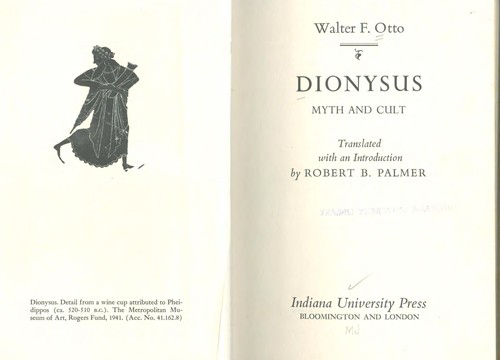
- Otto, Walter F. (1965). Dionysus: Myth and Cult. Trans. Robert B. Palmer. Indiana University Press.
- Otto, Walter F. (1954). The Homeric Gods: The Spiritual Significance of Greek Religion. Trans. Moses Hadas. Pantheon.