 Seba.Health
Key Takeaways
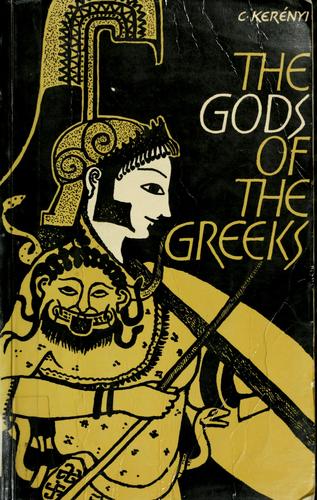
- Kerényi's *The Gods of the Greeks* is not a mythology handbook but an experiment in restoring mythological narration as a psychic medium — a deliberate attempt to translate "dead matter" back into the resonant, echo-awakening activity the Greeks called *mythologia*.
- The book's structure — moving from pre-Olympian cosmogonic chaos through the full genealogical web of the gods to the mysteries of Dionysos — enacts the psyche's own movement from undifferentiated ground to differentiated multiplicity, making it a phenomenology of polytheistic consciousness avant la lettre.
- By treating mythology as "material sui generis" with its own laws rather than as allegory, literature, or theology, Kerényi established the very foundation upon which Hillman, López-Pedraza, and David Miller could later build archetypal and polytheistic psychologies.
Mythology Is Not About the Gods — It Is the Psyche Externalized in Images
Kerényi opens The Gods of the Greeks with a theoretical claim that most readers rush past on the way to Zeus and Aphrodite, but it is the spine of the entire project. When mythology is “freed from the superficial psychology of previous presentations, and is revealed in its original context as material sui generis and having its own laws,” it produces “the effect of an activity of the psyche externalised in images.” This is not a decorative metaphor. Kerényi is asserting that Greek myth, properly narrated, is psychology — not because it symbolizes psychological concepts, but because it operates in the same medium as dreams, with the same degree of imaginal directness. He makes the comparison explicit: “dreams and mythology are nearer to one another than dreams and poetry.” The entire book that follows is constructed as an experiment to prove this claim — an “artificially constructed situation, an openly admitted fiction” designed to translate fragments of ancient source material back into the living medium of mythological storytelling, where the audience recognizes that the story “personally concerned the narrator and the audience.” This positions Kerényi against every rationalist mythographer from H. J. Rose to the structuralists. Rose’s famous characterization of the Greeks as “sane, high-spirited, clearheaded, beauty-loving optimists” whose legends are “free from cloudiness” is precisely the “superficial psychology” Kerényi wants to dissolve. Where Rose sees reasonable gentlemen, Kerényi sees the psyche in its full, dark, pre-Olympian complexity — Echidna, the Gorgons, the Erinyes — as imaginal realities that demand encounter rather than explanation.
The Genealogical Architecture Mirrors the Stratification of Psychic Life
The book’s table of contents is itself an argument. Kerényi begins not with Zeus or the Olympians but with Okeanos and Tethys, Night and the Egg, Chaos and Gaia — the pre-personal, pre-differentiated ground out of which all divine figures emerge. He then moves through the Titans, the Moirai, Hekate, and the archaic bogies (Skylla, Lamia, Empousa), only arriving at the familiar Olympians after establishing their deep genealogical roots in something older and stranger. The book culminates not with Zeus’s sovereignty but with Dionysos — the god of dissolution, ecstasy, and death-in-life. This is not arbitrary sequencing. It mirrors the stratification of psychic experience itself: from the oceanic undifferentiated, through the chthonic and fate-bound, into the differentiated world of Olympian consciousness, and finally into the Dionysian mysteries where differentiation is both achieved and dismembered. Hillman would later draw on exactly this insight in Re-Visioning Psychology, arguing that “Greek polytheistic complexity bespeaks our complicated and unknown psychic situations” and that Greek myth “serves less specifically as a religion and more generally as a psychology.” But Kerényi had already constructed the architecture for that claim. His genealogical ordering shows that the psyche is not a single sovereign figure (the ego-as-Zeus) but an entire kinship network of powers, many of them pre-rational, chthonic, and terrifying. The pre-Olympian deities receive as much careful narration as Apollo or Hermes — a formal decision that insists the archaic layers of psychic life deserve the same attention as its more conscious expressions.
The Book as Source Text for Archetypal Psychology’s Entire Polytheistic Project
To read Rafael López-Pedraza’s Hermes and His Children without Kerényi is to read commentary without text. López-Pedraza acknowledges this directly: “Karl Kerényi assembled these fragments in his book, The Gods of the Greeks, where, if we are lucky, we can read on just one or two pages enough to form an image.” He notes that “those pages were written after Kerényi had worked on a large bulk of classical literature,” meaning that the apparent simplicity of Kerényi’s narration conceals immense philological labor compressed into imagistic density. This is exactly the method: Kerényi draws on sources from Hesiod to Pausanias, from the Orphic Hymns to Proclus, but presents the mythological material not as a scholarly apparatus but as a living narrative that invites psychological participation. David Miller, in The New Polytheism, extends the Kerényian project into explicit theology, arguing that “the Gods and Goddesses are not cute allegories and analogies, figures of speech for evangelizing and moralistic orators … they are the empowering worlds of our existence; the deepest structures of reality.” And Hillman, in his 1983 articulation of archetypal psychology, distinguishes between gods as objects of religious belief and gods as “cosmic perspectives in which the soul participates” — a distinction that only becomes operational because Kerényi first demonstrated how to narrate the gods as psychic presences rather than as literary characters or theological propositions. The collaboration with Jung on Introduction to a Science of Mythology (1941/1951) provided the theoretical scaffolding — the concept of “individual mythology” as a synonym for psychology — but The Gods of the Greeks is the applied work, the full demonstration that a “collective psychology” can be restored through careful mythological narration.
Why This Book Remains Irreplaceable for Depth Psychology
Kerényi insists that the stuff of mythology “is composed of something that is greater than the story-teller and than all human beings” yet “always as something visible, perceptible or, at least, capable of being expressed in images, and never as the Godhead in abstracto.” This single sentence draws the decisive line between mythology and theology, between image and concept, that the entire tradition of archetypal psychology depends on. Without Kerényi’s demonstration that Greek myth can be narrated as psychology without being reduced to psychology, Hillman’s polytheistic project would lack its philological ground, López-Pedraza’s clinical imagism would lack its source texts, and Miller’s theological polytheism would lack its phenomenological warrant. For anyone encountering depth psychology today, The Gods of the Greeks provides what no Jungian commentary or archetypal essay can: direct, sustained, philologically grounded contact with the gods as they were actually told — not interpreted, not allegorized, not diagnosed, but narrated in the medium that allows them to seize the soul. It is the book that makes the entire polytheistic turn in psychology possible, and it does so by refusing to be a psychology book at all.
Sources Cited
- Kerenyi, Karl (1951). The Gods of the Greeks. Trans. Norman Cameron. Thames and Hudson.
- Kerenyi, Karl (1976). Dionysos: Archetypal Image of Indestructible Life. Princeton University Press.