 Seba.Health
Key Takeaways
- Tarnas does not argue for astrology as such but uses planetary-archetypal correlations as empirical leverage to crack open the central metaphysical commitment of modernity—the assumption that the cosmos is devoid of interiority—thereby repositioning the entire post-Copernican trajectory as an incomplete initiatory process rather than a settled epistemological achievement.
- The book's "two suitors" parable is not a rhetorical ornament but a rigorous epistemological argument: it demonstrates that the disenchanted stance is itself a participatory act, an unconscious projection of soullessness that the modern mind mistakes for neutral objectivity, inverting the very charge of "projection" that modernity levels against primal and archetypal consciousness.
- By linking Jung's synchronicity principle to Plato's archetypal cosmology through the concrete medium of planetary cycles, Tarnas constructs a bridge that neither Jung nor Hillman fully built—one that relocates archetypal psychology's ground from the interior psyche to the psyche-cosmos continuum, making depth psychology necessarily cosmological.
The Copernican Revolution Is Reframed as an Unfinished Initiation, Not a Completed Discovery
Tarnas’s governing argument is that the Copernican revolution was not simply an astronomical correction but the originating trauma of the modern psyche—a “prototypical act of deconstruction” that simultaneously liberated human reason and severed consciousness from any felt coherence with the cosmos. Every subsequent disenchanting move—Cartesian dualism, Kantian limitation, Darwinian blind mechanism, Freudian reductionism—is presented as an amplification of this single inaugural rupture. What makes the claim more than intellectual history is Tarnas’s insistence that this trajectory follows the structural logic of an initiatory descent: separation from the matrix, confrontation with meaninglessness, dark night of the soul, and—potentially—return to a deeper integration. He draws explicitly on Joseph Campbell’s hero journey, but the structural analogy functions at a civilizational rather than individual scale. The West’s alienation is not a terminal diagnosis; it is a phase within a larger archetypal pattern that requires completion. This framing is indispensable because it converts the postmodern crisis of meaning from a philosophical impasse into a developmental threshold. Where Heidegger diagnosed the “forgetting of Being” and left the matter suspended in waiting, Tarnas proposes that the very evidence capable of reopening the question—systematic correlations between planetary alignments and archetypal dynamics in human affairs—has been accumulating in plain sight, blocked only by the cosmological assumption it would overturn.
The “Two Suitors” Parable Exposes Disenchantment as the Modern Mind’s Own Unconscious Projection
The philosophical center of the book is its parable of two epistemological suitors approaching the cosmos. The first treats the universe as inert matter available for mastery; the second engages it as a co-creative intelligence worthy of reciprocal encounter. Tarnas is not merely recommending one attitude over another. He is making a precise epistemological argument: that the disenchanted world disclosed by the first suitor is not the objective cosmos but a cosmos constellated by that particular stance—an artifact of what the modern mind projects when it projects soullessness outward and then mistakes the resulting emptiness for “the facts.” This move directly parallels Jung’s concept of the shadow, but applied at the civilizational scale. The modern ego’s inflation consists not in claiming too much for itself but in denying interiority to everything that is not itself, a “long-hidden form of anthropocentric bias” that Tarnas identifies as the unexamined residue of Cartesian monotheistic subjectivity. Hillman’s critique in Re-Visioning Psychology—that psychology’s fixation on the interior of the human subject impoverishes soul by cutting it off from the world—finds its cosmological completion here. Where Hillman called for a “return of the soul to the world” through the recovery of the anima mundi, Tarnas supplies the empirical and philosophical architecture that would make such a return not merely a poetic gesture but a shift in the operative world view. The stakes are concrete: as long as the cosmos remains officially purposeless, every depth-psychological insight remains a “brave interpretive exercise in an alien cosmic environment,” incapable of genuine cultural authority.
Archetypal Astrology Bridges the Gap Between Jungian Synchronicity and Platonic Cosmology
Jung’s synchronicity principle, as Tarnas notes, was marked by “many conceptual incoherencies and confusions,” partly because Jung focused on paranormal anomalies rather than on the systematic, historically demonstrable correspondences that would have made the principle empirically testable. Tarnas’s research program—correlating major planetary alignments (especially outer-planet cycles involving Uranus, Neptune, and Pluto) with documented cultural, psychological, and biographical phenomena—is designed to supply exactly the missing empirical scaffold. The correlations he presents are not causal in the Newtonian sense; they are instances of what he calls “archetypal causality,” a mode of order that is Platonic in its formal structure but radically more fluid, participatory, and co-creative than classical Platonism allowed. Plotinus’s dictum that “everything breathes together” is invoked not as mystical decoration but as a precise description of the kind of coherence the data displays. This move has consequences for depth psychology that have not been fully absorbed. If archetypal dynamics are not merely intrapsychic phenomena but are correlated with measurable astronomical cycles, then the Jungian concept of individuation—as Robert Aziz argued—“extends beyond the psychological realm and assumes the character of a drama that takes the whole of nature for its stage.” Edinger’s model of the ego-Self axis, ordinarily understood as an interior topography, would need to be reconceived as a structure that implicates the individual psyche in the larger cosmic process. Stanislav Grof’s cartography of non-ordinary states, which already posits transpersonal and perinatal matrices that exceed individual biography, finds in Tarnas’s framework a cosmological ground that Grof himself acknowledged but never systematized with this degree of historical evidence.
Moral Imagination as Epistemological Prerequisite
Tarnas’s most radical claim is that cognition itself has a moral dimension—that “the quest for the true cannot be separated from the quest for the good.” This is not piety; it is a structural argument about participatory epistemology. If the cosmos one encounters is partly constellated by the quality of consciousness one brings to the encounter, then fear, greed, inflation, and reductive suspicion are not merely ethical failures but epistemological ones. They literally shape what can be known. The “hermeneutics of suspicion” that has dominated from Bacon through Derrida, while indispensable as a developmental discipline, becomes pathological when it operates without its complement, a “hermeneutics of trust.” Tarnas here converges with Goethe’s insight that “the very faculties we require for our knowledge can be developed only through our receptive engagement with what we wish to comprehend.” The study of archetypal forms opens the archetypal eye. This is precisely the logic that informs Jung’s insistence on the transformative effect of engaging the unconscious, Hillman’s demand that psychology honor the image before interpreting it, and Marion Woodman’s work on embodied soul-making. What Tarnas adds is the cosmological warrant: these are not merely therapeutic techniques but modes of participating in a cosmos that is itself intelligent, aesthetic, and responsive to the quality of human attention.
Why This Book Remains Singularly Necessary
No other work in the depth-psychological tradition attempts what Cosmos and Psyche accomplishes: the systematic reconnection of archetypal psychology’s interior insights with a publicly demonstrable cosmological order. Jung gestured toward it, Hillman demanded it, Campbell narrated its mythic precedents, Grof mapped its experiential geography—but Tarnas alone assembled the historical and astronomical evidence that makes re-enchantment something other than nostalgia. For anyone working within the depth tradition who has felt the invisible ceiling imposed by modernity’s dead cosmos, this book identifies the precise structural constraint and offers a concrete, evidence-based path beyond it.
Sources Cited
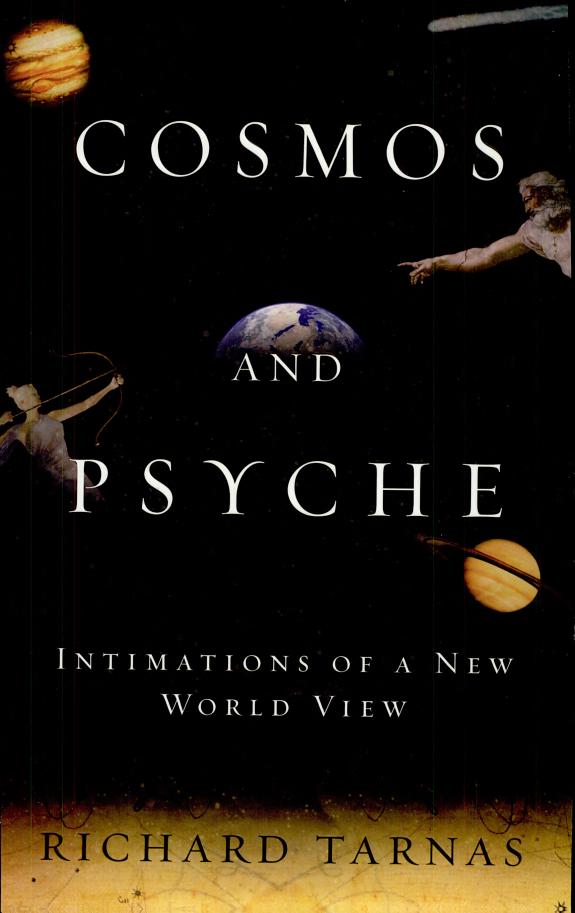
- Tarnas, R. (2006). Cosmos and Psyche: Intimations of a New World View. Viking/Penguin.
- Jung, C.G. (1960). Synchronicity: An Acausal Connecting Principle. Collected Works, Vol. 8. Princeton University Press.
- Tarnas, R. (1991). The Passion of the Western Mind. Harmony Books.
- Hillman, J. (1975). Re-Visioning Psychology. Harper & Row.