 Seba.Health
Key Takeaways
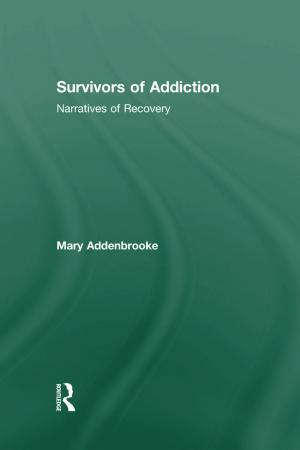
- Addenbrooke's *Survivors of Addiction* treats recovery narratives not as clinical case data but as genuine psychic events—soul stories in Hillman's sense—where the telling itself constitutes the therapeutic transformation rather than merely documenting it.
- The book implicitly demonstrates that addiction operates as a failed initiation rite: the addict's descent into darkness mirrors the mythic hero's journey but stalls without a symbolic container, a structural insight that links Addenbrooke's clinical work to Marion Woodman's concept of the "uninhabited body" and Cody Peterson's archetype of the Alcoholic.
- By centering lived narrative over diagnostic category, Addenbrooke challenges the fundamentalist identity formation Thomas Moore warns against—the reduction of a person to "I am an addict"—and instead uses story to restore the individuality of the soul.
Recovery Narrative as Psychological Poiesis, Not Clinical Exhibit
Mary Addenbrooke’s Survivors of Addiction (2011) operates at a precise intersection that most addiction literature misses entirely: the point where the telling of a recovery story becomes the recovery itself. This is not a book of case studies marshaled to validate a therapeutic model. It is a sustained argument—demonstrated through the narratives of people who have traversed addiction and emerged altered—that story is the medium through which the psyche metabolizes its own destruction and reconstitutes meaning. James Hillman, in Healing Fiction, made the claim that case histories are not empirical residues but “subjective phenomena, soul stories” whose chief importance lies in granting the subject a plot to live by, moving us “from the fiction of reality to the reality of fiction.” Addenbrooke’s book enacts exactly this principle. Each narrative she presents is not evidence for a theory; it is a psychological event, an act of poiesis in which the speaker discovers their own myth. The analyst’s role, as Addenbrooke frames it, is not to interpret the story from above but to attend to its unfolding with the discipline of someone who knows that the soul’s grammar reveals itself only to those who listen without premature synthesis.
Addiction as Failed Initiation and the Hunger for Symbolic Life
What gives Addenbrooke’s work its depth-psychological seriousness is her implicit recognition that addiction is not primarily a behavioral disorder but a spiritual crisis rooted in the absence of adequate symbolic containers. Marion Woodman articulated this with characteristic precision: addicts “are profoundly religious people” who “want something bigger than the bread-and-butter world,” and the addictive substance functions as a distorted sacrament—alcohol as counterfeit spirit, food as counterfeit maternal embrace. Woodman’s own journey from anorexia through decades of embodied analytical work demonstrated that the addiction marks the site of a “failed initiation rite,” a threshold the psyche reached but could not cross because no ritual structure existed to hold the passage. Addenbrooke’s narrators confirm this pattern repeatedly. Their stories reveal not moral weakness or neurochemical hijacking but a psyche starving for metaphor, reaching for substances that temporarily simulate the numinous contact the culture has ceased to provide. The recovery narratives she collects are therefore records of belated initiations—passages through darkness that finally found a container, whether in therapeutic relationship, in Twelve Step fellowship, or in the narrative act itself. This positions Addenbrooke’s clinical contribution as a direct complement to Cody Peterson’s thesis in The Shadow of a Figure of Light that the Twelve Steps constitute a modern myth of expanding consciousness, one that emerged precisely because traditional religious structures had failed to address what Peterson, channeling Jung, calls “a spiritual thirst of our being for wholeness.”
Against Fundamentalist Identity: The Particular Soul Beneath the Label
Thomas Moore, in Care of the Soul, warned against what he called the fundamentalism of self-identification: the moment when “I’m an alcoholic” or “I’m a survivor” ceases to be a courageous confession and calcifies into a fixed identity that screens the person from their own mystery. “Soul provides a strong sense of individuality,” Moore wrote, and “identifying with a group or a syndrome or a diagnosis is giving in to an abstraction.” Addenbrooke navigates this tension with considerable skill. Her narrative method insists on the particular—the specific texture of each person’s descent, the idiosyncratic images that populated their darkness, the unrepeatable moment when meaning reasserted itself. She does not deny the clinical reality of addiction as a shared condition, but she refuses to let diagnosis replace story. In this she aligns with Hillman’s insistence that we need to “de-moralize our images, letting them speak for themselves rather than for an ideology that restricts and slants them.” The narratives in Survivors of Addiction are not parables illustrating a predetermined recovery arc. They are dense, contradictory, layered documents of psyche in motion, and their therapeutic power resides precisely in their refusal to resolve into a single lesson.
The Body of the Story and the Story of the Body
Addenbrooke’s work also carries an implicit somatic dimension that connects it to Woodman’s central insight: that the voice saying “I am unlovable” lives in the cells, not merely in cognition, and that transformation must therefore reach the body. The recovery narratives she presents are not disembodied accounts of insight. They are stories told by people whose bodies carried the full weight of their addiction—whose organs failed, whose hands shook, whose flesh bore the evidence of years of self-destruction. When these bodies speak their stories, something shifts at a level deeper than conceptual understanding. Woodman called this “soul-making” rather than psychology, and Addenbrooke’s method participates in the same tradition. The analyst who receives these narratives is not extracting data; she is witnessing incarnation, the moment when lived suffering finds symbolic form and thereby becomes bearable. Peterson’s archetype of the Alcoholic—“a personification of the coniunctio oppositorum, an image of wholeness whose function is to evoke a reconciliation of the opposites”—finds its clinical ground here, in the bodies and voices of Addenbrooke’s narrators.
Why This Book Matters Now
Survivors of Addiction occupies a space no other book in the depth psychology library quite fills. It is neither a theoretical treatise on addiction’s archetypal dimensions (Peterson, Woodman) nor a philosophical meditation on story and soul (Hillman, Moore). It is the clinical evidence that these theoretical frameworks actually hold when tested against the raw material of human suffering and recovery. For anyone encountering depth psychology through the lens of addiction—and in a culture where, as Peterson notes, the entire civilization might be called “powerless over alcohol”—Addenbrooke’s book provides the irreplaceable thing: actual voices speaking from the other side of the descent, demonstrating that the mythic journey is not metaphor but lived reality.
Sources Cited
- Addenbrooke, M. (2011). Survivors of Addiction: Narratives of Recovery. Routledge.
- Brown, S. (1985). Treating the Alcoholic: A Developmental Model of Recovery. Wiley.
- Jung, C. G. (1961). Letter to Bill Wilson. In The Bill W.–Carl Jung Letters.