 Seba.Health
Key Takeaways
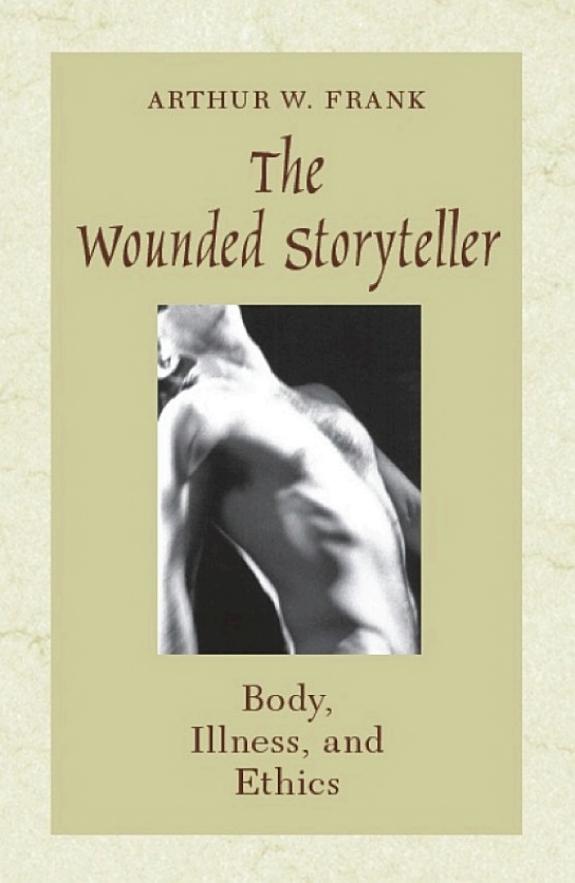
- Frank's three illness narratives—restitution, chaos, and quest—function not as literary categories but as diagnostic instruments for identifying how a culture's narrative monopolies colonize individual suffering, making *The Wounded Storyteller* a work of applied ethics disguised as narrative typology.
- The book's central ethical claim—that the ill body becomes a "communicative body" capable of witnessing for others—inverts the Cartesian medical gaze and positions the patient not as object of clinical knowledge but as a figure structurally equivalent to Hillman's wounded healer, where consciousness breaks through dismemberment rather than wholeness.
- Frank's insistence that illness stories must remain unfinished and resist moral closure directly challenges what Thomas Moore calls "fundamentalist stories about ourselves"—narratives reduced to axioms—making the book a sustained argument that ethical life requires narrative tolerance for chaos.
The Ill Person Is Not a Case History but an Ethical Agent Whose Body Speaks
Arthur Frank wrote The Wounded Storyteller from the wreckage of his own body—a heart attack at thirty-nine, testicular cancer shortly after—and from that wreckage constructed not a memoir but a moral philosophy of illness. The book’s foundational move is to wrest the sick person from the role of passive informant in someone else’s clinical narrative and reposition that person as the author of a story with irreducible ethical weight. Frank names what medicine systematically suppresses: that the ill body is not merely a malfunctioning organism awaiting repair but a site of testimony. His term “communicative body” designates a body that has turned its suffering outward, offering its experience to others not as data but as witness. This is not sentimentality. Frank grounds his claim in the observation that modernist medicine produces what he calls the “colonization” of the patient’s story—the clinical chart, the case history, the diagnostic code all translate embodied suffering into institutional language that serves the institution’s purposes, not the sufferer’s. The patient becomes what Hillman, in Healing Fiction, identified as the object of a “case history” that functions as fiction pretending to be science—a narrative form whose conventions remain invisible precisely because they masquerade as transparent description. Frank extends this critique from the consulting room to the hospital ward: the restitution narrative (“I was sick, medicine fixed me, I am well”) is not simply one story among many but the culturally dominant narrative that actively suppresses other ways of telling.
Chaos Narrative Is Not a Failure of Storytelling but Its Most Honest Form
Frank’s taxonomy of illness narratives—restitution, chaos, and quest—has been widely adopted, but its radical edge is almost always blunted in reception. The chaos narrative is the key. In chaos, the teller cannot impose sequence, cannot find causation, cannot locate a self that persists through the experience. The story collapses into present-tense fragments: “and then, and then, and then.” Frank insists that this is not narrative failure but the closest language can get to the body’s actual experience of dissolution. Here his work converges powerfully with Hillman’s account of dismemberment in Senex & Puer, where the Dionysian wound shatters centralized ego-consciousness into “primordial regions of organs, complexes, and erogenous zones.” Hillman writes that “healing comes then not because one is whole, integrated, and all together, but from a consciousness breaking through dismemberment.” Frank arrives at an almost identical position from sociological rather than archetypal premises: the chaos narrative must be honored not because it leads somewhere but because it is the sound of a body speaking from within its own destruction. The therapeutic and cultural reflex to hurry past chaos—to reassure, to reframe, to impose a redemption arc—is itself an act of violence against the teller. Listeners flee chaos because it threatens their own restitution fantasies.
The Quest Narrative Demands an Ethics of Listening, Not an Ethics of Cure
Frank’s third narrative type, the quest, is frequently misread as the “healthy” resolution of illness storytelling—the hero’s journey applied to cancer. Frank is more careful than his popularizers. The quest narrative transforms illness into an occasion for moral change, but Frank warns repeatedly against its commodification. The quest risks becoming what Thomas Moore, in Care of the Soul, identifies as a “fundamentalist story”—a narrative so devotedly believed that it screens out the mystery it claims to honor. Moore describes a woman who identified herself entirely as “an incest survivor,” collapsing her particularity into a collective category. Frank sees the same danger in the triumphant cancer memoir or the addiction recovery testimony that has hardened into creed. The quest narrative is ethically legitimate only when it remains open, when it refuses to convert suffering into a transferable lesson that closes down further questioning. Frank’s term for this openness is “thinking with stories” rather than “thinking about stories”—a distinction that parallels Hillman’s hermeneutic of “going with the story rather than interpreting it,” where psychological freedom lies in inhabiting the image rather than decoding it.
Testimony Replaces Diagnosis as the Primary Ethical Act
What Frank ultimately constructs is an ethics grounded not in principles but in testimony. The wounded storyteller bears witness; the listener’s ethical obligation is to receive that witness without domesticating it. This positions Frank’s work alongside but distinct from the Pauline theology of weakness that pervades the Christian tradition—the idea, articulated across the Corinthian correspondence, that God’s power is perfected in human fragility. Frank secularizes this structure without emptying it: the ill person’s authority derives precisely from vulnerability, not despite it. But where Paul’s theology resolves in eschatological hope—the resurrection vindicates the suffering messenger—Frank refuses final resolution. The wound does not heal into a scar that reveals identity, as with Odysseus; it remains open, speaking. This is Frank’s most challenging claim and his most necessary one. He asks readers to tolerate a form of narrative that does not conclude, that resists the “moral of the story,” that leaves the body exposed. In doing so, he provides something no clinical manual or self-help book offers: a rigorous account of what it means to be present to suffering without converting it into something useful. For anyone working within depth psychology, trauma studies, or the phenomenology of embodiment, The Wounded Storyteller supplies the missing ethical vocabulary—the language for what happens between the wound and whoever is willing to stay in the room with it.
Sources Cited
- Frank, A. W. (1995). The Wounded Storyteller: Body, Illness, and Ethics. University of Chicago Press.
- Kleinman, A. (1988). The Illness Narratives: Suffering, Healing, and the Human Condition. Basic Books.
- Nouwen, H. (1972). The Wounded Healer. Doubleday.