 Seba.Health
Key Takeaways
- Neimeyer's central move is to reframe grief not as a process of emotional recovery but as an epistemological crisis — the collapse and rebuilding of the meaning structures through which a person has organized reality itself.
- The book breaks definitively with Kübler-Ross stage models by demonstrating that grief is not linear passage through affect states but an active, constructive project — closer to what Hillman calls "dreaming the myth along" than to any clinical protocol of emotional discharge.
- By positioning narrative as the primary vehicle of meaning reconstruction, Neimeyer implicitly recovers what depth psychology has always known: that the psyche heals through story, not through catharsis — a claim that connects his constructivist bereavement theory directly to Jung's insistence on the reality of psychic experience and Hillman's archetypal re-imagining of personal history.
Grief Is Not an Emotion to Be Processed but a World to Be Rebuilt
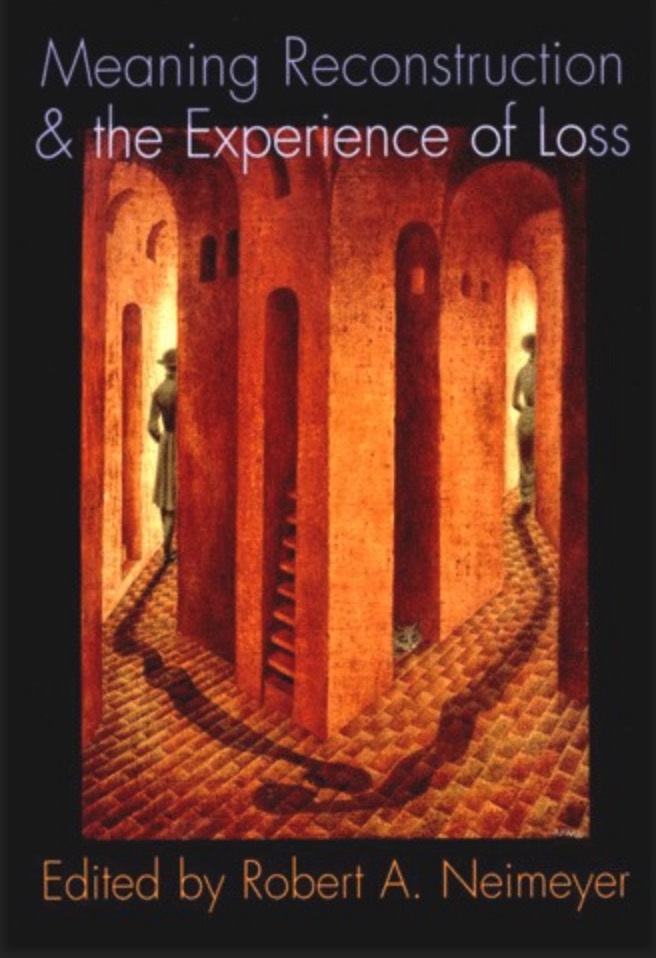
Robert Neimeyer’s Meaning Reconstruction and the Experience of Loss accomplishes something rare in the bereavement literature: it shifts the entire frame of reference from affect management to ontological reconstruction. The dominant paradigm Neimeyer confronts — the Kübler-Ross stage model and Freud’s concept of “grief work” as decathexis from the lost object — treats mourning as an emotional hydraulics problem. Energy is bound to the deceased; the task is to unbind it, redistribute it, and “move on.” Neimeyer dismantles this framework not by denying the reality of emotional pain but by demonstrating that the deeper crisis of bereavement is cognitive and existential: the death of a loved one shatters the assumptive world — the web of meaning, identity, and narrative coherence through which a person has understood who they are, what life means, and what is real. This is not a feeling problem. It is a meaning problem. The bereaved person does not simply hurt; they find themselves in a world that no longer makes sense. James Hollis, writing in Swamplands of the Soul, arrives at precisely this insight through the case of Devin, whose two-year disorientation after his wife’s death was “only the tip of a much deeper malaise and disaffection” — the collapse not merely of a relationship but of an entire provisional self organized around false meaning structures. Hollis names what Neimeyer theorizes: “a mythological disorientation.” Neimeyer gives this mythological disorientation a research program.
Narrative Is Not Decoration on Grief — It Is the Medium of Psychological Survival
The book’s most consequential theoretical claim is that meaning reconstruction occurs through narrative processes — the telling, retelling, revision, and co-construction of the story of the loss and, crucially, the story of the self that loss has shattered. Neimeyer draws on constructivist epistemology to argue that human beings do not passively receive meaning from the world; they actively build it through interpretive frameworks that are, at bottom, narrative in structure. When those frameworks collapse under the weight of catastrophic loss, the therapeutic task is not emotional ventilation but narrative repair. This positions Neimeyer closer to depth psychology than he perhaps intends. Hillman’s insistence, articulated in Suicide and the Soul, that the therapist’s role is to “enter the dream and dream the myth along with the patient” — to engage soul history rather than case history — is structurally identical to Neimeyer’s emphasis on co-constructing the bereaved person’s narrative. Hillman distinguishes between “case history,” which chronicles external facts, and “soul history,” which captures “emotions, fantasies, and images” through imaginative participation. Neimeyer, working from a constructivist rather than archetypal vocabulary, arrives at the same destination: the clinician’s task is not to diagnose or classify the mourner’s experience but to participate in the rebuilding of a story that can hold both the reality of the loss and the possibility of continued living. The convergence is not accidental. Both thinkers recognize that the psyche is fundamentally a meaning-making organ, and that its pathology is always, at root, a pathology of narrative coherence.
The Continuing Bond Replaces the Freudian Demand to “Let Go”
Neimeyer’s volume also champions the “continuing bonds” perspective developed by Klass, Silverman, and Nickman — the recognition that healthy mourning often involves maintaining an ongoing, transformed relationship with the deceased rather than severing the attachment. This directly contradicts the Freudian mandate of decathexis and resonates powerfully with Hollis’s account of Jung dreaming of his deceased wife Emma: “He saw Emma standing there, in white dress, smiling at him, and he knew the silence was broken. They were together, whether together or apart.” Hollis’s own experience of his deceased analyst Adolph Ammann appearing to him — “I have not lost him for he is still within” — illustrates exactly the phenomenon Neimeyer’s contributors theorize: the internalized relationship with the dead is not pathological clinging but a legitimate structure of meaning that sustains the living self. Where Freud saw continued attachment as melancholia, Neimeyer sees it as reconstruction. Where the stage model demands resolution, Neimeyer recognizes ongoing transformation. Erich Neumann’s observation that “the rediscovery of the human and cultural strata from which these symbols derive is in the original sense of the word ‘bildend’ — ‘informing’” provides the archetypal grounding for this claim: the dead inform us, shape us, remain constitutive of our psychological reality precisely because the psyche does not operate by severance but by integration.
Loss as the Crucible of Individuation, Not Its Interruption
Cody Peterson’s concept of “convergence” — the simultaneous experience of permanent loss, radical uncertainty, and utter powerlessness that creates a “closed system” in which no discharge is possible — provides the existential frame that Neimeyer’s clinical constructivism implicitly requires but does not fully articulate. Neimeyer demonstrates that meaning reconstruction is the task; Peterson reveals why the task is so difficult and so transformative: because genuine loss closes every exit, exhausts every active strategy of mastery, and forces the psyche into what Peterson calls the “Middle Voice” — a mode of being that is neither conquering nor collapsing but holding. Hollis names the same phenomenon: “Holding to the meaning and letting go of control is the double work of loss and grief.” Neimeyer’s book matters because it provides the empirical and clinical architecture for what depth psychology has always intuited — that loss is not an interruption of meaning but the condition under which deeper meaning becomes possible. For anyone encountering depth psychology today, this volume serves as the indispensable bridge between constructivist bereavement research and the tradition running from Jung through Hillman: it demonstrates with clinical rigor that the psyche’s response to annihilation is not regression but creation, not recovery of a prior self but the forging of one that did not exist before the loss.
Sources Cited
- Neimeyer, R. A. (Ed.). (2001). Meaning Reconstruction and the Experience of Loss. American Psychological Association.
- Klass, D., Silverman, P. R., & Nickman, S. (1996). Continuing Bonds: New Understandings of Grief. Taylor & Francis.
- Attig, T. (1996). How We Grieve: Relearning the World. Oxford University Press.