 Seba.Health
Key Takeaways
- Berry's figure of Echo is not a supplement to Narcissus but a complete counter-epistemology: a mode of psychological knowing that proceeds through reverberation, distance, and surface rather than through depth, identity, and self-reflection.
- The book performs what it theorizes — each essay "revisions" a standard analytic construct (defense, reduction, shadow, dream) not by replacing it but by echoing it into a new register, demonstrating that archetypal psychology's method is identical with its content.
- Berry's treatment of repetition as Echo's form of continuity — not compulsive pathology but aesthetic fidelity — offers the most rigorous phenomenology of the repetition compulsion available outside Freud, and one that directly challenges the Freudian framework by grounding repetition in beauty rather than the death drive.
Echo Is Not Narcissus’s Complement but Psychology’s Repressed Method
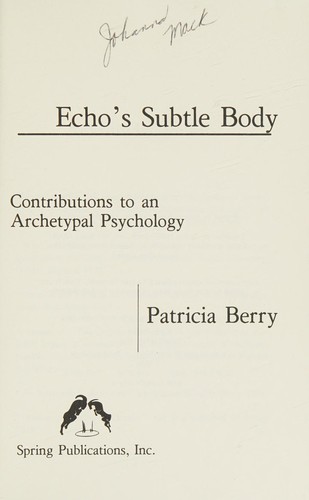
Patricia Berry’s Echo’s Subtle Body operates under a deceptive modesty. Collected between 1972 and 1982, these essays appear to be occasional pieces — conference papers, journal articles, guild lectures. Their actual achievement is systematic: Berry constructs a complete methodology for archetypal psychology by working through the figure of Echo as something far more radical than Narcissus’s neglected other half. Echo, in Berry’s reading, is the psyche’s own mode of operation — not originating meaning but catching it in reverberations, hollows, and the precise contours of what is already said. Where Hillman’s Re-Visioning Psychology (1975) lays the philosophical groundwork for an image-based psychology and polemicizes against ego-psychology’s literalism, Berry’s book does the clinical and methodological work that Hillman’s program requires but never quite delivers. She shows what it looks like, in practice, to stay with the image — not as a slogan but as a discipline of the ear.
The centerpiece essay, “Echo’s Passion,” makes the argument with mythological precision. Echo desires not Pan — not “everything” — but the singular, the narcissistically self-enclosed image. “You can’t be psychological everywhere,” Berry writes, insisting that Echo’s selectivity is constitutive, not deficient. This directly counters the therapeutic inflation that would psychologize all experience. Echo’s selectivity is also her suffering: she cannot consummate, cannot literalize her longing into fact. Berry draws out the Ovidian detail that Echo’s love “grows on grief,” that her body desiccates into voice and bone, and reads this not as pathology but as the creation of what she calls a “subtle body” — a structure of resonance that is more real, psychologically, than the physical body it replaces. This move parallels Henry Corbin’s concept of the mundus imaginalis as a realm with its own ontological density, but Berry grounds it in clinical experience rather than Sufi metaphysics. The subtle body is what you hear when a patient’s repetitions stop being noise and start being music.
Repetition Belongs to Beauty, Not to the Death Drive
Berry’s treatment of repetition is where the book makes its most original intervention. For Freud, repetition compulsion is governed by the death drive — a return to the inorganic that defies the pleasure principle. For Jung, verbal repetition flags the complex in the association experiment. Berry refuses both frameworks. In her reading, repetition is Echo’s form of continuity, the way a figure without “identity” in the conventional sense maintains duration. “To learn by heart — repetition goes to the heart, comes from the heart — is deep-seated.” Repetition is not compulsive return but aesthetic fidelity: the way a poem’s refrain deepens meaning through recurrence rather than merely restating it. This positions Berry against the entire therapeutic tradition that treats repetition as something to be overcome. When a patient tells the same story, uses the same phrase, returns to the same image, Berry hears not resistance but Echo’s passion — a longing for self-reflection that expresses itself precisely through the inability to originate. The clinical implications are immense: the therapist’s task shifts from interpreting repetition to echoing it with sufficient precision that its beauty becomes audible.
The Virginal Image Resists the Analyst’s Meaning-Making as a Form of Integrity
In “Virginities of Image,” Berry elaborates a taxonomy of ways images protect themselves from psychological appropriation. Hippolytus denies Aphrodite; Narcissus denies Echo; Cassandra denies Apollo. Each virginity represents a specific refusal of a specific mode of consciousness. The clinical brilliance here is Berry’s recognition that images in dreams resist interpretation not because the patient is defended but because the image itself has integrity — what she calls its virginal quality. This reframes “defense” from a concept about the ego to a quality belonging to the image. Where Guggenbuhl-Craig’s Power in the Helping Professions exposes the analyst’s shadow inflation, Berry exposes something subtler: the analyst’s hermeneutic greed, the compulsion to penetrate every image with meaning. The Cassandra pattern is especially acute — perceptions that are accurate but lack peitho, the power of persuasion. Berry shows that prophetic interpretations in analysis (“This dream is warning you about…”) arise precisely when the analyst cannot articulate the image’s present reality and projects its meaning into the future. This is formal analysis of therapeutic failure at a level of specificity that neither Hillman nor Jung achieves.
Training’s Shadow Is Standardization’s Destruction of Individuality
Berry’s final essay, “The Training of Shadow and the Shadow of Training,” delivered at the 1980 International Congress of Analytical Psychology, turns the book’s method on the Jungian institution itself. She argues that the push for uniform training standards among Jungian analysts constellates the very splitting it claims to remedy: “Talk of uniformity is destroying our unity.” The Jungian mind, rooted in individuation, cannot survive standardization without betraying its own principle. The true “Jungian commonality is rooted in each of us as individuals.” This is not anti-institutional posturing; it is the logical conclusion of the book’s entire argument. If Echo requires the particular — not Pan’s “everything” but Narcissus’s singular image — then a training program that enforces uniformity destroys the conditions under which psychological work can occur. Berry positions institutional Jungian psychology as Hera: concerned with fact, form, social establishment, literalizing the analytic relationship into credentialed procedures. Echo, the book’s presiding figure, works in the hollows beneath that establishment, making possible precisely the fertility that Hera’s consciousness cannot tolerate.
For a reader encountering depth psychology today — saturated with neuroscientific reductionism on one side and New Age inflation on the other — Berry’s book offers something unavailable elsewhere: a rigorous phenomenology of how psyche actually works with images, conducted by someone who practices what Hillman theorizes. Where Hillman gives you the philosophy, Berry gives you the ear.
Sources Cited
- Berry, P. (1982). Echo's Subtle Body: Contributions to an Archetypal Psychology. Spring Publications.
- Hillman, J. (1975). Re-Visioning Psychology. Harper & Row.
- Jung, C.G. (1951). Aion. In Collected Works, Vol. 9ii. Princeton University Press.