 Seba.Health
Key Takeaways
- Edinger does not merely explain Jung's late thought — he constructs from scattered remarks across Jung's letters, autobiography, and *Answer to Job* a coherent cosmological thesis: that consciousness is not a byproduct of evolution but the teleological purpose of creation itself, and that the individual ego is the organ through which divinity achieves self-knowledge.
- The book's most radical move is reclassifying the Trinity from theological dogma into a psychological formula for the generation of consciousness: Father and Son as the clash of opposites, the Holy Spirit as the "third thing" born from their collision — making every act of sustained inner conflict a participation in the divine process.
- Edinger positions depth psychology not as a successor to religion or science but as their synthesis — a "linked knowledge" that preserves Eros (religion's connective function) and Logos (science's knowing function), thereby offering a genuinely post-secular framework for meaning that neither regresses to faith nor stalls in empiricism.
The Ego Is Not a Problem to Be Dissolved but a Crucible Required by God
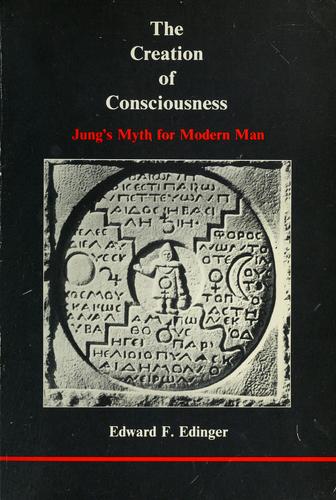
Edinger’s The Creation of Consciousness (1984) stakes a claim that runs directly against the grain of both Eastern-inflected spirituality and Hillman’s archetypal psychology: the ego is not an obstacle to the numinous — it is the vessel without which the numinous cannot know itself. The book distills Jung’s late-life statements, especially from Memories, Dreams, Reflections and the letters, into a single, unyielding proposition: “The purpose of human life is the creation of consciousness.” Edinger calls this “Jung’s myth for modern man” and treats it with the seriousness of a creed, while insisting it remains an empirical hypothesis rather than an article of faith. The foundational image is Jung’s revelation on the Athi Plains — watching the great herds of animals moving through the savanna and recognizing that without a conscious observer, the world “would have gone on in the profoundest night of non-being down to its unknown end.” Edinger reads this not as nature mysticism but as a cosmogonic event: man as “the second creator of the world.” This places the ego — Jung’s carrier of consciousness — at the center of a cosmic drama. Where Hillman in Re-Visioning Psychology sought to de-center the ego in favor of soul’s multiplicity, Edinger doubles down: consciousness requires an ego, and the ego’s suffering is not pathology but opus. The crucified Christ, in Edinger’s reading, is the image of the ego nailed to the cross of opposites, generating through agony a new substance — a “psychic substance produced by the experience of the opposites suffered, not blindly, but in living awareness.”
The Trinity Is a Formula for Psychogenesis, Not a Statement About Heaven
The book’s most audacious interpretive act is its psychological decoding of Trinitarian theology. Edinger reads Father and Son as a pair of opposites — God and man, infinite and finite — whose collision on the cross produces the Holy Spirit as a “third, transcendent condition which is a new quantum of consciousness.” Christ’s statement in John 16:7 — “It is to your advantage that I go away, for if I do not go away, the Counselor will not come to you” — becomes, in Edinger’s hands, a precise psychological instruction: identification with one term of an opposition must be sacrificed before consciousness can emerge from the tension between them. This is the coniunctio oppositorum that Jung tracked through alchemy in Mysterium Coniunctionis, and Edinger makes explicit what Jung often left implicit — that the alchemical opus and the Trinitarian procession describe the same psychic event. The Paraclete’s future “indwelling” anticipates, Edinger argues, a dispensation in which each individual ego becomes a vessel for transpersonal consciousness. The individual psyche is the Holy Grail, “made holy by what it contains.” This reading transforms the Grail legend from a medieval romance into a living symbol of the analytic task — a connection that von Franz explored in Alchemy and that Edinger’s earlier Ego and Archetype prepared the ground for, but which reaches its fullest theological articulation here.
God’s Unconsciousness Is the Engine of History
Edinger introduces what is perhaps the most unsettling proposition in the Jungian canon: God is unconscious and needs human consciousness to achieve self-knowledge. He quotes Jung’s letter to Erich Neumann — “being ‘made in the likeness’ applies not only to man but also to the Creator: he resembles man or is his likeness, which is to say that he is just as unconscious as man or even more unconscious” — and uses Answer to Job as the primary text demonstrating this thesis. The Yahweh of Job is not the omniscient, benevolent God of classical theology but a deity who acts from unconscious compulsion, who needs Job’s moral challenge to begin the long process of self-reflection that culminates in the incarnation. Edinger supports this with clinical material: a woman’s dream of a destructive gorilla-ape that turns out to be communicating about “the true meaning of Christianity,” and a man’s dream of a neckless ape-man associated with Yahweh and an autistic child. These dreams, Edinger insists, are not metaphors; they are empirical data showing that the modern psyche encounters the God-image in its archaic, pre-conscious form. The Gnostic figure of Ialdabaoth — the ignorant demiurge who boasts “there is none above me” — reappears in the consulting room. This reading places Edinger in direct dialogue with Neumann’s The Origins and History of Consciousness, but with a sharper theological edge: for Neumann, ego-development is the story; for Edinger, ego-development is a chapter in God’s story.
Depth Psychology as the Heir to Both Religion and Science
Edinger frames the historical moment with precision. Religion maintained the Eros-connection between ego and Self; science pursued Logos-knowledge at the cost of that connection. Neither suffices. The “new dispensation” that depth psychology represents is “linked knowledge” — con-scientia in its etymological sense of “knowing with.” The pursuit of consciousness unites what the Reformation tore apart: the sacramental immediacy of religious experience and the empirical rigor of scientific inquiry. Edinger is explicit that this new myth does not compete with existing religions but “elucidates and verifies every functioning religion by giving more conscious and comprehensive expression to its essential meaning.” This claim — that analytical psychology is genuinely ecumenical because it treats all living religions as expressions of individuation symbolism — is audacious. It echoes Jung’s own universalism but also anticipates the kind of comparative mythological work that Joseph Campbell popularized in less psychologically rigorous form.
What makes this book irreplaceable is its refusal to be either devotional or detached. Edinger writes as a clinician who has seen the new myth verified in dreams and as a scholar who can trace its lineage from Egyptian pyramid texts through Gnostic theology to alchemical symbolism. For anyone working with the question of meaning — not as an abstract philosophical exercise but as a daily, clinical, existential confrontation — The Creation of Consciousness provides the most concentrated and uncompromising articulation of what Jungian psychology ultimately claims: that your suffering, held in awareness, is not pointless. It is cosmogonic.
Sources Cited
- Edinger, E.F. (1984). The Creation of Consciousness: Jung's Myth for Modern Man. Inner City Books. ISBN 978-0-919123-13-7.
- Jung, C.G. (1952). Answer to Job. Collected Works, Vol. 11. Princeton University Press.