 Seba.Health
Key Takeaways
- Edinger's central methodological innovation is what he calls "network or cluster thinking" — a third mode beyond directed and fantasy thinking — which functions as the actual epistemological key to reading Jung's late alchemical work and, by extension, to navigating the autonomous psyche itself.
- The book recasts *Mysterium Coniunctionis* not as a treatise on alchemy but as a descriptive anatomy of the psyche, making Jung's final opus legible as a book of empirical facts about psychic structure rather than a speculative or historical exercise.
- By insisting that "the reality of the psyche has just been discovered" and "nobody knows it yet," Edinger positions the entire lecture series as an act of cultural transmission at a threshold moment — the point where the opus Christi is transferred from metaphysical dogma to the individual, completing the trajectory that runs from Jung's *Answer to Job* through *Aion* to *Mysterium*.
Mysterium Coniunctionis Is a Psychic Anatomy Text, and Edinger Is Its Dissector
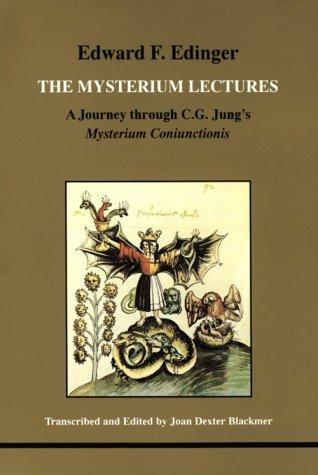
Edinger opens the lectures with a comparison that reveals his entire hermeneutic stance: Mysterium Coniunctionis is an anatomy book, and the difficulty it presents is the same difficulty a first-year medical student faces in the dissecting room — a sea of unfamiliar facts, each with a strange name, none of which become real until you work on the cadaver. The cadaver, for Edinger, is the psyche laid bare in analysis. This analogy is not decorative. It reframes Jung’s final masterwork from a historical study of alchemical symbolism into a descriptive science of psychic structure, where each image — the orphan, the widow, the basilisk, the dog, the king’s blackness — is as factual and observable as a tendon or a nerve plexus. Edinger insists that “Mysterium is quite strictly a descriptive book. It describes the anatomy of the psyche. It is a book of facts, not theories.” This assertion cuts against the widespread reception of Jung’s alchemical writings as esoteric speculation or intellectual history. Where Marie-Louise von Franz mined the same alchemical material for its amplification of the individuation process in works like Alchemy and Aurora Consurgens, and where Jung himself often buried the psychological meaning beneath layers of scholarly apparatus, Edinger strips the connective tissue to expose the bone. His method — proceeding paragraph by paragraph, isolating the major images in each assignment, building associative clusters around each one — transforms the reader’s relationship to the text from bewildered reverence into something closer to clinical competence.
A Third Kind of Thinking Is Required to Read the Psyche
The most original theoretical contribution of these lectures is Edinger’s delineation of “network or cluster thinking” as a third cognitive mode distinct from both directed (ego-driven, linear) thinking and fantasy (unconscious, associational) thinking. This third mode is “purposeful, but it is also concerned with elaborating a network of expanded meanings deriving from a central image. It is thinking that is oriented around a center, and moves radially to and from that center, circumambulating it.” This is not merely a reading strategy; it is a phenomenological description of how the psyche itself organizes meaning around archetypal cores. In Symbols of Transformation (CW 5), Jung distinguished the first two modes. Edinger’s addition of the third completes a triad that mirrors the alchemical progression itself: the nigredo of unconscious fantasy, the albedo of directed rational analysis, and the rubedo of a consciousness that can hold both simultaneously. This third thinking is what James Hillman later circles around in his emphasis on “sticking to the image” in Re-Visioning Psychology, though Hillman would resist the centripetal pull toward a single organizing archetype that Edinger endorses. Where Hillman pluralizes, Edinger circumambulates. The difference is not merely temperamental — it reflects divergent assessments of the Self as an organizing principle. For Edinger, the center holds. His cluster diagrams, cross-referenced from Anatomy of the Psyche, are the cartographic output of this thinking mode.
The Transfer of the Opus Christi to the Individual Is the Book’s Eschatological Claim
The deepest current running through the lectures surfaces in Edinger’s treatment of the king’s death and renewal. Drawing on Jung’s reading of John 14–16, he arrives at a formulation that constitutes the eschatological core of Jungian psychology: “The opus Christi is transferred to the individual. He then becomes the bearer of the mystery.” This is not a theological claim but a psychological one — it describes what happens when the projected God-image dies in its collective container and must be reborn as inner experience. Edinger links this directly to Matthew Arnold’s “Dover Beach,” where the loss of religious faith leads to an unbearable inflation of personal relationship: Arnold loads onto his new wife the entire weight of cosmic meaning that the retreating Sea of Faith can no longer carry. The clinical precision here is remarkable. Edinger demonstrates that the failure to internalize the dying God-image produces not atheism but a ravenous unconscious hunger — “the wolf, lion, and other ravening beasts” — that devours relationships, communities, and meaning-structures. This diagnosis connects directly to his earlier work The Creation of Consciousness, where the ego’s moral obligation to become conscious is framed as a cosmogonic act, and to Jung’s Answer to Job, where the Self requires human consciousness to complete its own transformation. The Gnostic model described by J. Gary Sparks in his appendix to Science of the Soul — where the creator God becomes lost in matter and must be reassembled piece by piece through conscious human effort — is precisely the template Edinger finds operating in the alchemical imagery of the king’s dissolution and renewal.
The Reality of the Psyche Has Just Been Discovered, and Nobody Knows It Yet
Edinger’s most startling declaration in the opening lecture — “the reality of the psyche has just been discovered! It was just discovered yesterday, and nobody knows it yet” — is not hyperbole but a diagnostic statement about the collective situation. Rationalistic consciousness, he argues, is so identified with the psyche that it cannot perceive psychic imagery as autonomous, objective fact. This is why the study of Mysterium is so difficult: not because the alchemical material is obscure, but because the modern mind deprecates images in favor of concepts and assumes that psyche and ego are identical. The practical consequence is that clinicians and analysands alike cannot see what is in front of them. This returns us to the anatomy metaphor: you can read the anatomy textbook all day, but until you enter the dissecting room — until you undergo analysis and encounter the images as living presences — the facts remain inert. Edinger’s lectures function as supervised dissection. For the contemporary reader navigating a therapeutic landscape saturated with cognitive-behavioral protocols and neuroscientific reductionism, this book offers something no other text does: a systematic, image-by-image demonstration that the psyche has a structure as precise as the body’s, that this structure is described in Mysterium Coniunctionis, and that learning to perceive it is the foundational clinical skill of depth psychology. No other commentator — not von Franz, not Hillman, not Stein — has walked through Jung’s most forbidding text with this combination of anatomical precision and clinical immediacy. The Mysterium Lectures is not a guide to a difficult book; it is a training manual for perceiving the autonomous psyche.
Sources Cited
- Edinger, E.F. (1995). The Mysterium Lectures: A Journey through C.G. Jung's Mysterium Coniunctionis. Inner City Books. ISBN 978-0-919123-66-3.
- Jung, C.G. (1955–56). Mysterium Coniunctionis. Collected Works, Vol. 14. Princeton University Press.