 Seba.Health
Key Takeaways
- Harding's central achievement is reframing the feminist movement not as a political campaign for equality but as an unconscious collective drive toward the differentiation of Eros — a developmental necessity that women could not have articulated because the goal preceded the consciousness required to name it.
- The book establishes that women's friendships are not compensatory substitutes for failed heterosexual bonds but are the historically necessary crucible in which feminine individuality — as distinct from collective role-identification — first becomes possible.
- Harding identifies a paradox at the heart of maternity that anticipates later object-relations theory: the pregnant woman achieves her most individual, "virginal" separateness precisely at the moment she most completely fulfills a collective biological role, collapsing the assumed opposition between individuation and nature.
The Feminist Movement Was an Instinctual Event, Not a Political One
Harding opens a line of interpretation that remains radical ninety years later: the feminist movement’s conscious aims — suffrage, economic independence, professional access — were surface phenomena masking a deeper, instinct-driven reorganization of the feminine psyche. She draws an explicit analogy to Henry VIII’s break with Rome: his motives were entirely personal and connubial, yet the historical consequence — the separation of the Anglican Church — was a civilizational pivot that had nothing to do with his desires. The women who fought for rights similarly did not understand what they were accomplishing. “The individual women concerned may not have realized this, but the historic sequence betrays the unrecognized aim.” The aim, Harding argues, was the evolution of conscious Eros — psychic relatedness raised from instinctual unconsciousness to differentiated awareness. This is not a political thesis but a depth-psychological one: the movement expressed an archetype pressing toward realization, using individual women as its vehicles. Jung’s own foreword to the book frames the problem identically: humanity has reached a point where “previous concepts are no longer adequate,” and the relation between the sexes demands a psychology — not a platform. Harding’s contribution is to show that women themselves were the medium through which this new psychology was being born, even as they remained largely unconscious of the process. This places her in direct dialogue with Neumann’s The Origins and History of Consciousness, where cultural evolution is likewise understood as the ego’s gradual emergence from the maternal uroboros — except Harding insists that the feminine psyche has its own developmental trajectory that Neumann’s patriarchal schema obscures.
Individuation Begins Where Collective Role-Playing Fails
The most psychologically precise chapters of the book concern friendship between women, where Harding identifies the exact mechanism by which individuation is catalyzed. A woman living collectively — functioning as “a wife,” “a mother,” “a good sport” — needs only to know the rules of the role. No consciousness of her actual feelings is required; she approximates the norm. But when two women live in sustained intimate proximity, each inevitably deviates from the collective standard, and this deviation forces a crisis: she must either dismiss it as human weakness or recognize it as evidence that she is not “a woman” but this particular woman. “In this very deviation she demonstrates that she does not function as a collective being — a woman — but as an individual — this particular woman.” This is Harding’s version of what Jung would later formalize as the withdrawal of projections, but she roots it in the concrete social reality of women’s lived experience rather than in theoretical abstraction. The parallel with Marion Woodman’s later work on the feminine body-soul split is striking: Woodman’s insistence in Addiction to Perfection that women must recover the instinctual body from patriarchal repression finds its antecedent in Harding’s argument that women must first differentiate from collective femininity before any authentic relationship — to self, to other, to body — becomes possible. Privacy, Harding insists, is the precondition: “anyone who lives always with others can only function collectively.” The American cult of the group, the open-plan house, the perpetual radio — she names these as enemies of individuation decades before the critique of mass culture became commonplace.
The Anima Woman Is Not a Diagnosis but a Developmental Stage
Harding’s treatment of the “anima woman” — the woman who instinctively adapts to the man’s unconscious image of the feminine — is the most clinically useful section of the book. She refuses both condemnation and romanticization. The anima woman carries a kind of borrowed power: the man’s projection gives her importance she has not earned, “like a fortune put into her hands for which she has not had to work.” But Harding does not treat this as pathology. She treats it as the first stage in a developmental sequence. The anima woman who becomes conscious of the role she plays — who sees that her charm operates through the man’s illusion — faces a genuine sacrifice: she must relinquish fictitious power in favor of a “non-personal goal” that supersedes ego satisfaction. This is individuation as renunciation, and it maps directly onto Edward Edinger’s account in Ego and Archetype of the ego’s necessary deflation when it recognizes that the Self, not the ego, is the center of psychic life. Harding’s second-century Gnostic citation — “Learn whence is sorrow and joy… and if thou shouldst closely investigate these things, thou wilt find Him in thyself” — is remarkable for anticipating the Jungian axiom that the way out of identification is through investigation of what moves autonomously within. The anima woman does not need to reject her instinctual nature; she needs to stop being identical with it. The dream she cites — “Let us live strongly and devotedly whatever comes, and afterwards let us analyze it” — is a formula for the integration of instinct and consciousness that remains as clinically precise as anything in the later analytical tradition.
Maternity as Hierophany, Not Biology
Harding’s chapter on maternity performs a reversal that unsettles both conventional and feminist readings of motherhood. The pregnant woman, she argues, paradoxically achieves maximum individuality — “the separateness of virginity” — at the moment she most completely enacts a collective biological role. She “attains, biologically and psychologically, to the completeness of the Virgin Mother Goddess.” This is not metaphor deployed for rhetorical effect. Harding means that pregnancy, when consciously entered, is a genuine encounter with the archetypal feminine — the Mothers — in which the woman’s personal identity is simultaneously stripped away and revealed. Childbirth literalizes the descent: “the distinguishing marks of her personality, of her social grade, of her race, are stripped off, until she… is revealed only as woman.” This is katabasis, the underworld descent that Perera would later explore in Descent to the Goddess through the Inanna-Ereshkigal myth. But Harding’s version is rooted in biological experience rather than mythological amplification, which gives it a different kind of authority. She warns, however, that identification with the mother role beyond its natural span — twenty to thirty years — is a developmental arrest, not a fulfillment. The woman who merges entirely with maternity forfeits the later stages of individuation that the second half of life demands.
For readers encountering depth psychology today, The Way of All Women provides something no other book in the tradition offers: a phenomenology of feminine consciousness written from inside that consciousness, before the categories of Jungian psychology had ossified into jargon. Harding writes not as a theorist applying concepts to women but as a woman tracing the inner logic of her own psyche’s unfolding. The book is the missing complement to Jung’s writings on anima and animus — the view from the other side of the projection.
Sources Cited
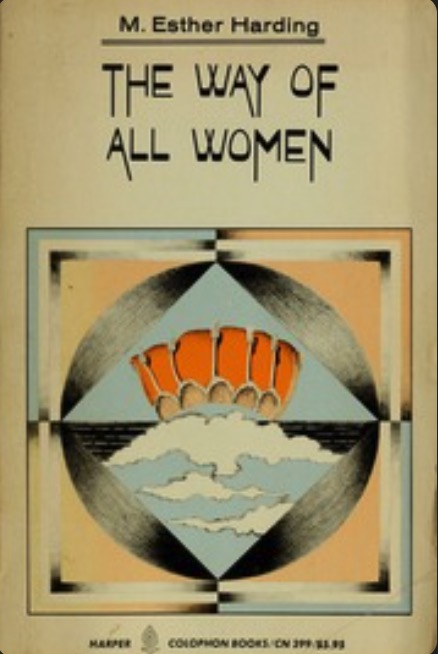
- Harding, M.E. (1933). The Way of All Women. Longmans, Green and Co. Revised edition 1970, Shambhala.
- Jung, C.G. (1953). Two Essays on Analytical Psychology. Collected Works, Vol. 7. Princeton University Press.
- Neumann, E. (1955). The Great Mother. Princeton University Press.