 Seba.Health
Key Takeaways
- Von Franz demonstrates that alchemy is not a precursor to chemistry that failed but a parallel empirical tradition that succeeded—at something chemistry never attempted: documenting the autonomous symbolism of the unconscious before any psychology existed to name it.
- The book's tripartite structure (Greek, Arabic, European) is itself an argument: it tracks not the "progress" of alchemical technique but the progressive differentiation of the psyche-matter problem across civilizations, showing how the same archetypal configurations recur with increasing specificity until they become recognizable as psychological processes.
- Von Franz's reading of the *Aurora Consurgens* as the climactic text of the tradition reveals that the alchemical opus reverses biological evolution—animals first, then plants, then mineral gold—establishing a model of individuation as the conscious internalization of what creation projected outward.
Alchemy Is the Empirical Record of an Unconscious That Had No Other Language
Von Franz opens with a declaration that should govern the entire reading: modern depth psychology is “a late descendant of that scientific spirit which, at an earlier date, manifested itself in alchemy.” This is not a metaphor or a polite genealogy. She means it literally. The alchemists and the analytical psychologist study the same unknown factor—what the alchemists located in matter and what Jungians call the unconscious. The difference is not one of substance but of where the observer stands relative to the phenomenon. Physics approaches it from without; depth psychology from within. Alchemy, crucially, approached it from both directions simultaneously, which is why its texts appear incoherent to anyone committed to the post-Cartesian split. Von Franz’s introductory lecture insists that alchemy “confronts us with something we cannot yet understand,” and this is not a limitation of the book—it is its thesis. The alchemists worked “without any conscious religious or scientific program,” producing what she calls “spontaneous, uncorrected impressions of the unconscious with very little conscious interference.” This makes alchemical texts the closest thing we possess to a pre-modern dream journal of Western civilization. Jung recognized this in Psychology and Alchemy, but von Franz does something Jung did not fully accomplish in that work: she traces the symbolic continuity across Greek, Arabic, and medieval European phases to show that the same archetypal configurations—the ouroboros, the divine water, the resurrection of the dead in the vessel—are not borrowed motifs but independent eruptions of the same psychic substrate. Edward Edinger’s Anatomy of the Psyche later systematized the alchemical operations as psychological categories, but von Franz’s book precedes and grounds that systematization by insisting that the symbols must be encountered in their historical density before they can be translated into clinical language.
The Macro-Microcosm Analogy Is Not a Philosophical Position but a Description of How Projection Works
The Olympiodorus passage von Franz unpacks—where man’s intestines correspond to rivers, his eyes to sun and moon, his bones to mountains—is routinely treated as quaint pre-scientific thinking. Von Franz refuses this reading. She shows that for the alchemists, the parallel between macrocosm and microcosm “is not only an idea it is also a substance, indeed it is man who is the material to be worked on.” The analogy is performative: it constitutes the opus. This is the pivot on which the entire book turns. When Cleopatra tells her assembly of alchemists that the secret is hidden within her, that all elements converge in a center, and that the blessed waters resurrect the dead in the underworld, she is not speaking allegorically. She is describing a psychic event—the condensation of scattered contents into a unified field of meaning—that von Franz recognizes as identical to what happens in active imagination. Jung said in Mysterium Coniunctionis that late alchemists performed “active imagination with chemical substances.” Von Franz extends this backward in time to the earliest Greek texts, arguing that the identity of psyche and matter in those documents is not naive confusion but archaic identity—a condition prior to the differentiation that rationalism would later enforce. This places her work in productive tension with James Hillman’s archetypal psychology, which resisted translating alchemical images into developmental narratives. Where Hillman wanted to stay with the image, von Franz insists the image is already a process—a transformation unfolding in time, demanding participation.
The Alchemical Opus Reverses Evolution, and This Reversal Is the Structure of Individuation
Von Franz’s most radical claim appears in her treatment of the Aurora Consurgens and the later alchemical tradition. In analysis, she observes, “we first meet the wild appetites, autonomous complexes, sex and power drives, which are generally symbolized by lions, mating dogs, and such.” After the animal encounters come plant similes—the growing tree, the flowering—and only at the end does the mineral goal appear: the stone, the gold, the crystal. This sequence reverses biological evolution. Where outer nature moves from inorganic matter to plant to animal to human, the alchemical opus moves inward and downward: animal, then plant, then mineral. Von Franz calls this “a reversal on a psychic level of the outer biological evolution.” The implications are staggering and largely unaddressed in the secondary literature. If individuation follows this reversed sequence, then the Self—symbolized by the lapis or philosopher’s stone—is not the apex of organic development but something prior to and more fundamental than life itself. It is inorganic, crystalline, eternal. This aligns with Jung’s late writings on synchronicity and the psychoid archetype, where the deepest layer of the unconscious touches the physical world. It also resonates with Erich Neumann’s The Origins and History of Consciousness, where the uroboric state precedes all differentiation, but von Franz’s formulation is more precise than Neumann’s: the stone is not a regression to the uroboric but its conscious recovery at the far end of the work.
Christianity’s Compensation and the Feminine Underground
Von Franz frames the entire alchemical tradition as a compensatory response to Christianity’s one-sided patriarchal spirituality. Citing Jung’s introduction to Psychology and Alchemy, she shows that the unconscious did not simply produce the opposite of Christian consciousness (a mother-daughter dyad to mirror the father-son) but instead generated the Cybele-Attis configuration: prima materia and filius macrocosmi, the chthonic son born of the mother-world. This son is “not the antithesis of Christ but rather his chthonic counterpart.” Alchemy thus functions as Christianity’s shadow tradition—not its enemy but its necessary completion. The alchemical vessel, the retort, becomes the womb of the rejected feminine, and what it births is the wholeness that official doctrine could not contain. Von Franz’s treatment of this theme is more historically grounded than Marion Woodman’s later explorations of the feminine in The Pregnant Virgin, but it opens the same territory: the body, the material, the dark feminine as the carrier of unrealized totality.
This book matters today not because it “introduces” alchemy—any encyclopedia can do that—but because it demonstrates, text by text, that the symbolic productions of the unconscious have a history, and that history is not random. Von Franz provides the philological and psychological scaffolding without which Jung’s alchemical writings remain opaque. More than that, she shows that the psyche-matter problem the alchemists struggled with is the same problem that confronts anyone who takes dreams seriously: the unsettling discovery that inner images behave as if they have substance, weight, and consequence in the material world. No other book in the Jungian corpus traces this discovery across twenty centuries of primary texts with such precision and such refusal to simplify.
Sources Cited
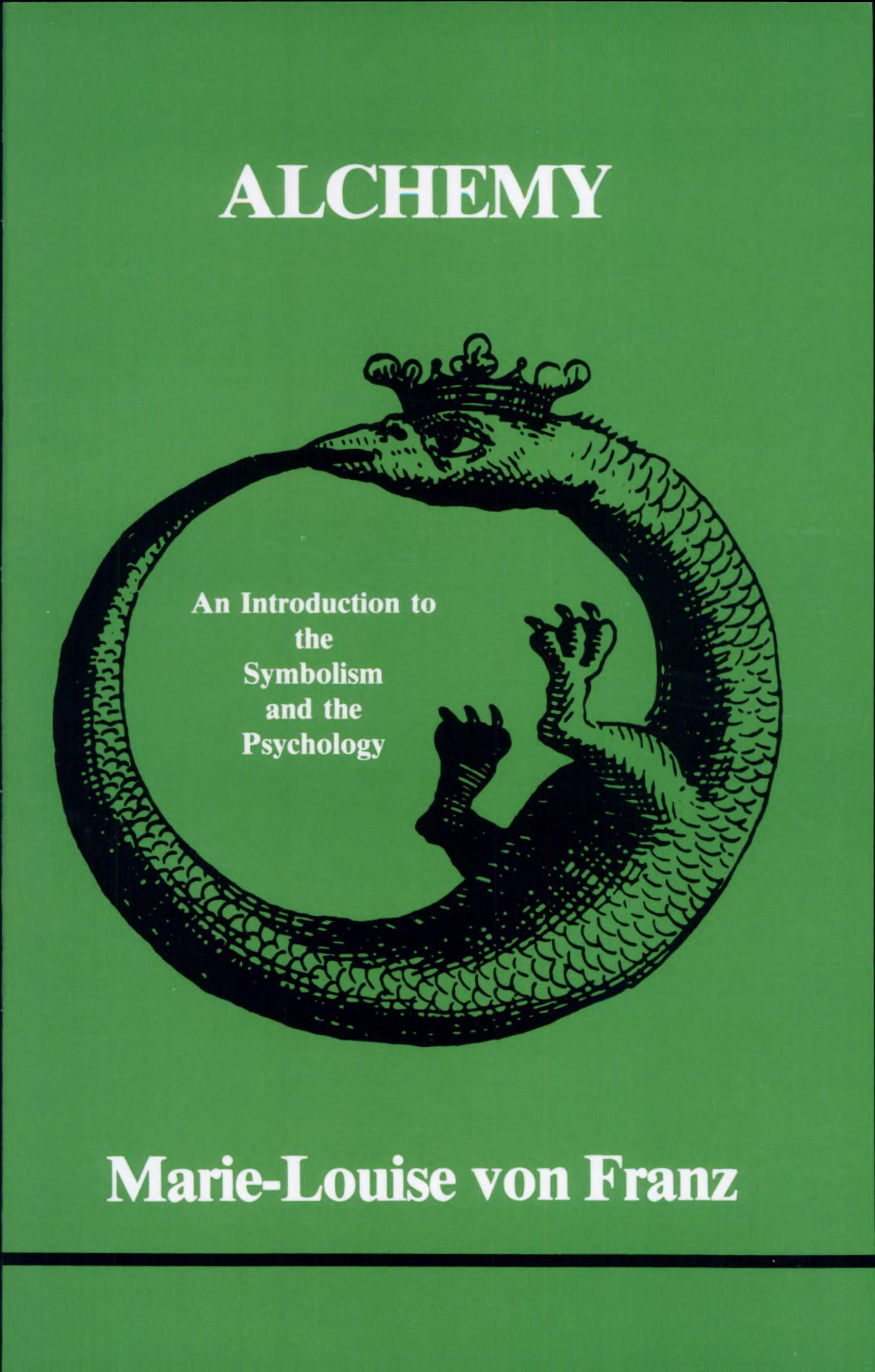
- von Franz, M.-L. (1980). Alchemy: An Introduction to the Symbolism and the Psychology. Inner City Books.