 Seba.Health
Key Takeaways
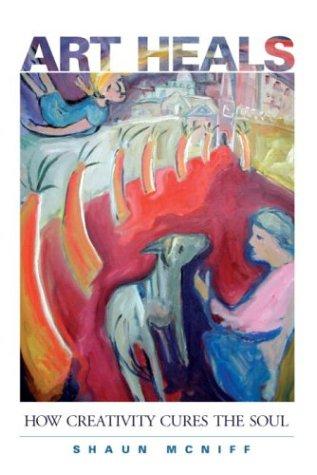
- McNiff's central claim—that the creative act itself is the therapeutic agent, not interpretation of the product—represents a direct operationalization of Hillman's dictum that "the art of healing is healing into art," transplanted from philosophical polemic into clinical and everyday practice.
- The book dissolves the boundary between artist and patient by treating imagination as an autonomous healing intelligence, a move that parallels Winnicott's concept of "non-purposive being" but replaces Winnicott's transitional space with a fully ensouled ecology of media, gesture, and material engagement.
- McNiff's insistence on trusting the process over analyzing the image quietly reverses a century of psychoanalytic hermeneutics: rather than reading the artwork as symptom or symbol, the making itself performs the psychological work, relocating cure from cognition to enactment.
The Creative Act as Pharmakon: McNiff Turns Hillman’s Poetics into a Practice of Cure
Shaun McNiff’s Art Heals occupies a peculiar and necessary position in the depth psychology tradition: it is the book that takes James Hillman’s most radical theoretical claims about imagination and fiction and subjects them to the test of therapeutic practice with real bodies, real paint, real sound. Hillman argued in Healing Fiction that “the art of healing is healing into art,” that memory heals into imagination, and that psychotherapy’s true work is mythopoetic rather than diagnostic. McNiff accepts this premise wholesale—but where Hillman remains within the philosophical register, McNiff asks: what happens when a person who cannot articulate suffering picks up a brush? His answer is that the image does not require interpretation to heal. The act of creation, the kinesthetic, sensory, and affective engagement with materials, constitutes the cure. This is not anti-intellectual populism; it is a rigorous claim about where psychic transformation actually occurs. For McNiff, the therapeutic agent is not the therapist’s hermeneutic skill but the autonomous intelligence of the creative process itself. The artwork is not a window onto pathology—it is the pharmakon, simultaneously the wound’s expression and its medicine. This positions McNiff as the clinician who made Hillman’s archetypal poetics accountable to the consulting room.
Imagination as Autonomous Agent: Beyond Winnicott’s Transitional Space
To understand what McNiff accomplishes, one must see him against the backdrop of Winnicott’s famous formulation in Playing and Reality. Winnicott insisted that “the finished creation never heals the underlying lack of sense of self,” and that what the patient needs is not explanation but “a new experience in a specialized setting”—a state of formless, non-purposive being from which creative reaching-out can emerge. McNiff shares Winnicott’s conviction that the therapeutic moment lives in process rather than product, but he diverges in a critical way. Winnicott’s transitional space remains fundamentally relational: it depends on the analyst’s capacity to hold formlessness without organizing it, to resist the temptation to find “sense where nonsense is.” McNiff radicalizes this by arguing that the creative medium itself—clay, paint, movement, voice—can serve as the holding environment. The materials have their own intelligence, their own capacity to receive and transform what the maker brings. This is not metaphor for McNiff; it is phenomenological description. When a person moves paint across a surface, the paint resists, flows, surprises, demands response. That dialogue between maker and medium replicates and, McNiff contends, can surpass the relational holding Winnicott located exclusively in the therapeutic dyad. In this sense, McNiff extends the Winnicottian insight into territory Winnicott himself could not enter: the artwork as co-therapist, the image as Other with its own autonomous life.
Trusting the Process Against the Tyranny of Interpretation
McNiff’s methodological core—“trust the process”—directly challenges the interpretive reflex that dominates both Freudian and Jungian clinical traditions. In classical Jungian work, the patient’s drawing or sandplay configuration is amplified through myth, archetype, and association; the image becomes legible through the analyst’s symbolic literacy. McNiff does not reject amplification, but he subordinates it to something prior: the enactive, embodied experience of making. Hillman himself, in The Myth of Analysis, argued that “psychological creativity concerns the soul as opus” and that its aim is not the development of any particular content or talent but “the creating, engendering, awakening, enlightening, and individuating of the soul.” McNiff takes this dictum and gives it hands. The soul’s opus, in his framework, is not the interpretation of the image but the act of imaging—the verb, not the noun. This has profound implications for trauma work, where verbal narration can retraumatize and where the body holds what language cannot yet reach. McNiff’s approach offers a way into the wound that does not depend on the patient’s capacity for symbolic thought or narrative coherence. The image emerges before understanding, and understanding, when it comes, arrives as recognition rather than analysis. This resonates with von Franz’s clinical observation that dreams often “ignore” the presenting symptom entirely, addressing instead the blocked creativity behind it—and that when creativity is released, symptoms resolve “by the way,” almost as afterthought. McNiff formalizes this intuition into method.
The Anima Mundi at the Easel: Art-Making as Ecological Psychology
McNiff also extends Hillman’s late turn toward the anima mundi—the ensouled world—into the studio. Hillman’s pivotal 1982 essay argued that “the world is inundating me with its unalleviated suffering” and called for an aesthetic response to the world’s pathology, a therapy of buildings, streets, and things. McNiff translates this into the materiality of art practice: the texture of paper, the weight of stone, the resonance of a drum are not neutral substrates onto which psyche projects meaning. They are participants in the therapeutic field, ensouled presences whose qualities shape what emerges. This is what separates McNiff’s art therapy from cognitive-behavioral approaches that use art as a vehicle for “expression” of pre-existing internal states. For McNiff, the encounter with materials is an encounter with world-soul, and healing occurs precisely at the junction where inner suffering meets the resistant, generative, surprising life of matter. Thomas Moore’s observation that Hillman counseled “the professional therapist to move into the street where today’s major unconsciousness now lies” finds its studio analogue in McNiff’s work: the unconscious lies not only in the dream but in the clay.
Why This Book Matters Now
Art Heals matters for depth psychology today because it resolves a problem the tradition has struggled with since Jung’s Red Book: how to honor the primacy of the image without reducing image-work to an elite intellectual exercise. McNiff demonstrates that the healing power of imagination does not require mythological erudition, analytical training, or even verbal fluency. It requires the willingness to make something and to let that something teach you what you did not know you knew. For clinicians working with trauma, addiction, or developmental injury—populations for whom verbal therapy can be inadequate or iatrogenic—this is not a soft supplement to real treatment. It is a rigorous alternative epistemology of cure, grounded in the same archetypal tradition that runs from Hillman through Winnicott and back to the alchemists, but accessible to anyone with hands and the courage to use them.
Sources Cited
- McNiff, S. (2004). Art Heals: How Creativity Cures the Soul. Shambhala. ISBN 978-1-57062-835-1.
- McNiff, S. (1992). Art as Medicine: Creating a Therapy of the Imagination. Shambhala.
- Hillman, J. (1975). Re-Visioning Psychology. Harper & Row.