 Seba.Health
Key Takeaways
- Hillman's lifelong project was not to bring animals into psychology but to reveal that psychology's exile of the animal is identical to the Cartesian exile of soul from the world — making the animal question the foundational question of depth psychology itself.
- The book's central methodological move — reading the dream animal through its morphology rather than through symbolic dictionaries — constitutes a radical phenomenology of image that breaks with both Freudian decoding and classical Jungian amplification.
- Hillman reframes the Garden of Eden not as a lost origin but as a perceptual capacity available whenever consciousness descends from its aerial ego-position to the creaturely eye, making the Fall a diagnostic term for abstraction rather than a moral event.
The Animal Is Not a Symbol to Be Decoded but a Presence That Demands a Perceptual Revolution
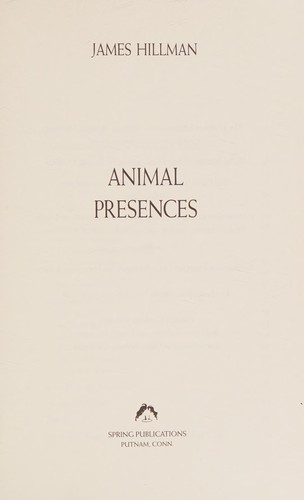
Hillman opens the volume with a deceptively quiet preposition: he speaks of animals “to” the human psyche, not “in” it. That single word dismantles the entire interpretive apparatus most therapists bring to animal dreams. If the dream bear is “in” the psyche, it becomes a subjective content — my aggression, my instinct, my shadow. If it appears “to” the psyche, it retains ontological independence; it is a visitor, a foreign dignitary, a god. This distinction is the spine of Animal Presences. Throughout the book — across dream seminars, the Eranos lecture, conversations with Thomas Moore, Jonathan White, and John Stockwell — Hillman insists that reducing dream animals to aspects of the dreamer’s personality insults the animal and impoverishes the psyche simultaneously. “That reduces the bear to just a piece of himself and insults the bear — it interprets the bear away.” The therapeutic corollary is explosive: the animal comes not as a symptom to manage but as an ancestor bestowing blessing. Foxiness is not a character disorder; it is a totem. This move places Hillman in direct confrontation with ego psychology’s interpretive habits but also, more subtly, with mainstream Jungian practice. Where Marie-Louise von Franz might amplify the fox through fairy-tale parallels and Edward Edinger might locate it on the ego-Self axis as a shadow figure demanding integration, Hillman refuses the upward movement toward meaning. He wants the therapist to kneel — literally to bring the superior posture to the level of the creature, as the dreamer in one seminar gets down to eye level with ants. The reading of animal form is not hermeneutics; it is genuflection.
Portmann’s Biology of Appearance Replaces Darwin’s Biology of Function as the Foundation for Dream Interpretation
The most intellectually formidable section of the book is the Eranos lecture “The Animal Kingdom in the Human Dream,” where Hillman deploys Adolf Portmann’s biological aesthetics to devastating effect. Portmann demonstrated that the vivid coloring and symmetrical patterning of deep-sea organisms — creatures with no visual organs, living where no light reaches, seen by nothing — serve no adaptive function. “Appearance is its own purpose.” Hillman seizes this as the biological ground for his entire archetypal psychology: the animal is an aesthetic creation compelled by an aesthetic necessity to present itself as image. This explodes the functionalist view that animal behavior reduces to feeding, breeding, and territorial defense — and, by extension, it explodes the functionalist psychology that reads animal images in dreams as nothing more than drives. If behavioral biology views the aesthetic as secondary decoration on survival mechanisms, then a behavioral psychology must view the dream animal as mere coding for instinctual pressure. Hillman calls this a refusal to see. The animal kingdom is “first of all an aesthetic ostentation, a fantasy on show.” This aligns Hillman with Gaston Bachelard’s insistence on the irreducibility of the poetic image, but it goes further: Bachelard still locates imagination in the human subject, while Hillman, through Portmann, relocates it in the creature itself. The animal’s interiority is not hidden inside it — it is displayed in its form. This is what Hillman means by “a depth psychology of extraversion”: the soul is not buried; it is showing itself. Jung’s concept of the archetypes as autonomous psychic factors finds here its most radical extension — the archetype is not merely transpersonal but transhuman, walking on four legs.
The Fall from Eden Is Not a Moral Event but a Perceptual Catastrophe — and the Dream Is Its Nightly Reversal
Hillman’s rereading of Genesis threads through the entire volume and constitutes its deepest theological provocation. The Garden is not a place forfeited by sin; it is a mode of perception in which “the animal and the name of the animal, natural pig and symbolic pig, cannot be fallen apart.” The Fall is the rupture between image and meaning, between creature and concept — precisely the rupture that Cartesian Christianity cemented into Western consciousness. When Descartes declared animals to be machines without sensation, he completed what Genesis began: the ontological separation of human and animal that, as Hillman notes through a Japanese critic, is the precondition for eating meat with impunity, for strip-mining, for treating the nonhuman world as dead matter. This is not environmentalism dressed in mythological costume. Hillman is explicit that sentimental nature-worship is itself a symptom of the disease: “Nature is no longer adequately imagined as the Great Mother who sustains us; instead, she has become a very fragile, endangered old lady.” The Romantic idealization of nature and its industrial destruction share the same root — both stand apart from nature, one as caretaker, the other as conqueror. Neither feels itself to be nature. The dream, however, restores the Garden nightly. “Our dreams recover what the world forgets. Forgotten pagan polytheism breeds in animal forms.” Here Hillman converges with Jung’s late insight that the gods have become diseases, but he rotates it: the gods have also become animals, and the dream zoo is a cathedral where Beelzebub keeps his insects and the Celtic gods keep their salmon. The therapeutic task is not interpretation but attendance — showing up for the animal, letting its form work on the dreamer’s perception.
Why This Book Is Irreplaceable
For anyone practicing depth psychology today, Animal Presences delivers something no other volume in the tradition provides: a fully articulated method for working with animal images that neither inflates them into cosmic symbols nor deflates them into personal complexes. It is simultaneously Hillman’s most accessible work — grounded in dream examples, rich with conversational texture — and his most philosophically radical, importing Portmann’s biology into the consulting room to argue that aesthetic perception is not a luxury of the cultivated mind but the fundamental animal capacity that therapy must recover. Where Jung’s Red Book dramatizes the encounter with the autonomous image, Hillman’s Animal Presences theorizes it and provides the practitioner with a posture: get down to eye level. The animals have been teaching us longer than we have been interpreting them.
Sources Cited
- Hillman, J. (2008). Animal Presences. Uniform Edition, Vol. 9. Spring Publications.
- Hillman, J. (1972). Pan and the Nightmare. Spring Publications.
- Portmann, A. (1967). Animal Forms and Patterns. Schocken Books.